We might be living in a gigantic, intergalactic bubble [View all]
By Rafi Letzter - Staff Writer 2 days ago
It would explain a lot.
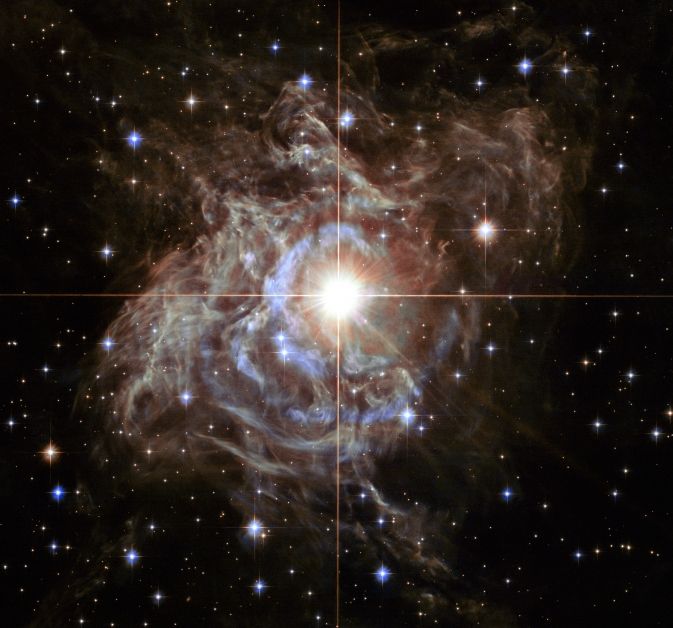
A Hubble Space Telescope image shows RS Puppis, one of the cepheids used to measure the
expansion of the universe.
(Image: © NASA/ESA/Hubble Heritage (STScI/AURA)-Hubble/Europe Collab)
We might be living in a bubble.
That's the conclusion of a new paper published in the journal Physics Letters B, due for print publication April 10. The paper is an attempt to resolve one of the deepest mysteries of modern physics: Why don't our measurements of the speed of the universe's expansion make sense? As Live Science has previously reported, we have multiple ways of measuring the Hubble constant, or H0, a number that governs how fast the universe is expanding. In recent years, as those methods have gotten more precise, they've started to produce H0s that dramatically disagree with one another. Lucas Lombriser, a physicist at the University of Geneva in Switzerland and co-author of the new paper, thinks the simplest explanation is that our galaxy sits in a low-density region of the universe — that most of the space we see clearly through our telescopes is part of a giant bubble. And that anomaly, he wrote, is likely messing with our measurements of H0.
It's hard to imagine what a bubble would look like that's on the scale of the universe. Most of space is just that anyway: space, with a handful of galaxies and their stars scattered through the nothingness. But just like our local universe has areas where matter packs closely together or spreads extra-far apart, stars and galaxies cluster together at different densities in different parts of the cosmos.
"When we look at the cosmic microwave background [a remnant of the very early universe], we see an almost perfectly homogenous temperature of 2.7 K [kelvins, a temperature scale where 0 degrees is absolute zero] of the universe all around us. At a closer look, however, there are tiny fluctuations in this temperature," Lombriser told Live Science.
Models of how the universe evolved over time suggest that those tiny inconsistencies would have eventually produced regions of space that are more and less dense, he said. And the sort of low-density regions those models predict would be more than sufficient to distort our H0 measurements in the way that's happening right now.
More:
https://www.livescience.com/cosmology-hubble-constant-mystery-could-be-solved-with-low-density-galaxy-bubble.html

 = new reply since forum marked as read