Native South Americans were early inhabitants of Polynesia [View all]
DNA analysis of Polynesians and Native South Americans has revealed an ancient genetic signature that resolves a long-running debate over Polynesian origins and early contacts between the two populations.
...
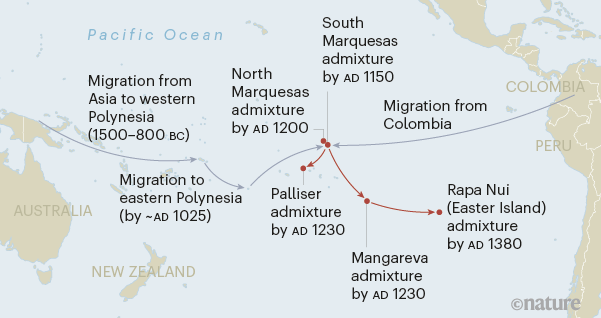
Figure 1 | Genetic clues reveal early migration from South America to Polynesia. Ioannidis et al.1 report a DNA analysis of Polynesians and Native American people from South America, focused mainly on modern populations. The authors shed light on the early peopling of Polynesia by uncovering signs of ancient encounters between Polynesians and South Americans (probably those from Colombia), which resulted in a genetic signature called an admixture indicating that children had parents from both populations. The earliest signs of such admixture in Polynesia were estimated to have occurred on the Southern Marquesas islands in AD 1150. Previous studies3,5 indicate that populations moving eastwards from Asia had populated this area by around that time. The authors find evidence for the same type of population admixture being present between AD 1150 and AD 1230 in nearby islands, and then in Rapa Nui (also known as Easter Island) by AD 1380. Some Polynesian islands, including Rapa Nui, have characteristics in common with those of ancient South America, such as elaborate stonework and the sweet-potato plant. But an early role for South Americans in the peopling of the Polynesian islands had not previously been widely accepted.
...
The authors propose that the Native South American genetic signatures they found were probably the result of a single ancient contact. Their model suggests that the mixed population then spread from central eastern Polynesia around AD 1200 to other Polynesian islands during an early eastern Polynesian expansion, and finally reached Rapa Nui. These spectacular results have major implications for future discussions concerning early migrations and interactions in Polynesia. Rapa Nui itself is not suggested to be the initial point of contact between Polynesians and South Americans, but the admixture identified there is thought to have arisen elsewhere in Polynesia in a population that eventually reached Rapa Nui (Fig. 1).
The authors also raise other possible contact scenarios: for example, that Polynesian populations made voyages to South America and then returned to Polynesia along with South American people, or that people returned to Polynesia who carried Native South American genetic heritage. Ioannidis et al. suggest that further genetic studies will be needed to address such alternative hypotheses.
https://www.nature.com/articles/d41586-020-01983-5

 = new reply since forum marked as read