Welcome to DU!
The truly grassroots left-of-center political community where regular people, not algorithms, drive the discussions and set the standards.
Join the community:
Create a free account
Support DU (and get rid of ads!):
Become a Star Member
Latest Breaking News
Editorials & Other Articles
General Discussion
The DU Lounge
All Forums
Issue Forums
Culture Forums
Alliance Forums
Region Forums
Support Forums
Help & Search

Evidence grows that peopling of the Americas began more than 20,000 years ago [View all]
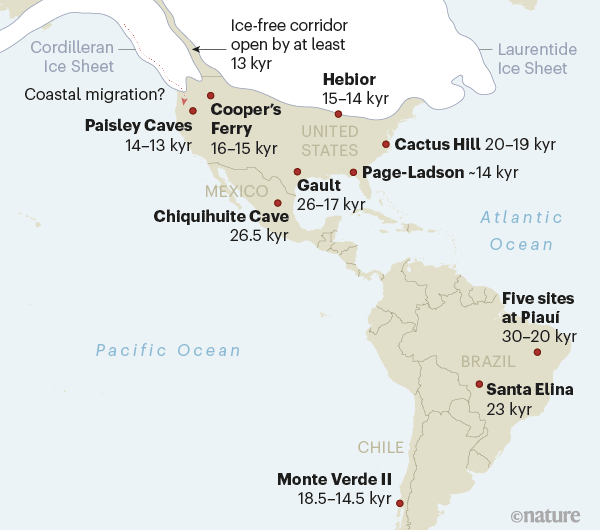
Writing in Nature, Ardelean et al.1 and Becerra-Valdivia and Higham2 report evidence that the initial human settlement of the American continent happened earlier than is widely accepted, and some of this evidence suggests that expansion into the continent began at least 10,000 years earlier than was generally suspected. A study of radiocarbon dating of early archaeological sites by Becerra-Valdivia and Higham reveals that interior regions of Alaska, Yukon in Canada and the continental United States were already widely populated before 13,000 years ago. For decades, that time frame was widely considered to mark the earliest possible date of initial entry, until data from sites more than 13,000 years old in North and South America, first reported in the 1970s, raised the possibility of earlier arrivals3–5. Archaeological excavations in Chiquihuite Cave in northern Mexico by Ardelean and colleagues provide evidence of human occupation about 26,500 years ago. This Mexican site now joins half a dozen other documented archaeological sites in northeast and central Brazil that have yielded evidence suggesting dates for human occupation between 20,000 and 30,000 years ago6–12.
Following discoveries in the 1930s on the American Great Plains of distinctive, well-crafted stone spear points — of a type connected with the Clovis culture — alongside bones of mammoths, mastodons and a now-extinct bison species, archaeologists maintained, for many of the following decades, that the earliest people in the Americas were specialized big-game hunters who very rapidly expanded into North and South America, within 1,000 years of initial entry13. This model became known as the Clovis-first theory. It was later established that Clovis technology did not reach the southern continent. The time of their entry from Alaska into what is now the continental United States was thought to coincide with the opening of an ice-free corridor (Fig. 1) by around 13,000 years ago between the great northern continental ice sheet (called the Laurentide Ice Sheet) and the ice-covered northern Rocky Mountains (the Cordilleran Ice Sheet) in western Canada.
...
This is where the evidence from Chiquihuite Cave comes in. After an initial test excavation suggested that the site was of great antiquity, Ardelean and colleagues continued their research using a range of scientific techniques. They recovered stone artefacts of a distinctive technology located in layers with dates corresponding to around 27,000 years ago in the lowest parts of the cave’s sedimentary deposits, and the authors uncovered more artefacts in higher layers that dated to up to 13,000 years ago. The dating for the layer with the earliest artefacts indicates that there were people in northern Mexico at a time corresponding to the beginning of, or early during, the last major stage of glacial advance in North America.
Ardelean and colleagues’ suggestion that the initial entry date was as far back as 33,000 years ago, which is more than double the currently popular date of around 16,000 years ago, will be very hard for most archaeologists specializing in early America to accept. There will undoubtedly be challenges to this interpretation and close examination of the site data. The six Brazilian archaeological sites dated as older than 20,000 years ago, five in the centre of the state of Piauí6–11 and one in central Mato Grosso (the Santa Elina rock shelter)12, although expertly excavated and analysed, are commonly disputed or simply ignored by most archaeologists as being much too old to be real. The findings at Chiquihuite Cave will bring about fresh consideration of this issue.
https://www.nature.com/articles/d41586-020-02137-3
Following discoveries in the 1930s on the American Great Plains of distinctive, well-crafted stone spear points — of a type connected with the Clovis culture — alongside bones of mammoths, mastodons and a now-extinct bison species, archaeologists maintained, for many of the following decades, that the earliest people in the Americas were specialized big-game hunters who very rapidly expanded into North and South America, within 1,000 years of initial entry13. This model became known as the Clovis-first theory. It was later established that Clovis technology did not reach the southern continent. The time of their entry from Alaska into what is now the continental United States was thought to coincide with the opening of an ice-free corridor (Fig. 1) by around 13,000 years ago between the great northern continental ice sheet (called the Laurentide Ice Sheet) and the ice-covered northern Rocky Mountains (the Cordilleran Ice Sheet) in western Canada.
...
This is where the evidence from Chiquihuite Cave comes in. After an initial test excavation suggested that the site was of great antiquity, Ardelean and colleagues continued their research using a range of scientific techniques. They recovered stone artefacts of a distinctive technology located in layers with dates corresponding to around 27,000 years ago in the lowest parts of the cave’s sedimentary deposits, and the authors uncovered more artefacts in higher layers that dated to up to 13,000 years ago. The dating for the layer with the earliest artefacts indicates that there were people in northern Mexico at a time corresponding to the beginning of, or early during, the last major stage of glacial advance in North America.
Ardelean and colleagues’ suggestion that the initial entry date was as far back as 33,000 years ago, which is more than double the currently popular date of around 16,000 years ago, will be very hard for most archaeologists specializing in early America to accept. There will undoubtedly be challenges to this interpretation and close examination of the site data. The six Brazilian archaeological sites dated as older than 20,000 years ago, five in the centre of the state of Piauí6–11 and one in central Mato Grosso (the Santa Elina rock shelter)12, although expertly excavated and analysed, are commonly disputed or simply ignored by most archaeologists as being much too old to be real. The findings at Chiquihuite Cave will bring about fresh consideration of this issue.
https://www.nature.com/articles/d41586-020-02137-3
The paper: https://www.nature.com/articles/s41586-020-2509-0
4 replies
 = new reply since forum marked as read
Highlight:
NoneDon't highlight anything
5 newestHighlight 5 most recent replies
= new reply since forum marked as read
Highlight:
NoneDon't highlight anything
5 newestHighlight 5 most recent replies
= new reply since forum marked as read
Highlight:
NoneDon't highlight anything
5 newestHighlight 5 most recent replies
Evidence grows that peopling of the Americas began more than 20,000 years ago [View all]
muriel_volestrangler
Jul 2020
OP
I recall hearing something on NPR, at least 20, perhaps a good 30 years ago,
PoindexterOglethorpe
Jul 2020
#1