Science
In reply to the discussion: China opens its 50th nuclear reactor. [View all]
NNadir
(38,924 posts)This may surprise you, but the continental shelf is wilderness, a very rich habitat.
So, for that matter are deserts.
As for roads, maybe you should call up one of the thousands of pictures on the internet of "green" steel wind turbine towers being hauled by diesel trucks. These roads aren't scenic Route 1 in Big Sur. They're roads to service an industrial park, which is what a fucking wind farm is, an industrial park, serviced by trucks.
I have calculated, using the Danish Energy Agency's comprehensive data base of every piece of Danish wind shit on shore and off it, the average life time of Danish wind turbines. It's about 18 years. Some last 30 years, some two years, but the average is roughly 18 years. That shit has to be either left to rot, or hauled away, by huge diesel trucks.. The former is the general habit.
I recently calculated how much land these wind monstrosities would require - using data from an excellent scientific paper it would take to replace the Diablo Canyon nuclear plant with rickety wind shit requiring back up with fracked gas plants.
Synthesizing Clean Transportation Fuels from CO2 Will at Least Quintuple the Demand for Electricity.
An excerpt:
Pay attention and note that the amount of CO2 being reduced is only that from US ethanol plants, 0.125% of all carbon dioxide dumped each year.
To wit:
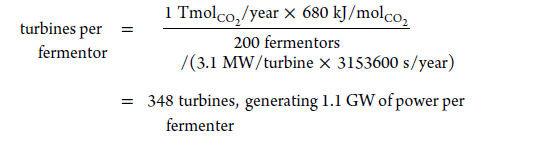
Turbines have a land usage(36) of about 35 ha/MW nameplate. The average capacity factor of a modern turbine in the U.S. is 30–40%; (37) therefore, the 216 GW of power generation needed to revert carbon dioxide from all of the U.S. fermenters would require access to at least 19 million ha

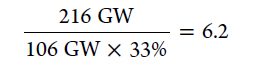
which is nearly 50% more than the amount of land needed to grow the corn(38) (15 billion gallons per year at 462 gallons/acre = 13.1 million ha) and larger than the state of Iowa. The land comprising the wind park could be dual-use(39) (farming and power generation), and there are reports of wind turbines benefiting the growth of crops.(40−42) However, some of the wind park is needed for roads and other ground structures that could interfere with the mechanized farming associated with the high yield of corn. The nameplate capacity of the U.S. fleet of wind turbines(35,43) at the end of 2019 was 106 GW, but as noted above, the average capacity factor(37) (actual/maximum) is only about 33%; therefore, equipping all of the U.S. ethanol fermenters to convert their waste carbon dioxide back into fuel would require about 6 times the current total wind-generated electricity now produced in the U.S.
Therefore, making electrofuels from CO2 is challenging in the near term and includes, minimally, adding significant amounts of clean generating capacity along with energy storage and making the electrofuels energy-efficiently. We discuss the capital cost of this option below.
I have added the bold in the above excerpt.
It is popular to wax romantic about electric vehicles, a belief system that embraces the fantasy - but not the observed reality - that all of the electricity that comes out of the wall is generated by so called "renewable energy." It doesn't. The amount of electricity generated from the combustion of dangerous fossil fuels is rising, not falling.
Because of the fact that electric power still comes mostly from dangerous fossil fuels, converting liquid fuel vehicles to electric vehicles, ignoring the mining of vast amounts of copper, lithium, and cobalt (if it can be found) as shown in the following two graphics from the text, will be no better than raising the fuel efficiency of vehicles. Note that this assumes that we don't run out of fracked gas, although nobody really knows how long these gas fields will continue to produce.
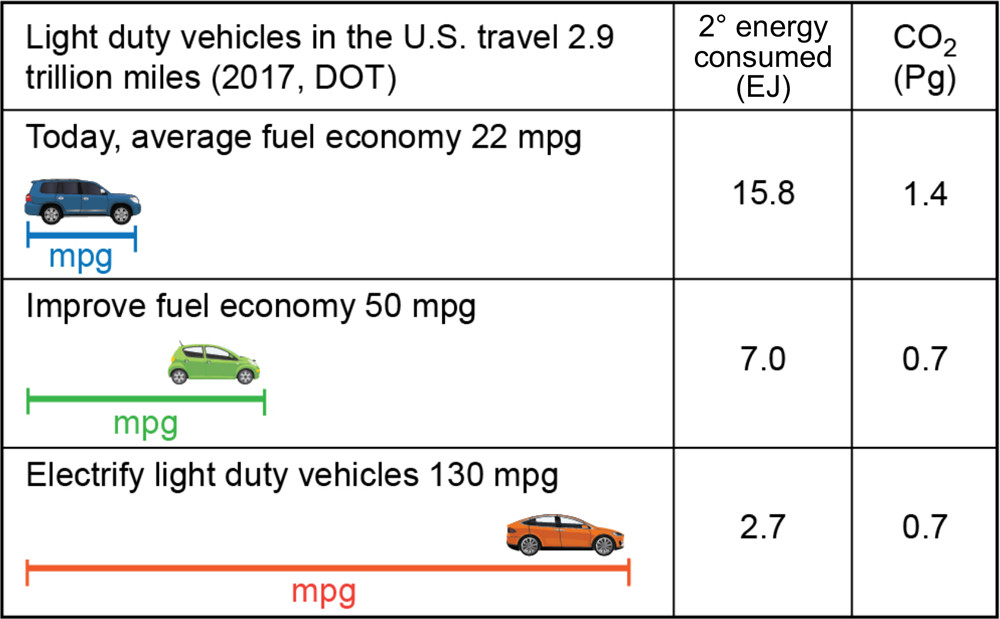
The caption:
...It is instructive to consider the land use requirements of providing all of the electricity. For reference, let's consider the Diablo Canyon nuclear plant, the last plant in California, due to be shut, which has two reactors, each of which routinely provides, uninterrupted, 1140 MW of electricity, which is roughly 1/3 of the thermal output provided by the fission of uranium and plutonium. The plant is situated on 900 acres of land, but most of this land is beautiful undisturbed chaparral. The two reactors, with their parking lots, take up about 12 acres of land.
Above we see, in figure 6, that the electric power consumed in the United States amounts to 14.2 exajoules per year. From this, we can calculate that about 400 reactors would be required to completely eliminate all carbon dioxide output connected with electricity, about 4 times as many as we built between 1965 and 1985, using primitive technology. (If, using the techniques described above, we were to raise the thermodynamic efficiency of these plants to 60%, a little over 200 would be required.)
An acre of land is equal to approximately 0.405 hectares. Thus the Diablo Canyon plant itself takes up about 5 hectares, and the surrounding land belonging to the power plant takes up about 365 hectares. The 3.1 nameplate wind turbines, which, allowing for capacity utilization of 33% as suggested in the authors' text, produces about 1 MWe on 35 hectares of land, means that to provide the same electrical power that the Diablo Canyon reactors produce would require 2280 MW * 35 hectares/MW = 79,800 hectares.
Note that this land, unlike the Diablo Canyon site, whose 365 hectares are mostly pristine, the 79,800 hectares would need to be crisscrossed with asphalt or concrete service roads.
The 19 million hectares, described above for the reduction of ethanol's carbon dioxide side product, would also be reduced. The average continuous power produced by 216 GW of power from any source at 100% capacity utilization is about 6.8 exajoules, a huge portion of the current electricity production. This would require about 200 nuclear reactors to meet, although, as I spent considerable time describing above, it would be stupid for a nuclear plant to produce electricity to reduce carbon dioxide, since thermochemical means would be far superior via high thermodynamic efficiency. But if we used the 40-50 year old technology used to design Diablo Canyon, and only produced electricity, 216 GW/(2.28 GW/nuclear plant = 95 nuclear plants would be required. At 365 hectares, mostly unused per nuclear plant, this amounts to around 35,000 hectares, most of which would be undisturbed land, or about 0.2% as much land.
The wind industry is, um, filthy, and it is entirely dependent on access to dangerous natural gas, and since steel is made from coke, and coke from coal roasted with coal fires, on coal as well.
It, along with the electronic waste generating solar industry has soaked up trillions of dollars in the 21st century with the result that climate change is accelerating faster than ever. As of 2020, we have now reached 2.4 ppm per year of annual increases in carbon dioxide concentrations, after having had increases of 1.8 at the end of the 20th century,
So much for so called "renewable energy," the cute little dogmatic chant we all embrace even as we destroy the future.
I don't do rote, OK?
History will not forgive us, nor should it.
Edit history
Recommendations
0 members have recommended this reply (displayed in chronological order): = new reply since forum marked as read
Highlight:
NoneDon't highlight anything
5 newestHighlight 5 most recent replies
RecommendedHighlight replies with 5 or more recommendations
= new reply since forum marked as read
Highlight:
NoneDon't highlight anything
5 newestHighlight 5 most recent replies
RecommendedHighlight replies with 5 or more recommendations