New deadly snake from Asia named after character from Chinese myth 'Legend of White Snake' [View all]
NEWS RELEASE 6-APR-2021
PENSOFT PUBLISHERS
In 2001, the famous herpetologist Joseph B. Slowinski died from snakebite by an immature black-and-white banded krait, while leading an expedition team in northern Myanmar. The very krait that caused his death is now confirmed to belong to the same species identified as a new to science venomous snake, following an examination of samples collected between 2016 and 2019 from Yingjiang County, Yunnan Province, China.
The new krait species, found in Southwestern China and Northern Myanmar, is described by Dr Zening Chen of Guangxi Normal University, PhD candidate Shengchao Shi, Dr Li Ding from the Chengdu Institute of Biology at the Chinese Academy of Sciences, Dr Gernot Vogel of the Society for Southeast Asian Herpetology in Germany and Dr Jingsong Shi of the Institute of Vertebrate Paleontology and Paleoanthropology at Chinese Academy of Sciences. Their study is published in the open-access, peer-reviewed journal ZooKeys.
The researchers decided to name the new species Bungarus suzhenae - Suzhen's krait, after the mythical figure of Bai Su Zhen - a powerful snake goddess from the traditional Chinese myth 'Legend of White Snake'.
The legend says that, after thousands of years of practicing magic power, the white snake Bai Su Zhen transformed herself into a young woman and fell in love with the human man Xu Xian. Together, they ran a hospital, saving lots of human lives with medicine and magic. However, this love between goddess and human was forbidden by the world of the gods and, eventually, Bai Su Zhen was imprisoned in a tower for eternity. Since then, the Chinese regard her as a symbol of true love and good-heartedness.
More:
https://www.eurekalert.org/pub_releases/2021-04/pp-nds040221.php
~ ~ ~
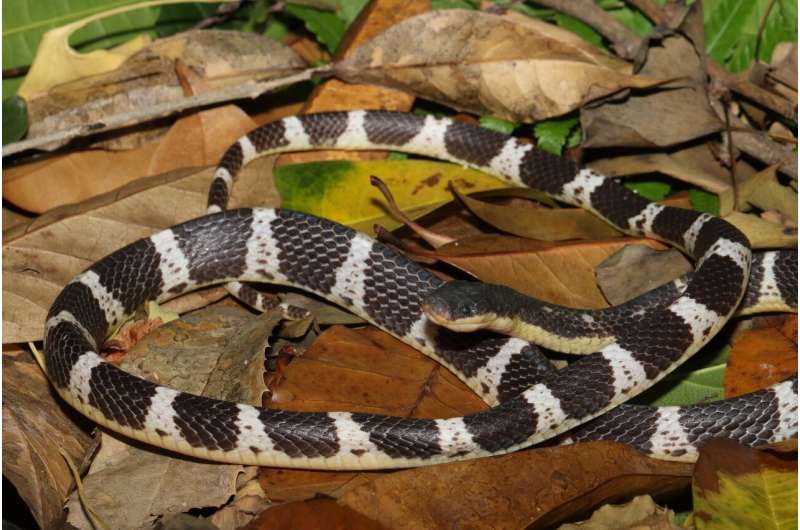
The new krait species Bungarus suzhenae. Credit: Dr Li Ding
https://phys.org/news/2021-04-deadly-snake-asia-character-chinese.html


 = new reply since forum marked as read