Proxima Centauri shoots out humongous flare, with big implications for alien life [View all]
By Harry Baker - Staff Writer 4 days ago
The flare was around 100 times more powerful than those emitted by the sun.
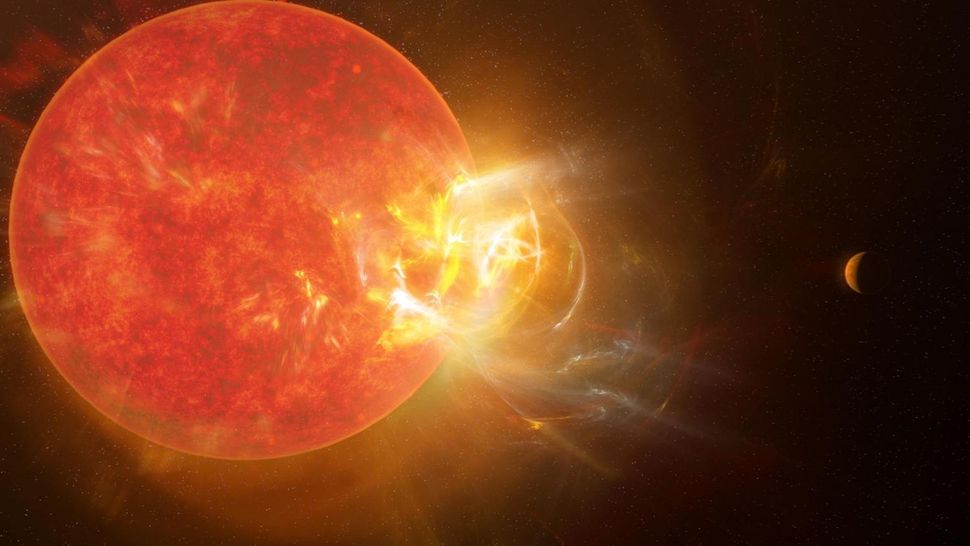
Artist's conception of a violent flare erupting from the star Proxima Centauri. (Image credit: NRAO/S. Dagnello )
Scientists have spotted one of the largest stellar flares ever recorded in our galaxy. The jets of plasma shot outward from the sun's nearest neighbor, the red dwarf star Proxima Centauri. The flare, which was around 100 times more powerful than any experienced in our
solar system, could change the way scientists think about solar radiation and alien life.
Proxima Centauri is a
red dwarf — the smallest, dimmest and most common type of main sequence stars in the galaxy — located approximately 4.25 light-years from
Earth. Its mass is only one-eighth of the sun's, and it is orbited by two
exoplanets. One of these planets, Proxima Centauri b, is considered to be Earth-like and lies within the star's habitable zone — the distance from a star that could support the development of life, according to the researchers.
In a new study, researchers used nine ground and orbital telescopes — including the Hubble Space Telescope, the Atacama Large Millimeter/submillimeter Array and NASA's Transiting Exoplanet Survey Satellite — to closely monitor Proxima Centauri for a total of 40 hours over several months in 2019. On May 1, 2019, the team captured the mega flare, which shone for just 7 seconds and was mainly visible in the ultraviolet spectrum.
"The star went from normal to 14,000 times brighter when seen in
ultraviolet wavelengths over the span of a few seconds," lead author Meredith MacGregor, an astrophysicist at the University of Colorado Boulder,
said in a statement.
More:
https://www.livescience.com/proxima-centauri-emits-largest-stellar-flare.html

 = new reply since forum marked as read