
Fun With Poverty: The Immunology of How Cockroaches Make People Sick. [View all]
The paper to which I'll refer in this post is this one: Prangtaworn, P., Chaisri, U., Seesuay, W. et al. Tregitope-linked Refined Allergen Vaccines for Immunotherapy in Cockroach Allergy. Sci Rep 8, 15480 (2018). The article is open sourced, anyone can read it.
There's therefore no need for me to excerpt a lot of it, but I'll make a few editorial comments before posting some brief excerpts and a graphic or two.
It is my privilege to be asked serious questions to explain subjects about which I know nothing at all. This inspires me to find things out. This brief post is about one of those adventures.
Over the years, I've garnered some impressions of immunology by osmosis, mostly connected with proteomics issues in my work, and of course, Covid has inspired additional desultory interest in the subject, but effectively, I know nothing at all. So this weekend I'm watching recorded lectures on the topic and reading lots and lots of papers on the subject. It really is fascinating, thrilling actually, particularly since the immune system, as recorded on chromosome six, can illuminate the disease history of various ethnic groups, going back tens of thousands, hundreds of thousands of years. There are very real genetic differences between ethnic groups with respect to their immune systems.
This is shown in a graphic, with some explanation required, from this paper: McKinney, D.M., Southwood, S., Hinz, D. et al. A strategy to determine HLA class II restriction broadly covering the DR, DP, and DQ allelic variants most commonly expressed in the general population. Immunogenetics 65, 357–370 (2013):
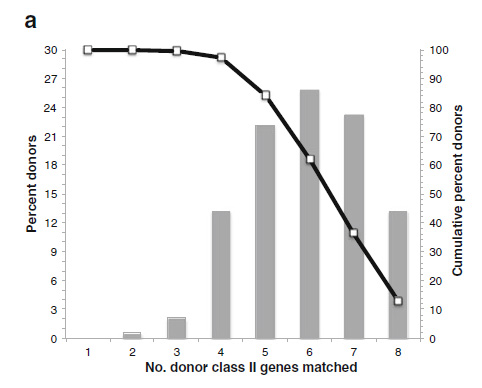
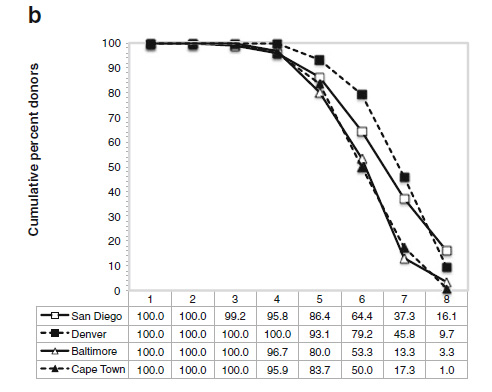
The caption:
I recently listened to a lecture by one of the authors of the paper from this graphic who explained that San Diego's subjects were ethnically diverse, Denver's mostly Caucasian, Baltimore's mostly African American, and Cape Town, of course, African although whether the Cape Town subjects were mostly native African and/or Euro-Africans. The near homology with the Baltimore subjects suggests the former. (Note this data was accumulated in the context of other studies, and was not generated in studies connected with determining allele frequency.)
"Tregitope" is a compound word; like German, although not quite as broadly, English allows for compound words. "Tregitope" is a compound word of "Treg" for regulatory T-Cells, T-cells that shut off immune responses after the antigen insult has been addressed. The "-itope" is a truncation of "epitope," an "epitope" being the business sequence of a protein, a short sequence of those amino acids that actually bind to a target, whether the target is actually an antigen like, say, the S-Protein of SARS-Cov-2 of Covid frame, or a physiological target for instance for the release of digestive enzymes, or binding to a receptor that increases heart rate during exercise. The bulk of many proteins is actually involved in exposing, hiding, or changing the geometry of epitopes.
Anyway, Cockroach immune responses - in this case allergies - can make you feel horrible, and/or even kill you.
From the introductory text of the open sourced paper:
I added the bold so you can see the good...I mean bad...part.
A picture of mouse lung cells from cockroach allergic mice and normal mice and those injected with the vehicle but not the allergen (sham mice):
Figure 3
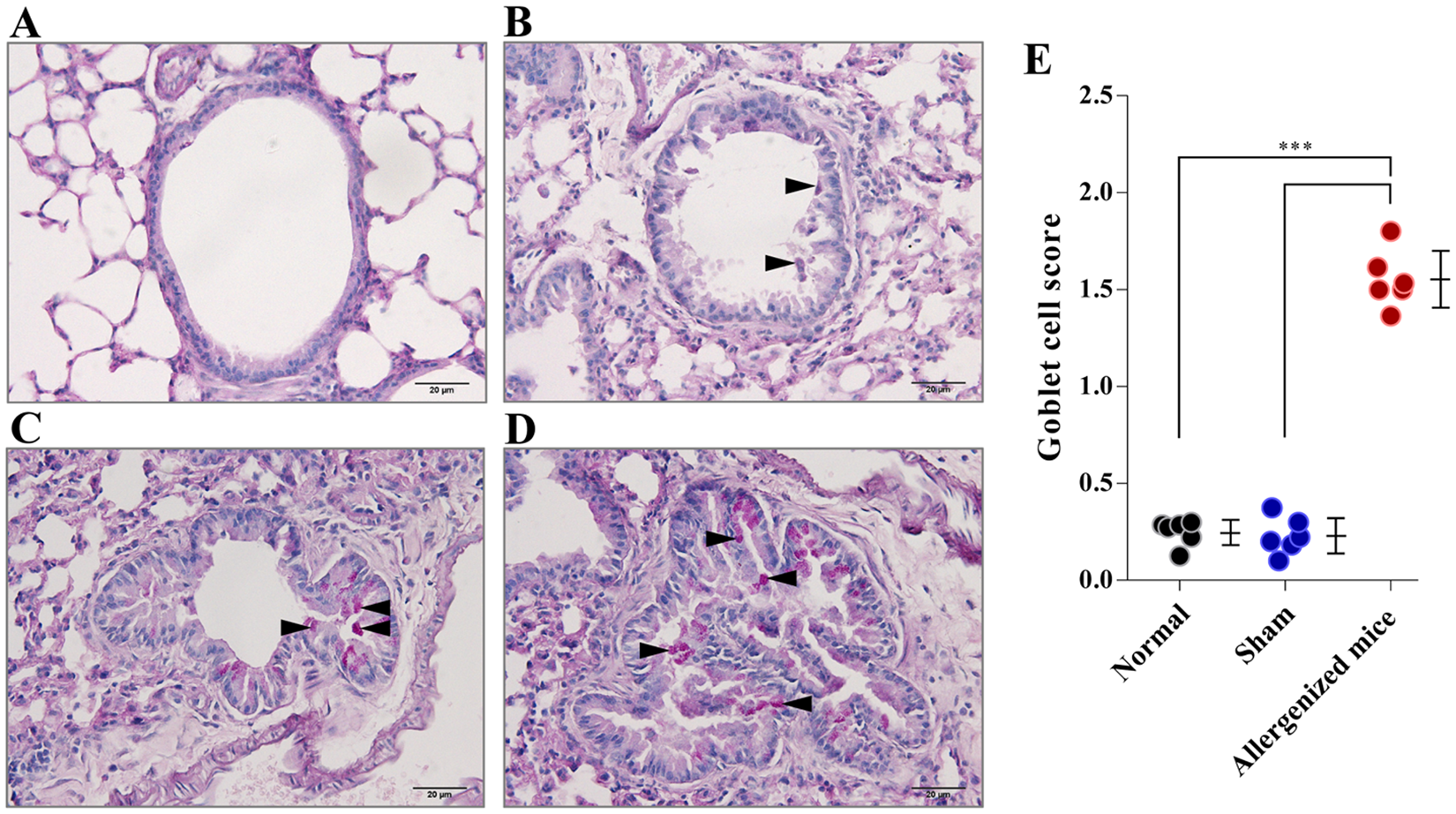
The caption:
As for the word "poverty" in the title of this post, coupled with the (hopefully recognized as sarcastic) word "fun," I don't know whether you've ever lived around cockroaches, but I have, but only in those "fun" portions of my life where I was, um, "down and out."
This rather ignored issue, allergies to cockroaches, may be just one reason that life-expectancy is lower for the impoverished than for the relatively wealthy or, for that matter, the super wealthy.
If this paper is to be believed, cockroach exposure can kill people.
I have convinced myself, to the extent that I consider social issues and recognizing some over-simplification, that many of the world's most intractable problems are related to poverty. There is a difference between a person who parks his shiny new Tesla electric car in the driveway of his McMansion, its roof strewn with solar cells, so all his or her neighbors know how "green" she or he is, and a person who is trying to keep the babies alive by pouring contaminated water over them in an extreme heat outbreak. If the latter person has to burn coal to run a pump to get the water, or have someone else burn coal to do so, they are not likely to have the time or energy to worry about climate change.
I often hear from people whose per capita climate impacts are greater than those of 50 citizens of the Central African Republic that "population" is the problem. In cultures where the future of elderly adults in entirely contingent on care by their offspring, and where infant and child mortality is high, one may be inclined to have more children to address the probability of having someone to care for them. This is why, I suspect, that birthrates are below the replacement rate in precisely those countries where people can feel secure with healthcare, are secure in their homes, and have access to health care, generally.
Simplistic, to be sure, but I may be on to something.
Bill Gates's children didn't have a cockroach allergy problem. Neither did mine.
But I'd guess billions of people do.
Have a pleasant weekend.
 = new reply since forum marked as read
Highlight:
NoneDon't highlight anything
5 newestHighlight 5 most recent replies
= new reply since forum marked as read
Highlight:
NoneDon't highlight anything
5 newestHighlight 5 most recent replies