
A Different Perspective on How Many Billions of Tons of CO2 Equivalents We Dump Each Year. [View all]
The working figure for CO2 emissions I often use in my posts is 35 billion tons per year dumped into the atmosphere while we all wait for the grand so called "renewable energy" nirvana that did not come, is not here, and won't come.
This evening, catching up on my reading - I'm way behind for various personal reasons - I came across this paper: Alkalinity Generation Constraints on Basalt Carbonation for Carbon Dioxide Removal at the Gigaton-per-Year Scale (Benjamin M. Tutolo, Adedapo Awolayo, and Calista Brown Environmental Science & Technology 2021 55 (17), 11906-11915.)
This is a paper about the limits of one much discussed scheme for dumping the dangerous fossil fuel waste carbon dioxide in a way such as it doesn't destroy climatic stability, that is via mineralization, the formation of solid carbonates from rocks. This would be in lieu of not burning dangerous fossil fuels at all, something that has been difficult, not because it is impossible, but because we have lots of people running around saying that nuclear energy is "too dangerous" which implies that climate change is not "too dangerous" even though climate change is destroying vast areas of territory and causing untold economic destruction because...because...because...Fukushima.
History will not forgive us, nor should it.
From the paper's introductory text:
This study highlights the differing carbonation efficiencies expected during gigaton-per-year scale CO2 injection into basalts versus those inferred from lab and pilot-scale studies.
Introduction
Atmospheric CO2 concentrations are expected to double during the latter half of the 21st century unless aggressive action is taken to reduce anthropogenic emissions.(1) The 2015 Paris Agreement was set to curb greenhouse gas emissions and limit anthropogenic warming to 1.5–2 °C, which is the largely cited threshold above which many of the most severe consequences of global climate change would become inevitable.(2,3) However, the International Panel on Climate Change has noted that even if emissions are kept to the levels prescribed by the Paris Agreement, global temperature increases would still be expected to exceed 1.5 °C.(4) Thus, restricting emissions alone will likely be insufficient, and carbon dioxide removal (CDR) techniques such as mineral carbonation coupled to direct air capture (DAC)(5) of CO2 will be required to prevent the most dire consequences of global climate change.(2)
Mineral carbonation mimics Earth’s so-called silicate weathering “thermostat”, in which the weathering of silicate rocks converts atmospheric CO2 gas into carbonate minerals.(6) Mineral carbonation is thus a method for “mineral trapping”, which is the most stable CO2 trapping mechanism (in order of increasing stability, these are structural/stratigraphic trapping, residual trapping, solubility trapping, and mineral trapping(5,7)). The carbonation process is heavily dependent on the presence of divalent cations (Mg2+, Ca2+, and Fe2+) such that ultramafic and mafic rocks, i.e., peridotite and basalt, respectively, are ideal for mineral carbonation.(5,8,9) Due to their abundance on Earth’s surface (they underlay all of Earth’s oceans and are commonly exposed in continental settings), high concentrations of cation-rich silicate minerals and generally favorable porosity, permeability, and injectivity of basaltic rocks have become ideal target lithologies for the rapid injection and mineralization of large volumes of CO2.(5)
While many people turn into Ayn Rand when, and only when discussing nuclear energy, and whine insipidly about cost, please note that this scheme implies cost for no value added. Dumps are money holes. They provide no value, and in fact destroy value. The need for dumps is a hidden cost of the complete and total failure of the reactionary so called "renewable energy" scheme tp address climate change, just as the need to construct redundant systems is a hidden cost, while everyone carries on, again insipidly with very selective attention about how "cheap" so called renewable energy is. Energy prices in Europe hit record highs this week in mid September 2021 because the wind isn't blowing in the North Sea. Either they turn out the lights everywhere except France - which runs on nuclear electricity generally - or they burn dangerous natural gas and dump the dangerous natural gas waste, carbon dioxide, directly into the planetary atmosphere because they ignore the question of whether climate change is "too dangerous."
I'm not going to discuss the cited paper in any great length. There is a nice discussion of the thermodynamics of this scheme and a few remarks on some tiny pilot programs that are very late in the game, since industrialization of the dumping scheme - assuming the money can be found for it, which it won't be - is sure to be way to late as climate change has arrived already, big time, not that this has had any effect on our belief that the return to the 18th century, where all the energy on Earth was allegedly "renewable," is a good idea.
The pilots discussed in the paper were in Iceland, where CO2 is released by the use of geothermal energy, and Wallula, Washington, where CO2 was injected as supercritical fluid, the creation of the supercritical fluid itself an energetically expensive proposition. One may refer to the paper if one has access.
Here's a nice little graphic from the paper about rocks used in the experiments to check out whether mineralization waste dumps would work, even if we could find the money to build them:
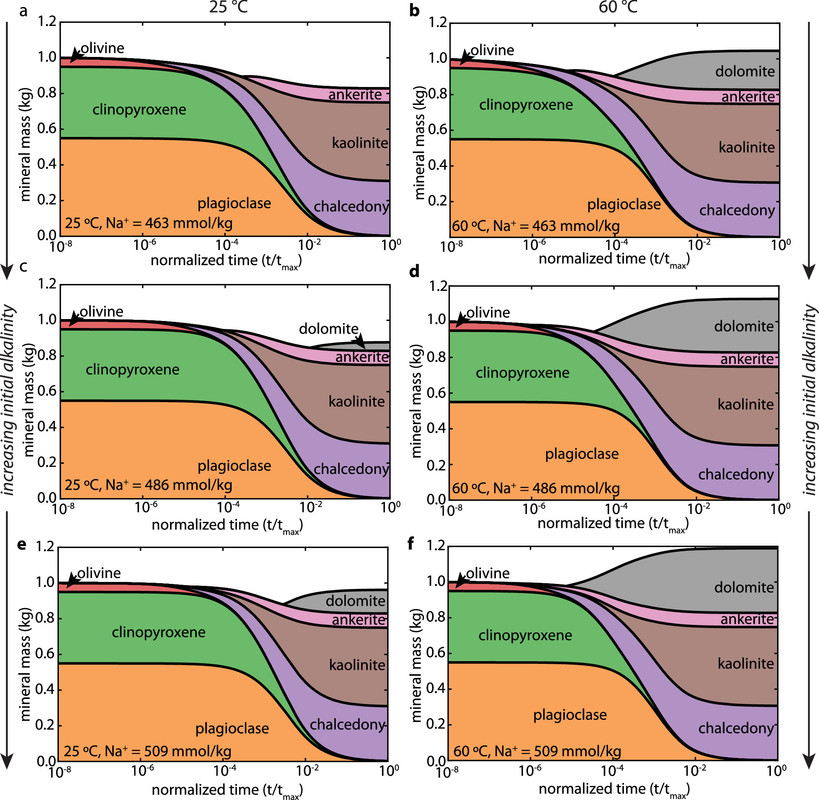
The caption:
60 °C, for those who don't know, is a fairly high temperature, 140°F, meaning one needs to find energy to use these temperatures, energy that does not come from dangerous fossil fuels, even though the use of dangerous fossil fuels as an energy source is rising, not falling, despite all those wind turbines and solar cells on which we've bet the planetary atmosphere, a bet we lost.
Before providing the conclusion of the paper, I note that "DAC" - direct air capture of carbon dioxide - is also energetically expensive, since it involves recovering a considerable portion of the energy produced when the carbon dioxide was dumped in the first place; we're talking at approaching on some level, a kind of perpetual motion machine, a perpetual motion machine being a violation of the immutable laws of thermodynamics.
The conclusion of the paper:
Oh well then.
The motivation for looking into this paper was the figure in the abstract in the text for the amount of carbon dioxide we add to the atmosphere each year while we all wait for the grand "renewable energy" nirvana that is not here and won't come. This figure is 51 Gigatons per year, higher than the working figure I often use, 51 Gigatons/year.
In the text of the paper it says:
Reference 43 is this one: 43. Christiansen, L.; von Kursk, O.; Haselip, J. A. UN Environment Emissions Gap Report; 2018. 2018
It is open sourced, anyone can read it: Emissions Gap Report 2020
The difference between my 35 gigaton/year figure and the 51 gigaton/year cited in the paper is that the UN authors used carbon dioxide equivalents as opposed to the fossil fuel waste that is carbon dioxide, which some people seem to think is not "too dangerous" even though in their ignorance, they claim that so called "nuclear waste" is "too dangerous" even though used nuclear fuel has had a spectacular record over half a century of killing very, very few people, if, in fact, anyone has died as a result of its accumulation as an object of fear and, again, ignorance.
For convenience, a graphic from the open sourced UN report, breaking down the carbon dioxide equivalents graphically:
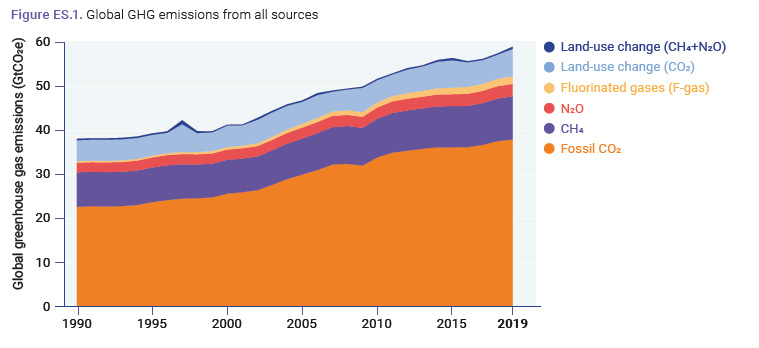
I'd like to note the role of land use changes, which is a huge contributor, second only to dangerous fossil fuel waste (including methane), to climate change. As I noted earlier in another post in this space, just one of the California Wind Turbine Areas, the Tehachapi "Wind Resource Area" is spread over 800 square miles, laced with access roads for diesel trucks for the purpose of servicing the turbines over their 18 to 25 year lifetime.
Busbar Electricity Prices at the Tehachapi Wind Farm This Evening
In that post I compared land footprint of the Tehachapi wind turbine area with that of the Diablo Canyon Nuclear Power Plant, which is due to be shut in 2025, prematurely, as part of a vast crime against the future of humanity. I wrote:
I've been monitoring at the CAISO website the output of all the wind turbines in California, including but not limited to the Tehachapi Wind Resources area. All of them.
California has been experiencing, over the last week or so, an incident of wind Dunkelflaute. For a significant periods of this week, all the wind turbines in California have been producing less power than Diablo Canyon was producing in two buildings located on 12 acres of land.
I plan to discuss some of the data in a subsequent post, should I find the time to do so.
This dramatic information will not induce wisdom on the part people who even at this late date, with the coasts of major continents burning or burned, incredible weather events causing huge destruction and death, still think that wind turbines and solar cells will save the world. They haven't, they aren't, and they won't.
The power of ignorance is not limited to the anti-vax types. There are many other examples of similar rhetoric in other areas, and some of us need to take a good hard look in the mirror. I don't expect we will, but we need to do so.
Have a nice day tomorrow.
 = new reply since forum marked as read
Highlight:
NoneDon't highlight anything
5 newestHighlight 5 most recent replies
= new reply since forum marked as read
Highlight:
NoneDon't highlight anything
5 newestHighlight 5 most recent replies