Beneath Canyons on Mars, Astronomers Find Potentially 'Water-Rich Area the Size of the Netherlands' [View all]
A Martian orbiter located a large reserve of hydrogen in a mountainous area of the Red Planet
Elizabeth Gamillo
Daily Correspondent
December 20, 2021
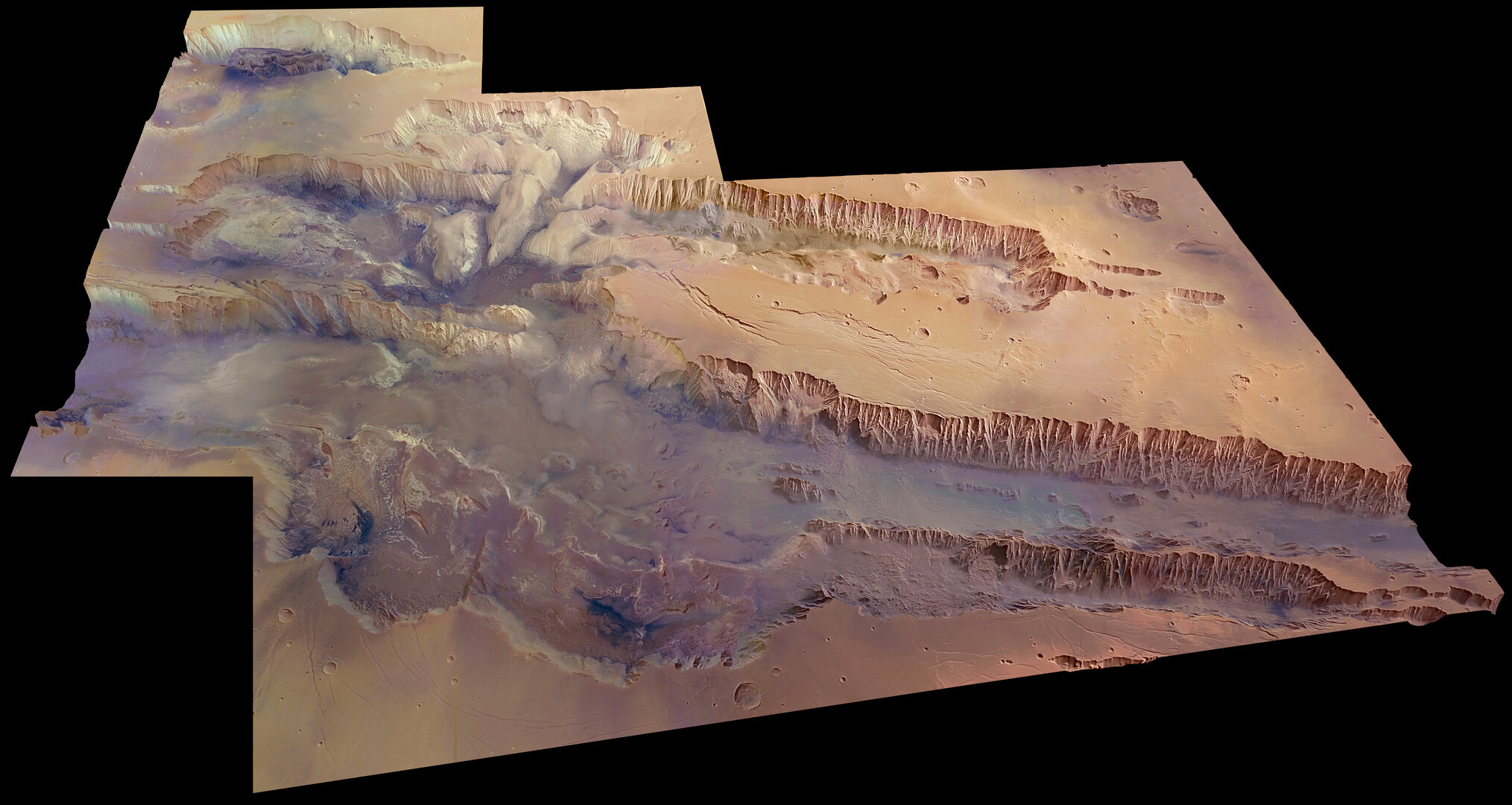
A region within Mars's Valles Marineris (pictured) called the Candor Chaos had a large amount of hydrogen about a meter below the surface. European Space Agency
Located below the Red Planet's equator, the Valles Marineris is one of the largest known series of canyons in the solar system. About a meter beneath the valley's surface, astronomers have now detected a large amount of hydrogen, reports Michelle Starr for Science Alert. The discovery, published in the journal Icarus, may allow future astronauts to access water on Mars easily.
While water has been previously known to exist on Mars, most of it is found as ice caps near the poles. Water and ice have never been found at the surface near the equator, however, because temperatures are not cold enough for it to be stable, per a statement. Other missions have looked for surface water hidden as ice on dust particles or locked within minerals.
Researchers at the European Space Agency and the Russian Space Research Institute found evidence of water underneath the cosmic tectonic fracture using the ESA-Roscosmos ExoMars Trace Gas Orbiter (TGO) probe, reports Alex Wilkins for New Scientist.
Launched in 2016, TGO detected and mapped hydrogen in the top meter of Martian soil using an instrument dubbed Fine Resolution Epithermal Neutron Detector (FREND), reports Meghan Bartels for Space.com. By detecting neutrons instead of light, the instrument peers through the Red Planet's dust to search for water reservoirs not picked up by other equipment. FREND can measure the hydrogen content of Mars' soil up to a meter below the surface, Science Alert reports.
More:
https://www.smithsonianmag.com/smart-news/astronomers-discover-hidden-water-in-the-red-planets-grand-canyon-180979267/

 = new reply since forum marked as read