Science
In reply to the discussion: Mary Boas. [View all]
NNadir
(38,527 posts)I have this habit of taking a look at the first couple of pages of any book before drifting into the good stuff.
The ebook is not a *.pdf; I haven't bought ebooks from Wiley; Elsevier lets one download PDFs. Wiley makes you use a program called "VitalSource." It's OK if you get used to it, but it's another password to remember; not good for old people.
It's pretty pedestrian, the first chapter; I find a "pedestrian" first chapter to be a good idea, as people come to a book at all different levels: It's simple first order first order differential equations. One can do most of the problems in one's head, although I have to confess, being old, and having not actually solved many differential equations I encounter for many years - I generally take the authors of papers in which they appear for their word on the solutions - I had to recall very basic stuff like integration by parts, which caused my old brain to pause for a minute or two.
The book has only one reference to neutrons, a problem:
...Mean energy (keV) of delayed neutron group (Group 3 , half‐life 6s ) for uranium-235 fission: a sample of values with mean 442.5 and variance 9.3.
For me, perhaps not for real nuclear engineers or, ultimately my son, as I am mostly interested in fuel, the governing equations of nuclear engineering are the Bateman equations. The form I like for them is this one:
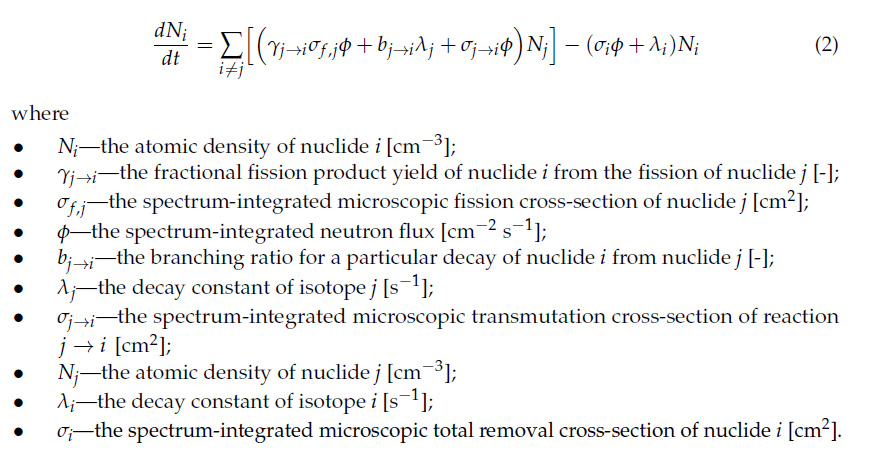
Cetnar, J.; Stanisz, P.; Oettingen, M. Linear Chain Method for Numerical Modelling of Burnup Systems. Energies 2021, 14, 1520. https://doi.org/10.3390/en14061520
The author of the paper from which this graphic comes also published a much cited paper on the topic of the Bateman equations some years back, this one: Jerzy Cetnar, General solution of Bateman equations for nuclear transmutations, Annals of Nuclear Energy, Volume 33, Issue 7, 2006, Pages 640-645.
Of course, long before this paper was published, there was lots of software to address these coupled equations numerically; they worked fine since most nuclear reactors work fine. This software has been, of course, greatly refined over the years, even as the nuclear properties of nucleus i or nucleus j have been refined.
Many years back, while drifting somewhat aimlessly through the Firestone Library at Princeton, I came across Serber's famous Los Alamos Primer. What I recall of it was how the people on the Manhattan Project were introduced to neutrons pretty much with statistical mechanics equations. The point is that neutron diffusion and neutron absorption are not entirely out of the realm of closely related mathematical physics.
It occurs to me, now that I think about it, that the "Teller" in Brunauer–Emmett–Teller (BET) theory may have had its origins in thinking about neutrons as models of adsorption.
I think as climate change accelerates, we urgently need to look at rather different nuclear fuels beyond simple enriched uranium.
When I contemplate these things, wonderful thoughts eddy through my mind:
One of the interesting things about the Bateman equation is that the λ, φ, σ in the equation are really not constants, they are functions of temperature, particularly in the case of σ for capture owing to Doppler broadening, and functions time and space, albeit localized space. Moreover φ, the neutron flux, is very much a function of ΣN, the composition, also a function of time. Moreover, there are really two temperatures in a reactor, the "Boltzmann temperatures" of neutrons, and the "Boltzmann temperature" of the fuels itself, fuels that I, at least, if not my son, envision as liquids, cooled by gases. Indeed the "Boltzmann temperatures" of neutrons will be coupled to the Bateman ΣN, and these will be functions of space and time. So we have heat equations, the classic differential equations, compositional Bateman equations, and diffusion equations, all coupled, never mind Breit Wigner distributions for resonances.
I'm quite confident that all of this can be handled numerically, and for now it is, and the very powerful computational infrastructure at Oak Ridge, where my son interned, for example can address these systems; more primitive computers have long been sufficient for practical engineering over the years.
But the thought of the depth of mathematics involved is very beautiful, and whether he needs it or not, I encourage him to keep his mathematical muscles stronger than I have kept mine. Perhaps he'll think me quaint, but he accepts these things are the price of having a father.
My son has made it clear to me, and to the people who interviewed him that his interest is more in experiment than in theory, but I'm sure that he will appreciate how beautiful theory is.
I'd do my life differently if I thought these things when I was a kid, but I was a bit of a jerk as a kid. If I accomplished anything, I raised two sons who escaped many of my mistakes, who are more ready to serve the world than I ever was.
In a "do over," I'd definitely be a nuclear engineer, and my son I guess will need to tolerate his Dad's vicarious interest.
My Father, who I loved very much, and who I still miss decades after his death, was in no position to cheer me on in the same way I cheer my son on. My Dad quit school in the 8th grade.
I know this is all esoteric, but thinking about it set me to musing about how things converge. My sons will live in interesting times, and much of that is surely very scary, but it's nice to know they're equipped to do what can be done.
Thanks for your wonderful advice and comments.
Edit history
Recommendations
0 members have recommended this reply (displayed in chronological order): = new reply since forum marked as read
Highlight:
NoneDon't highlight anything
5 newestHighlight 5 most recent replies
RecommendedHighlight replies with 5 or more recommendations
= new reply since forum marked as read
Highlight:
NoneDon't highlight anything
5 newestHighlight 5 most recent replies
RecommendedHighlight replies with 5 or more recommendations