Stonehedge fine goldwork compared to sewing needle [View all]
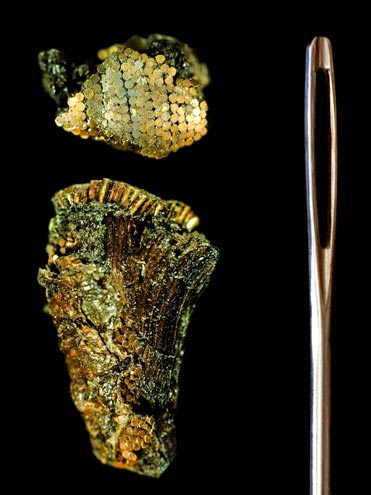
Detail of the decoration of the dagger handle, shown next to a sewing needle for scale. The studs were placed in straight lines and the heads overlapped each other like fish scales
The Stonehenge area object with the largest number of ultra-small gold components is a dagger made in around 1900 BC – and now on display in Devizes’ Wiltshire Museum.
Crafted more than 1100 years before the invention of the first magnifying glass, the dagger’s 12 centimetre long handle was adorned with up to 140,000 tiny gold studs – each around a millimetre long and around 0.2 of a millimetre in diameter. Even the heads of each stud are just a third of a millimetre wide.
They were set, with great manual dexterity and remarkable skill, into the surface of the wooden dagger handle - with more than a thousand studs neatly embedded in each square centimetre.

The ancient dagger
more of the story
http://www.independent.co.uk/news/science/archaeology/stonehenges-most-intricate-archaeological-finds-were-probably-made-by-children-9738993.html
CHILD LABOR LAWS WERE NOT IN EFFECT

 = new reply since forum marked as read