Noctilucent cloud sightings have been pouring in from the western half of the nation. [View all]
There was a “huge outbreak” of rare noctilucent clouds over the weekend with sightings in ten states and parts of Europe:
Replying to @capitalweather
NW Wisconsin Sunday night ~10pm. https://www.facebook.com/groups/greatlakesaurorahunters/permalink/3299533730072306/ …
Noctilucent cloud
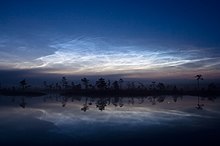
Noctilucent clouds over Kuresoo bog, Viljandimaa, Estonia
Abbreviation: NLC/PMC
Altitude: 76,000 to 85,000 m (250,000 to 280,000 ft)
Classification: Other
Precipitation cloud?: No
Noctilucent clouds, or
night shining clouds, are tenuous cloud-like phenomena in the upper atmosphere of Earth. They consist of ice crystals and are only visible during astronomical twilight. Noctilucent roughly means "night shining" in Latin. They are most often observed during the summer months from latitudes between 50° and 70° north and south of the Equator. They are visible only during local summer months and when the Sun is below the observer's horizon, but while the clouds are still in sunlight. Recent studies suggests that increased atmospheric methane emissions produce additional water vapor once the methane molecules reach the mesosphere - creating, or reinforcing existing noctilucent clouds.
They are the highest clouds in Earth's atmosphere, located in the mesosphere at altitudes of around 76 to 85 km (47 to 53 mi). They are too faint to be seen in daylight, and are visible only when illuminated by sunlight from below the horizon while the lower layers of the atmosphere are in Earth's shadow.
General
Noctilucent clouds are not fully understood and are a recently discovered meteorological phenomenon. No confirmed record of their observation exists before 1885, although they may have been observed a few decades earlier by Thomas Romney Robinson in Armagh. Doubts now surround Robinson's out-of-season records, following observations, from several points around high northern latitudes, of NLC-like phenomena following the Chelyabinsk superbolide entry in February 2013 (outside the NLC season) that were in fact stratospheric dust reflections visible after sunset.
Noctilucent clouds can form only under very restricted conditions during local summer; their occurrence can be used as a sensitive guide to changes in the upper atmosphere. They are a relatively recent classification. The occurrence of noctilucent clouds appears to be increasing in frequency, brightness and extent.

 = new reply since forum marked as read