Welcome to DU!
The truly grassroots left-of-center political community where regular people, not algorithms, drive the discussions and set the standards.
Join the community:
Create a free account
Support DU (and get rid of ads!):
Become a Star Member
Latest Breaking News
Editorials & Other Articles
General Discussion
The DU Lounge
All Forums
Issue Forums
Culture Forums
Alliance Forums
Region Forums
Support Forums
Help & Search
History of Feminism
In reply to the discussion: women and prison reform [View all]iverglas
(38,549 posts)1. perhaps not equal renown ...
but googling for united states prison reform 19th century woman, I found
http://reformproject.wikispaces.com/prison_reform_19th_century
Dorothea Dix
Dorothea Dix was first introduced to prison reform when she went to England to recover from tuberculosis. When she returned to the United States in the 1840's, she was so inspired by what she had seen in England that she began to help inmates who were mentally ill in the United States. She believed these inmates deserved better treatment than they were being given. Serving for the Union, she had helped the mentally ill during the Civil War. Because she thought that the mentally ill were so mistreated, she took matters to the courts and won. After this, she visited jails and almhouses, to take notes for a document she drafted and gave to the Massachusetts legislature. This document won her support and caused funds to be set aside for the expansion of the Worcester State Hospital. In addition, she helped to found thirty-two mental hospitals, a school for the blind, and many nursing training facilities. The women under her nursing training struggled to be accepted by army physicians who felt that they, the males, should be in charge of medical issues. She was strict in her criteria for women that she would train, and she was very impatient. For this, she lost the support of the United States Sanitary Commission and other groups that had helped her begin her training. She had a difficult time being accepted, but Dorothea Dix was determined to help.
Dorothea Dix was first introduced to prison reform when she went to England to recover from tuberculosis. When she returned to the United States in the 1840's, she was so inspired by what she had seen in England that she began to help inmates who were mentally ill in the United States. She believed these inmates deserved better treatment than they were being given. Serving for the Union, she had helped the mentally ill during the Civil War. Because she thought that the mentally ill were so mistreated, she took matters to the courts and won. After this, she visited jails and almhouses, to take notes for a document she drafted and gave to the Massachusetts legislature. This document won her support and caused funds to be set aside for the expansion of the Worcester State Hospital. In addition, she helped to found thirty-two mental hospitals, a school for the blind, and many nursing training facilities. The women under her nursing training struggled to be accepted by army physicians who felt that they, the males, should be in charge of medical issues. She was strict in her criteria for women that she would train, and she was very impatient. For this, she lost the support of the United States Sanitary Commission and other groups that had helped her begin her training. She had a difficult time being accepted, but Dorothea Dix was determined to help.
And the other US prison reformer noted there:
Eliza Farnham
Eliza Farnham was appointed prison matron of Sing Sing Prison in 1844. She believed strongly in prison reform, but faced a lot of obstacles. Previously, Sing Sing Prison had been the quintessential scary "House of Fear" under several wardens, most notably Elam Lynds. A new board of inspectors, helmed by John Worth Edmonds, wanted to reform the prison and ergo appointed Eliza Farnham, a well-known philanthropist, feminist, phrenologist, and author. Farnham removed the silence rule, added an educational program, and advocated such luxuries as decorations, recreational activities, and leisure activities. Eventually, Farnham angered John Luckey, a chaplain, and their disagreements prompted Farnham to leave Sing Sing in 1877. But Farnham was remembered for her work as a prison reformist.
Eliza Farnham was appointed prison matron of Sing Sing Prison in 1844. She believed strongly in prison reform, but faced a lot of obstacles. Previously, Sing Sing Prison had been the quintessential scary "House of Fear" under several wardens, most notably Elam Lynds. A new board of inspectors, helmed by John Worth Edmonds, wanted to reform the prison and ergo appointed Eliza Farnham, a well-known philanthropist, feminist, phrenologist, and author. Farnham removed the silence rule, added an educational program, and advocated such luxuries as decorations, recreational activities, and leisure activities. Eventually, Farnham angered John Luckey, a chaplain, and their disagreements prompted Farnham to leave Sing Sing in 1877. But Farnham was remembered for her work as a prison reformist.
Dorothea Dix
In 1831 she established in Boston a model school for girls, and conducted this successfully until 1836, when her health again failed.[2] In hopes of a cure, in 1836 she traveled to England, where she had the good fortune to meet the Rathbone family, who invited her to spend a year as their guest at Greenbank, their ancestral mansion in Liverpool. The Rathbones were Quakers and prominent social reformers, and at Greenbank, Dix met men and women who believed that government should play a direct, active role in social welfare. She was also exposed to the British lunacy reform movement, whose methods involved detailed investigations of madhouses and asylums, the results of which were published in reports to the House of Commons.
After she returned to America, in 1840-41, Dix conducted a statewide investigation of how her home state of Massachusetts cared for the insane poor. In most cases, towns contracted with local individuals to care for people with mental disorders who could not care for themselves, and who lacked family and friends to provide for them. Unregulated and underfunded, this system produced widespread abuse. After her survey, Dix published the results in a fiery report, a Memorial, to the state legislature. "I proceed, Gentlemen, briefly to call your attention to the present state of Insane Persons confined within this Commonwealth, in cages, stalls, pens! Chained, naked, beaten with rods, and lashed into obedience." The outcome of her lobbying was a bill to expand the state's mental hospital in Worcester.
After she returned to America, in 1840-41, Dix conducted a statewide investigation of how her home state of Massachusetts cared for the insane poor. In most cases, towns contracted with local individuals to care for people with mental disorders who could not care for themselves, and who lacked family and friends to provide for them. Unregulated and underfunded, this system produced widespread abuse. After her survey, Dix published the results in a fiery report, a Memorial, to the state legislature. "I proceed, Gentlemen, briefly to call your attention to the present state of Insane Persons confined within this Commonwealth, in cages, stalls, pens! Chained, naked, beaten with rods, and lashed into obedience." The outcome of her lobbying was a bill to expand the state's mental hospital in Worcester.
She was a multi-tasker. She was Superintendent of Army Nurses for the Union Army, kind of the Florence Nightingale of the US.
 (Nightingale was contemporary, taking her passion from the conditions she saw in the Crimea, a decade before the Civil War in the US. And she took the same straight-laced approach to women entering the profession.)
Eliza Farnham
Eliza Farnham (November 17, 1815 – December 15, 1864) was a 19th-century American novelist, feminist, abolitionist, and activist for prison reform.
In 1844, through the influence of Horace Greeley and other reformers, she was appointed matron of the women's ward at Sing Sing Prison. She strongly believed in the use of phrenology to treat prisoners. She also advocated using music and kindness in the rehabilitation of female prisoners. She retained the office of matron until 1848, when she moved to Boston, and was for several months connected with the management of the Institution for the Blind.
In 1849 she visited California, and remained there until 1856, when she returned to New York. For the two years following, she devoted herself to the study of medicine, and in 1859 organized a society to assist destitute women in finding homes in the west, taking charge in person of several companies of this class of emigrants. She subsequently returned to California.
She died from consumption in New York City at the age of 49.
In 1844, through the influence of Horace Greeley and other reformers, she was appointed matron of the women's ward at Sing Sing Prison. She strongly believed in the use of phrenology to treat prisoners. She also advocated using music and kindness in the rehabilitation of female prisoners. She retained the office of matron until 1848, when she moved to Boston, and was for several months connected with the management of the Institution for the Blind.
In 1849 she visited California, and remained there until 1856, when she returned to New York. For the two years following, she devoted herself to the study of medicine, and in 1859 organized a society to assist destitute women in finding homes in the west, taking charge in person of several companies of this class of emigrants. She subsequently returned to California.
She died from consumption in New York City at the age of 49.
She seems to be a bit of an unsung heroine.
There's a lot of hers stories out there.
And of course, animal welfare was among the social reform causes these well-rounded women espoused:
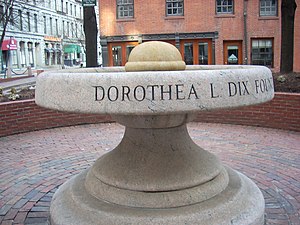
Fountain for thirsty horses Dix gave to
the city of Boston to honor the MSPCA
Edit history
Please sign in to view edit histories.
Recommendations
0 members have recommended this reply (displayed in chronological order):
2 replies
 = new reply since forum marked as read
Highlight:
NoneDon't highlight anything
5 newestHighlight 5 most recent replies
RecommendedHighlight replies with 5 or more recommendations
= new reply since forum marked as read
Highlight:
NoneDon't highlight anything
5 newestHighlight 5 most recent replies
RecommendedHighlight replies with 5 or more recommendations
= new reply since forum marked as read
Highlight:
NoneDon't highlight anything
5 newestHighlight 5 most recent replies
RecommendedHighlight replies with 5 or more recommendations