Welcome to DU!
The truly grassroots left-of-center political community where regular people, not algorithms, drive the discussions and set the standards.
Join the community:
Create a free account
Support DU (and get rid of ads!):
Become a Star Member
Latest Breaking News
Editorials & Other Articles
General Discussion
The DU Lounge
All Forums
Issue Forums
Culture Forums
Alliance Forums
Region Forums
Support Forums
Help & Search
 Congratulations to our presumptive Democratic nominee, Joe Biden!
Democratic Primaries
In reply to the discussion: Giving Trump every single probable state and EV, it comes down to 3 states and we have to sweep them [View all]Celerity
(54,465 posts)18. Black voter turnout fell in 2016, even as a record number of Americans cast ballots
https://www.pewresearch.org/fact-tank/2017/05/12/black-voter-turnout-fell-in-2016-even-as-a-record-number-of-americans-cast-ballots/
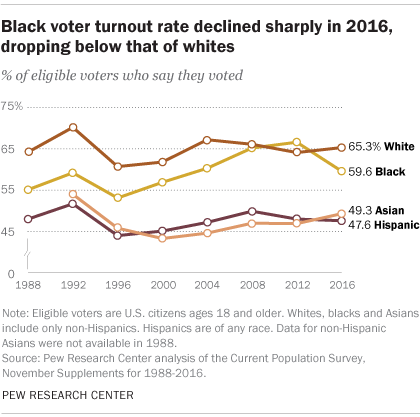
he black voter turnout rate declined for the first time in 20 years in a presidential election, falling to 59.6% in 2016 after reaching a record-high 66.6% in 2012. The 7-percentage-point decline from the previous presidential election is the largest on record for blacks. (It’s also the largest percentage-point decline among any racial or ethnic group since white voter turnout dropped from 70.2% in 1992 to 60.7% in 1996.) The number of black voters also declined, falling by about 765,000 to 16.4 million in 2016, representing a sharp reversal from 2012. With Barack Obama on the ballot that year, the black voter turnout rate surpassed that of whites for the first time. Among whites, the 65.3% turnout rate in 2016 represented a slight increase from 64.1% in 2012.
Why black voter turnout fell in 2016
How voting Democratic has become integral to African Americans’ cultural identity.
https://www.vox.com/mischiefs-of-faction/2018/1/15/16891020/black-voter-turnout
“Black Voters Aren’t Turning Out For The Post-Obama Democratic Party.” It’s a familiar headline in the aftermath of the 2016 presidential election. Indeed, post-election analysis of voter data shows black turnout in presidential elections declined 4.7 percent between 2012 and 2016 (overall turnout showed a small decline from 61.8 percent in 2012 to 61.4 percent in 2016).
How do we explain it — and can it be changed? My ongoing research with Ismail White on political norms among black Americans says we ought to have expected the decline, but that the Democratic Party can do much more to cut it back by recognizing how social dynamics shape African-American politics.
Some have attributed the decline in black turnout to voter suppression tactics made possible by the Shelby v. Holder (2013) decision that rescinded key protections from the Voting Rights Act. But black turnout saw similar declines in states where no new voter laws were implemented after the Shelby decision. Others have simplistically pointed to the absence of the first black president on the ballot — as if that fact offers an explanation. Our work on the social dynamics of politics within the black community provides the missing explanation.
In our recent publication in the American Political Science Review, we argue that the continued social isolation of blacks in American society has created spaces and incentives for the emergence of black political norms. Democratic partisanship has become significantly tied to black identity in the United States. The historical and continued racial segregation of black communities has produced spaces in which in-group members can leverage social sanctions against other group members to ensure compliance with group partisan norms.
snip
Study: Black turnout slumped in 2016
https://www.politico.com/story/2017/05/10/black-election-turnout-down-2016-census-survey-238226
Census shows pervasive decline in 2016 minority voter turnout
https://www.brookings.edu/blog/the-avenue/2017/05/18/census-shows-pervasive-decline-in-2016-minority-voter-turnout/
Study: Black voter turnout in Wisconsin declined by nearly one-fifth in 2016
https://madison.com/wsj/news/local/govt-and-politics/study-black-voter-turnout-in-wisconsin-declined-by-nearly-one/article_d3e72e41-96a0-51fb-83ba-11dfc6693daf.html
Turnout among black voters in Wisconsin dropped about 19 percent in the 2016 election from 2012, more than four times the national decline, according to a new study by a liberal group.
The study, released by the Center for American Progress, made the estimates based on data from the U.S. Census, polls and state voter files.
It provides the strongest evidence yet that Wisconsin’s decline in voter turnout, while seen in other demographic groups, was much more dramatic among African-Americans.
The study also found in Wisconsin, as in other key states, the 2016 electorate was significantly more white and non-college- educated than was reported by exit polls immediately after the election.
snip
Many in Milwaukee Neighborhood Didn’t Vote — and Don’t Regret It
https://www.nytimes.com/2016/11/21/us/many-in-milwaukee-neighborhood-didnt-vote-and-dont-regret-it.html
MILWAUKEE — Four barbers and a firefighter were pondering their future under a Trump presidency at the Upper Cutz barbershop last week.
“We got to figure this out,” said Cedric Fleming, one of the barbers. “We got a gangster in the chair now,” he said, referring to President-elect Donald J. Trump.They admitted that they could not complain too much: Only two of them had voted. But there were no regrets. “I don’t feel bad,” Mr. Fleming said, trimming a mustache. “Milwaukee is tired. Both of them were terrible. They never do anything for us anyway.”
Wisconsin, a state that Hillary Clinton had assumed she would win, historically boasts one of the nation’s highest rates of voter participation; this year’s 68.3 percent turnout was the fifth best among the 50 states. But by local standards, it was a disappointment, the lowest turnout in 16 years. And those no-shows were important. Mr. Trump won the state by just 27,000 voters.
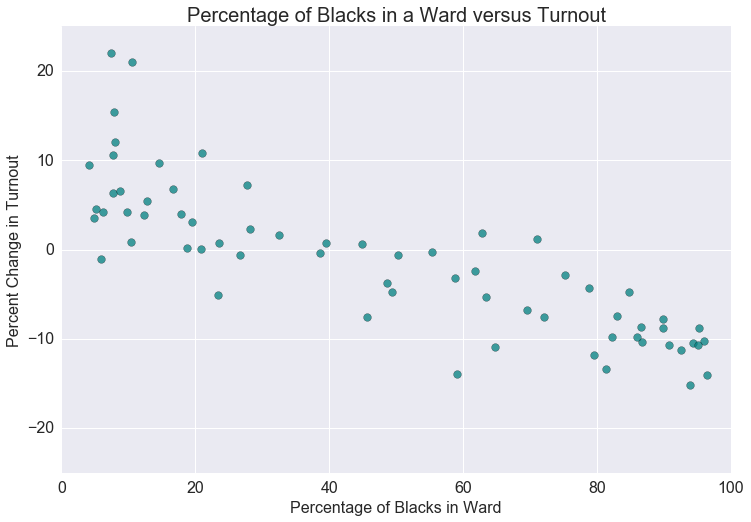
Milwaukee’s lowest-income neighborhoods offer one explanation for the turnout figures. Of the city’s 15 council districts, the decline in turnout from 2012 to 2016 in the five poorest was consistently much greater than the drop seen in more prosperous areas — accounting for half of the overall decline in turnout citywide.
The biggest drop was here in District 15, a stretch of fading wooden homes, sandwich shops and fast-food restaurants that is 84 percent black. In this district, voter turnout declined by 19.5 percent from 2012 figures, according to Neil Albrecht, executive director of the City of Milwaukee Election Commission. It is home to some of Milwaukee’s poorest residents and, according to a 2016 documentary, “Milwaukee 53206,” has one of the nation’s highest per-capita incarceration rates.
At Upper Cutz, a bustling barbershop in a green-trimmed wooden house, talk of politics inevitably comes back to one man: Barack Obama. Mr. Obama’s elections infused many here with a feeling of connection to national politics they had never before experienced. But their lives have not gotten appreciably better, and sourness has set in.
snip
and when they did vote there was this...
Mostly black neighborhoods voted more Republican in 2016 than in 2012
https://www.washingtonpost.com/news/politics/wp/2017/09/25/mostly-black-neighborhoods-voted-more-republican-in-2016-than-in-2012/
snip
A few things jump out. First: The most heavily white neighborhoods voted much more heavily Republican in 2016 than in 2012 (the dark red line shoots up past the light-red one). Second, the most heavily black neighborhoods voted less heavily Democratic last year than four years ago. (We’ll come back to this, obviously.) Third, Hispanic neighborhoods voted for Republicans less than in 2012.
The net effect of those shifts can be measured by comparing the margin between Barack Obama and Mitt Romney in 2012 with the Trump-Clinton margin in each neighborhood last year. In heavily white neighborhoods, a big shift to the Republicans. In mostly Hispanic neighborhoods, generally more support for the Democrat, except in the most dense places (although, as the chart on the right makes clear, the sample size for those is very small and therefore more subject to volatility).
snip
This Chart Shows Philadelphia Black Voters Stayed Home, Costing Clinton
A shift in Philadelphia voter turnout, which broke along racial lines, appears to have cost Hillary Clinton almost 35,000 votes.
https://www.buzzfeednews.com/article/johntemplon/this-chart-shows-philadelphia-black-voters-stayed-home-costi
One of the most surprising results of Election Day was Donald Trump winning Pennsylvania — a state that had voted for the Democrat in every election since 1988. As of the Pennsylvania Board of Elections’ latest tally, Trump leads Hillary Clinton by 57,588 votes. More than 60% of that margin comes from a shift in the vote in Philadelphia.
The Philadelphia data offers a particularly clear glimpse at what went wrong for Hillary Clinton: A block of voters who showed up for Barack Obama wasn’t inspired enough by her — or scared enough by Donald Trump — to show up. And as analysts pore over the results of the campaign, the numbers in Philadelphia offer perhaps the most devastating single data point for the Clinton campaign.
snip
massive drop in 85% black Detroit too
he black voter turnout rate declined for the first time in 20 years in a presidential election, falling to 59.6% in 2016 after reaching a record-high 66.6% in 2012. The 7-percentage-point decline from the previous presidential election is the largest on record for blacks. (It’s also the largest percentage-point decline among any racial or ethnic group since white voter turnout dropped from 70.2% in 1992 to 60.7% in 1996.) The number of black voters also declined, falling by about 765,000 to 16.4 million in 2016, representing a sharp reversal from 2012. With Barack Obama on the ballot that year, the black voter turnout rate surpassed that of whites for the first time. Among whites, the 65.3% turnout rate in 2016 represented a slight increase from 64.1% in 2012.
Why black voter turnout fell in 2016
How voting Democratic has become integral to African Americans’ cultural identity.
https://www.vox.com/mischiefs-of-faction/2018/1/15/16891020/black-voter-turnout
“Black Voters Aren’t Turning Out For The Post-Obama Democratic Party.” It’s a familiar headline in the aftermath of the 2016 presidential election. Indeed, post-election analysis of voter data shows black turnout in presidential elections declined 4.7 percent between 2012 and 2016 (overall turnout showed a small decline from 61.8 percent in 2012 to 61.4 percent in 2016).
How do we explain it — and can it be changed? My ongoing research with Ismail White on political norms among black Americans says we ought to have expected the decline, but that the Democratic Party can do much more to cut it back by recognizing how social dynamics shape African-American politics.
Some have attributed the decline in black turnout to voter suppression tactics made possible by the Shelby v. Holder (2013) decision that rescinded key protections from the Voting Rights Act. But black turnout saw similar declines in states where no new voter laws were implemented after the Shelby decision. Others have simplistically pointed to the absence of the first black president on the ballot — as if that fact offers an explanation. Our work on the social dynamics of politics within the black community provides the missing explanation.
In our recent publication in the American Political Science Review, we argue that the continued social isolation of blacks in American society has created spaces and incentives for the emergence of black political norms. Democratic partisanship has become significantly tied to black identity in the United States. The historical and continued racial segregation of black communities has produced spaces in which in-group members can leverage social sanctions against other group members to ensure compliance with group partisan norms.
snip
Study: Black turnout slumped in 2016
https://www.politico.com/story/2017/05/10/black-election-turnout-down-2016-census-survey-238226
Census shows pervasive decline in 2016 minority voter turnout
https://www.brookings.edu/blog/the-avenue/2017/05/18/census-shows-pervasive-decline-in-2016-minority-voter-turnout/
Study: Black voter turnout in Wisconsin declined by nearly one-fifth in 2016
https://madison.com/wsj/news/local/govt-and-politics/study-black-voter-turnout-in-wisconsin-declined-by-nearly-one/article_d3e72e41-96a0-51fb-83ba-11dfc6693daf.html
Turnout among black voters in Wisconsin dropped about 19 percent in the 2016 election from 2012, more than four times the national decline, according to a new study by a liberal group.
The study, released by the Center for American Progress, made the estimates based on data from the U.S. Census, polls and state voter files.
It provides the strongest evidence yet that Wisconsin’s decline in voter turnout, while seen in other demographic groups, was much more dramatic among African-Americans.
The study also found in Wisconsin, as in other key states, the 2016 electorate was significantly more white and non-college- educated than was reported by exit polls immediately after the election.
snip
Many in Milwaukee Neighborhood Didn’t Vote — and Don’t Regret It
https://www.nytimes.com/2016/11/21/us/many-in-milwaukee-neighborhood-didnt-vote-and-dont-regret-it.html
MILWAUKEE — Four barbers and a firefighter were pondering their future under a Trump presidency at the Upper Cutz barbershop last week.
“We got to figure this out,” said Cedric Fleming, one of the barbers. “We got a gangster in the chair now,” he said, referring to President-elect Donald J. Trump.They admitted that they could not complain too much: Only two of them had voted. But there were no regrets. “I don’t feel bad,” Mr. Fleming said, trimming a mustache. “Milwaukee is tired. Both of them were terrible. They never do anything for us anyway.”
Wisconsin, a state that Hillary Clinton had assumed she would win, historically boasts one of the nation’s highest rates of voter participation; this year’s 68.3 percent turnout was the fifth best among the 50 states. But by local standards, it was a disappointment, the lowest turnout in 16 years. And those no-shows were important. Mr. Trump won the state by just 27,000 voters.
Milwaukee’s lowest-income neighborhoods offer one explanation for the turnout figures. Of the city’s 15 council districts, the decline in turnout from 2012 to 2016 in the five poorest was consistently much greater than the drop seen in more prosperous areas — accounting for half of the overall decline in turnout citywide.
The biggest drop was here in District 15, a stretch of fading wooden homes, sandwich shops and fast-food restaurants that is 84 percent black. In this district, voter turnout declined by 19.5 percent from 2012 figures, according to Neil Albrecht, executive director of the City of Milwaukee Election Commission. It is home to some of Milwaukee’s poorest residents and, according to a 2016 documentary, “Milwaukee 53206,” has one of the nation’s highest per-capita incarceration rates.
At Upper Cutz, a bustling barbershop in a green-trimmed wooden house, talk of politics inevitably comes back to one man: Barack Obama. Mr. Obama’s elections infused many here with a feeling of connection to national politics they had never before experienced. But their lives have not gotten appreciably better, and sourness has set in.
snip
and when they did vote there was this...
Mostly black neighborhoods voted more Republican in 2016 than in 2012
https://www.washingtonpost.com/news/politics/wp/2017/09/25/mostly-black-neighborhoods-voted-more-republican-in-2016-than-in-2012/
snip
A few things jump out. First: The most heavily white neighborhoods voted much more heavily Republican in 2016 than in 2012 (the dark red line shoots up past the light-red one). Second, the most heavily black neighborhoods voted less heavily Democratic last year than four years ago. (We’ll come back to this, obviously.) Third, Hispanic neighborhoods voted for Republicans less than in 2012.
The net effect of those shifts can be measured by comparing the margin between Barack Obama and Mitt Romney in 2012 with the Trump-Clinton margin in each neighborhood last year. In heavily white neighborhoods, a big shift to the Republicans. In mostly Hispanic neighborhoods, generally more support for the Democrat, except in the most dense places (although, as the chart on the right makes clear, the sample size for those is very small and therefore more subject to volatility).
snip
This Chart Shows Philadelphia Black Voters Stayed Home, Costing Clinton
A shift in Philadelphia voter turnout, which broke along racial lines, appears to have cost Hillary Clinton almost 35,000 votes.
https://www.buzzfeednews.com/article/johntemplon/this-chart-shows-philadelphia-black-voters-stayed-home-costi
One of the most surprising results of Election Day was Donald Trump winning Pennsylvania — a state that had voted for the Democrat in every election since 1988. As of the Pennsylvania Board of Elections’ latest tally, Trump leads Hillary Clinton by 57,588 votes. More than 60% of that margin comes from a shift in the vote in Philadelphia.
The Philadelphia data offers a particularly clear glimpse at what went wrong for Hillary Clinton: A block of voters who showed up for Barack Obama wasn’t inspired enough by her — or scared enough by Donald Trump — to show up. And as analysts pore over the results of the campaign, the numbers in Philadelphia offer perhaps the most devastating single data point for the Clinton campaign.
snip
massive drop in 85% black Detroit too
Link to tweet
If I were to vote in a presidentialprimary today, I would vote for: Joe Biden
Edit history
Please sign in to view edit histories.
Recommendations
0 members have recommended this reply (displayed in chronological order):
66 replies
 = new reply since forum marked as read
Highlight:
NoneDon't highlight anything
5 newestHighlight 5 most recent replies
RecommendedHighlight replies with 5 or more recommendations
= new reply since forum marked as read
Highlight:
NoneDon't highlight anything
5 newestHighlight 5 most recent replies
RecommendedHighlight replies with 5 or more recommendations
= new reply since forum marked as read
Highlight:
NoneDon't highlight anything
5 newestHighlight 5 most recent replies
RecommendedHighlight replies with 5 or more recommendations
Giving Trump every single probable state and EV, it comes down to 3 states and we have to sweep them [View all]
Celerity
Mar 2019
OP
2 centrist white men, with the top of the ticket being 86 at the end of his terms is not
Celerity
Mar 2019
#50
Many miles to go until then, and Biden isn't even in the race yet. When he enters many other
Celerity
Mar 2019
#6
Other candidates will, at some point, have a go at him, especially if he is the front-runner.
Celerity
Mar 2019
#32
Again with the misrepresenting of what I said, and also some strange attempt at projection.
Celerity
Mar 2019
#35
the only centering of Bernie came from you, you are completely trying to turn it into yet another
Celerity
Mar 2019
#37
again, and again and again with the misrepresentation and the attempts at Sanders-centric deflection
Celerity
Mar 2019
#39
Greater turnout of POC is key, I agree. Those aren't the only 3 states that will flip.
Garrett78
Mar 2019
#7
Thee senate is tough. I don't think any senator from a state that has a GOP governor should run
Demsrule86
Mar 2019
#15
you completely miss my point, I never said those other states were not in play
Celerity
Mar 2019
#12
Black voter turnout fell in 2016, even as a record number of Americans cast ballots
Celerity
Mar 2019
#18
Be mindful of damage done with the Russian trolling of black millennials during the 2016 campaign
allgood33
Mar 2019
#23
oh, wow, Mandela Barnes looks so impressive, he absolutely has a big future in our party!!
Celerity
Mar 2019
#41
before the orange turd picked the man married to Mother as VP, I was thinking Walker
Celerity
Mar 2019
#48
Luckily, with a crap candidate, we only lost those three states by less than 80K votes...
SKKY
Mar 2019
#59
Which is why all of us need to continue to support the National Popular Vote Compact
PatrickforO
Apr 2019
#64