 Congratulations to our presumptive Democratic nominee, Joe Biden!
Democratic Primaries
In reply to the discussion: So M4A is a vote loser. What about Obamacare? [View all]Celerity
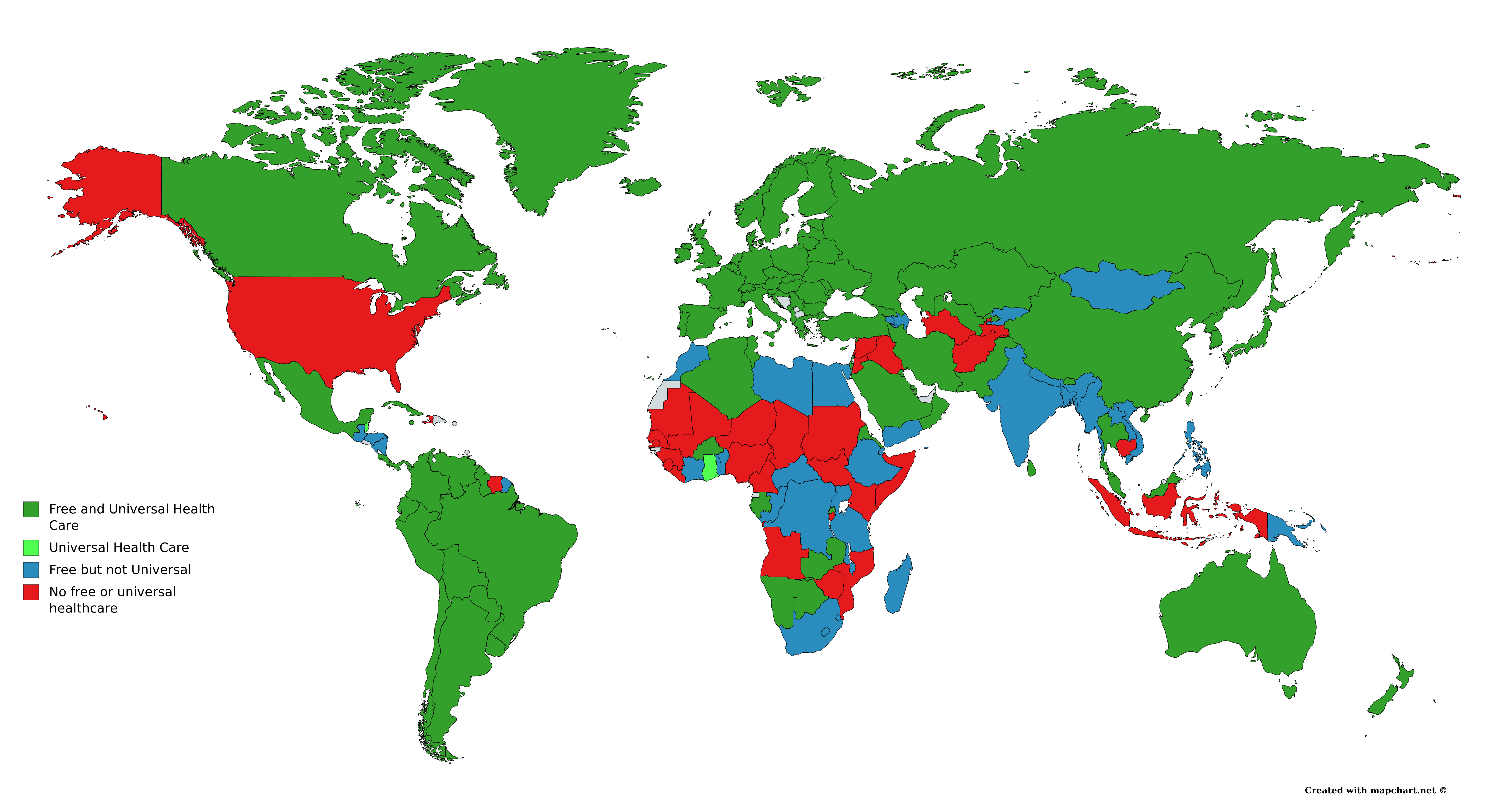
(54,470 posts)Taiwan and South Korea have national single payer systems
then there are
https://en.wikipedia.org/wiki/Single-payer_healthcare
Regions with 'Beveridge Model' systems
Nordic countries
The Nordic countries are sometimes considered to have single-payer health care services, as opposed to single-payer national health care insurance like Taiwan or Canada. This is a form of the 'Beveridge Model' of health care systems that features public health providers in addition to public health insurance.
The term 'Scandinavian model' or 'Nordic model' of health care systems has a few common features: largely public providers, limited private health coverage, and regionally-run, devolved systems with limited involvement from the central government. Due to this third characteristic, they can also be argued to be single-payer only on a regional level, or to be multi-payer systems, as opposed to the nationally run health coverage found in Taiwan and South Korea.¨
United Kingdom
As in Scandinavia, healthcare in the United Kingdom is a devolved matter, meaning England, Northern Ireland, Scotland, and Wales each has its own system of private and publicly funded healthcare, generally referred to as the National Health Service (NHS). With largely public or government owned providers, this also fits into the 'Beveridge Model' of health care systems, sometimes considered to be single-payer, although unlike Scandinavia, there is a more significant role for both private coverage and providers. Each country's having different policies and priorities has resulted in a variety of differences existing between the systems.[30][31] That said, each country provides public healthcare to all UK permanent residents that is free at the point of use, being paid for from general taxation.
In addition, each also has a private sector which is considerably smaller than its public equivalent, with provision of private healthcare acquired by means of private health insurance, funded as part of an employer funded healthcare scheme or paid directly by the customer, though provision can be restricted for those with conditions such as AIDS/HIV.[32][33]
The individual systems are:
England: National Health Service
Northern Ireland: Health and Social Care in Northern Ireland (HSCNI)
Scotland: NHS Scotland
Wales: NHS Wales
In England, funding from general taxation is channeled through NHS England, which is responsible for commissioning mainly specialist services and primary care, and Clinical Commissioning Groups (CCGs), which manage 60% of the budget and are responsible for commissioning health services for their local populations. These commissioning bodies do not provide services themselves directly, but procure these from NHS Trusts and Foundation Trusts, as well as private, voluntary, and social enterprise sector providers.
Regions with hybrid single-payer/private insurance systems
Australia
Healthcare in Australia is provided by both private and government institutions. Medicare is the publicly funded universal health care venture in Australia. It was instituted in 1984 and coexists with a private health system. Medicare is funded partly by a 2% income tax levy (with exceptions for low-income earners), but mostly out of general revenue. An additional levy of 1% is imposed on high-income earners without private health insurance.
As well as Medicare, there is a separate Pharmaceutical Benefits Scheme that considerably subsidises a range of prescription medications. The Minister for Health administers national health policy, elements of which (such as the operation of hospitals) are overseen by individual states.
Spain
Building upon less structured foundations, in 1963 the existence of a single-payer healthcare system in Spain was established by the Spanish government. The system was sustained by contributions from workers, and covered them and their dependants.
The universality of the system was established later in 1986. At the same time, management of public healthcare was delegated to the different autonomous communities in the country. While previously this was not the case, in 1997 it was established that public authorities can delegate management of publicly funded healthcare to private companies.
Additionally, in parallel to the single-payer healthcare system there are private insurers, which provide coverage for some private doctors and hospitals. Employers will sometimes offer private health insurance as a benefit, with 14.8% of the Spanish population being covered under private health insurance in 2013. In 2000, the Spanish healthcare system was rated by the World Health Organization as the 7th best in the world.
snip
If I were to vote in a presidentialprimary today, I would vote for: Joe Biden
Edit history
Recommendations
0 members have recommended this reply (displayed in chronological order): = new reply since forum marked as read
Highlight:
NoneDon't highlight anything
5 newestHighlight 5 most recent replies
RecommendedHighlight replies with 5 or more recommendations
= new reply since forum marked as read
Highlight:
NoneDon't highlight anything
5 newestHighlight 5 most recent replies
RecommendedHighlight replies with 5 or more recommendations