Welcome to DU!
The truly grassroots left-of-center political community where regular people, not algorithms, drive the discussions and set the standards.
Join the community:
Create a free account
Support DU (and get rid of ads!):
Become a Star Member
Latest Breaking News
Editorials & Other Articles
General Discussion
The DU Lounge
All Forums
Issue Forums
Culture Forums
Alliance Forums
Region Forums
Support Forums
Help & Search
General Discussion
In reply to the discussion: A 70 yr old friend of mine is not planning to get the COVID vaccine. [View all]
Celerity
(54,824 posts)9. Abortion opponents protest COVID-19 vaccines' use of fetal cells
https://www.sciencemag.org/news/2020/06/abortion-opponents-protest-covid-19-vaccines-use-fetal-cells
snip
Cells derived from elective abortions have been used since the 1960s to manufacture vaccines, including current vaccines against rubella, chickenpox, hepatitis A, and shingles. They have also been used to make approved drugs against diseases including hemophilia, rheumatoid arthritis, and cystic fibrosis. Now, research groups around the world are working to develop more than 130 candidate vaccines against COVID-19, according to the World Health Organization; 10 had entered human trials as of 2 June.
At least five of the candidate COVID-19 vaccines use one of two human fetal cell lines: HEK-293, a kidney cell line widely used in research and industry that comes from a fetus aborted in about 1972; and PER.C6, a proprietary cell line owned by Janssen, a subsidiary of Johnson & Johnson, developed from retinal cells from an 18-week-old fetus aborted in 1985. Both cell lines were developed in the lab of molecular biologist Alex van der Eb at Leiden University. Two of the five vaccines have entered human trials (see table, below).
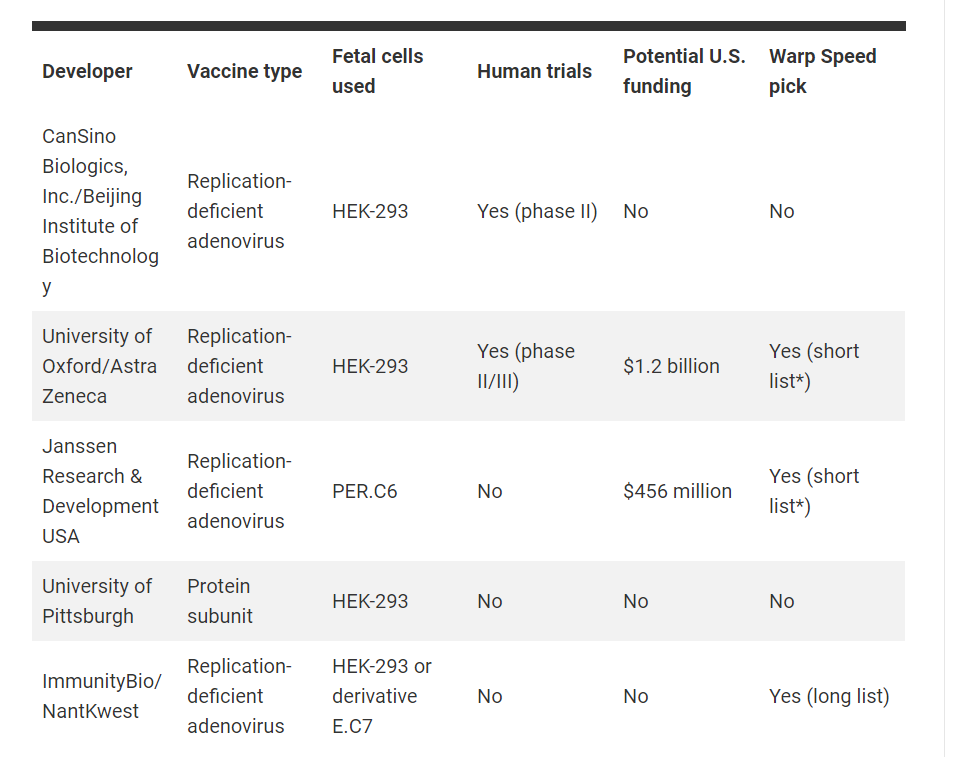
In four of the vaccines, the human fetal cells are used as miniature “factories” to generate vast quantities of adenoviruses, disabled so that they cannot replicate, that are used as vehicles to ferry genes from the novel coronavirus that causes COVID-19. When the adenoviruses are given as a vaccine, recipients’ cells begin to produce proteins from the coronavirus, hopefully triggering a protective immune response. The fifth vaccine, which has shown promise in monkeys and is headed for human trials as soon as this summer, is what is known as a protein subunit vaccine. Researchers at the University of Pittsburgh use HEK-293 cells to manufacture the coronavirus’ spike protein—a vital part of its structure—which is used to trigger an immune response. The vaccine is delivered through a skin patch with 400 tiny needles.
The fetal cell lines are key to producing both types of vaccine. “HEK-293 [cells] are essential for making protein subunit vaccines,” says Andrea Gambotto, a vaccine scientist at the University of Pittsburgh School of Medicine and the vaccine’s lead developer. Their human origin is important, he says: “Cultured [nonhuman] animal cells can produce the same proteins, but they would be decorated with different sugar molecules, which—in the case of vaccines—runs the risk of failing to evoke a robust and specific immune response.” (Among the developers of the five vaccines, only Gambotto responded to a request for comment.)
David Prentice, vice president and research director at the Charlotte Lozier Institute, which opposes abortion, notes researchers making adenovirus vaccines have modified HEK-293 cells to be adept at packaging new genes—such as those that direct cells to assemble the coronavirus spike protein—into adenoviruses. But he adds that other technologies are available, including using cells captured from amniocentesis that are engineered to make replication-deficient adenoviruses. “The use of cells from electively aborted fetuses for vaccine production makes these five COVID-19 vaccine programs unethical, because they exploit the innocent human beings who were aborted,” Prentice and a co-author—molecular biologist James Sherley, a Lozier Institute associate scholar and director of the adult stem cell company Asymmetrex—wrote in a position paper published last month.
snip
snip
Cells derived from elective abortions have been used since the 1960s to manufacture vaccines, including current vaccines against rubella, chickenpox, hepatitis A, and shingles. They have also been used to make approved drugs against diseases including hemophilia, rheumatoid arthritis, and cystic fibrosis. Now, research groups around the world are working to develop more than 130 candidate vaccines against COVID-19, according to the World Health Organization; 10 had entered human trials as of 2 June.
At least five of the candidate COVID-19 vaccines use one of two human fetal cell lines: HEK-293, a kidney cell line widely used in research and industry that comes from a fetus aborted in about 1972; and PER.C6, a proprietary cell line owned by Janssen, a subsidiary of Johnson & Johnson, developed from retinal cells from an 18-week-old fetus aborted in 1985. Both cell lines were developed in the lab of molecular biologist Alex van der Eb at Leiden University. Two of the five vaccines have entered human trials (see table, below).
In four of the vaccines, the human fetal cells are used as miniature “factories” to generate vast quantities of adenoviruses, disabled so that they cannot replicate, that are used as vehicles to ferry genes from the novel coronavirus that causes COVID-19. When the adenoviruses are given as a vaccine, recipients’ cells begin to produce proteins from the coronavirus, hopefully triggering a protective immune response. The fifth vaccine, which has shown promise in monkeys and is headed for human trials as soon as this summer, is what is known as a protein subunit vaccine. Researchers at the University of Pittsburgh use HEK-293 cells to manufacture the coronavirus’ spike protein—a vital part of its structure—which is used to trigger an immune response. The vaccine is delivered through a skin patch with 400 tiny needles.
The fetal cell lines are key to producing both types of vaccine. “HEK-293 [cells] are essential for making protein subunit vaccines,” says Andrea Gambotto, a vaccine scientist at the University of Pittsburgh School of Medicine and the vaccine’s lead developer. Their human origin is important, he says: “Cultured [nonhuman] animal cells can produce the same proteins, but they would be decorated with different sugar molecules, which—in the case of vaccines—runs the risk of failing to evoke a robust and specific immune response.” (Among the developers of the five vaccines, only Gambotto responded to a request for comment.)
David Prentice, vice president and research director at the Charlotte Lozier Institute, which opposes abortion, notes researchers making adenovirus vaccines have modified HEK-293 cells to be adept at packaging new genes—such as those that direct cells to assemble the coronavirus spike protein—into adenoviruses. But he adds that other technologies are available, including using cells captured from amniocentesis that are engineered to make replication-deficient adenoviruses. “The use of cells from electively aborted fetuses for vaccine production makes these five COVID-19 vaccine programs unethical, because they exploit the innocent human beings who were aborted,” Prentice and a co-author—molecular biologist James Sherley, a Lozier Institute associate scholar and director of the adult stem cell company Asymmetrex—wrote in a position paper published last month.
snip
Edit history
Please sign in to view edit histories.
Recommendations
0 members have recommended this reply (displayed in chronological order):
70 replies
 = new reply since forum marked as read
Highlight:
NoneDon't highlight anything
5 newestHighlight 5 most recent replies
RecommendedHighlight replies with 5 or more recommendations
= new reply since forum marked as read
Highlight:
NoneDon't highlight anything
5 newestHighlight 5 most recent replies
RecommendedHighlight replies with 5 or more recommendations
= new reply since forum marked as read
Highlight:
NoneDon't highlight anything
5 newestHighlight 5 most recent replies
RecommendedHighlight replies with 5 or more recommendations
A 70 yr old friend of mine is not planning to get the COVID vaccine. [View all]
milestogo
Jan 2021
OP
I really am not interested in convincing them. I accept that I am in a moral struggle with them
Blue_true
Jan 2021
#62
Stem cells were not used in the development or manufacture of the existing vaccines.
The Velveteen Ocelot
Jan 2021
#4
That's true for the only two it lists, the Pfizer & the Moderna vaccines, but at least 5 others do
Celerity
Jan 2021
#15
The Johnson & Johnson (likely soon approved in the US) and others do use them in the manufacturing
Celerity
Jan 2021
#24
If they're OK with the Pope they should be OK with the OP's friend.
The Velveteen Ocelot
Jan 2021
#25
Yes, the first two should be fine for the friend of the OP, some of the others, no.
Celerity
Jan 2021
#27
Time magazine had a great article on the development of the vaccines. Neither of the two....
EarnestPutz
Jan 2021
#6
mrna vaccines Pfizer, Moderna do not use stem cells in production. They do use cells in testing.
Pobeka
Jan 2021
#8
You posted some philosophical points for me to consider. I guess it is a fuzzy
Blue_true
Feb 2021
#69
Yet, those same people was ok with Trump taking Regeneron and getting it to his pals that got sick.
Blue_true
Jan 2021
#49
Pope Francis suggests people have moral obligation to take coronavirus vaccine
dalton99a
Jan 2021
#28
same here We have not been in the same room with any of his family since
yellowdogintexas
Jan 2021
#31
I have gotten to the point with those people that even such a blunt assessment
Blue_true
Jan 2021
#55