Welcome to DU!
The truly grassroots left-of-center political community where regular people, not algorithms, drive the discussions and set the standards.
Join the community:
Create a free account
Support DU (and get rid of ads!):
Become a Star Member
Latest Breaking News
Editorials & Other Articles
General Discussion
The DU Lounge
All Forums
Issue Forums
Culture Forums
Alliance Forums
Region Forums
Support Forums
Help & Search
General Discussion
In reply to the discussion: Gen Z on Republican Party (from Reddit) [View all]
Celerity
(54,560 posts)63. That is factually untrue when comparing the 2016 POTUS election versus the 2020 POTUS election,
and (obviously) turnout was higher in the Presidential year election of 2020 than in the midterm 2018 election (for all ages, not just the youth vote).
Thus, your statement
is invalid.
Half of Youth Voted in 2020, An 11-Point Increase from 2016
https://circle.tufts.edu/latest-research/half-youth-voted-2020-11-point-increase-2016
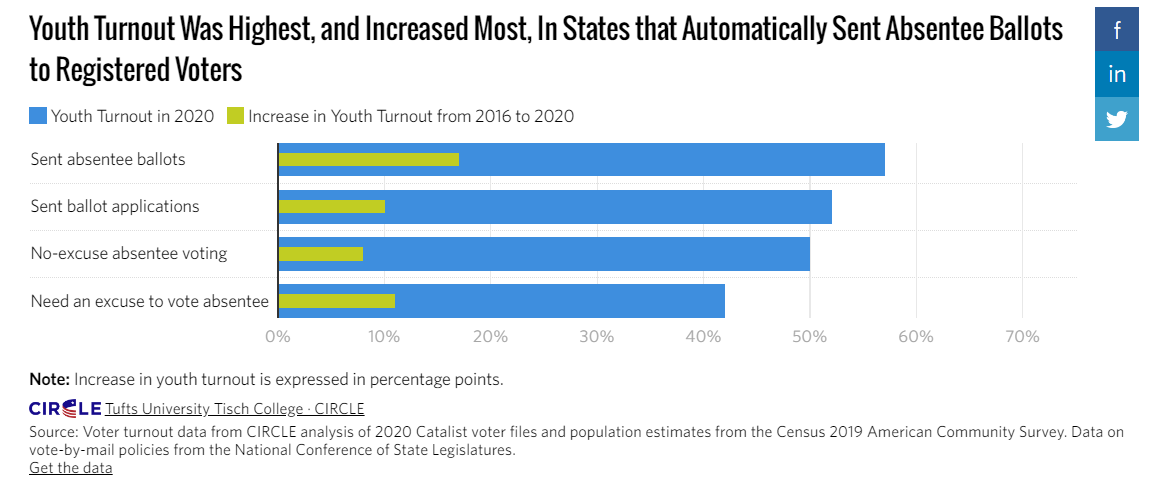
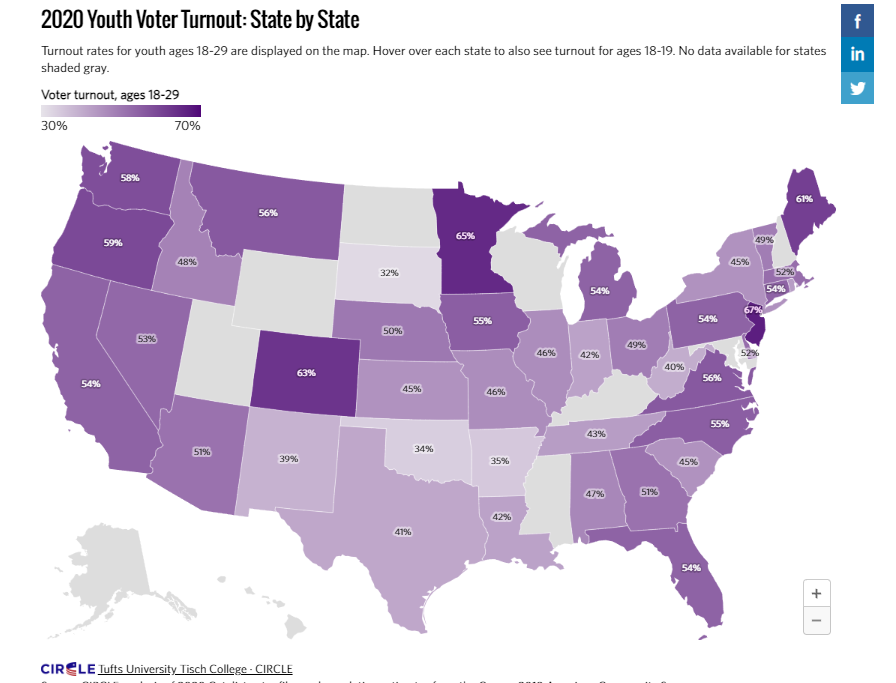
Our analysis of youth voter turnout nationwide finds wide variation between states and underscores the importance of electoral laws and policies that help grow voters. We estimate that 50% of young people, ages 18-29, voted in the 2020 presidential election, a remarkable 11-point increase from 2016 (39%) and likely one of the highest rates of youth electoral participation since the voting age was lowered to 18. Our new estimate is based on newly available voter file data in 41 states—AK, DC, HI, MD, MS, NH, ND, UT, WI, WY do not have reliable vote history data by age. This analysis replaces our earlier estimate, released immediately after Election Day, which estimated a 5 to 11 point increase in youth voter turnout compared to 2016 based on data available in that moment.
In recent weeks, we released youth voter turnout in all available states by region: West/Southwest, South, Midwest, and East/Northeast. Those analyses offer more details on several notable states and have now been updated with the latest data. Our estimates of youth voter turnout rates in more than 80% of states are in some ways a tribute to young people’s commitment to political engagement and action in 2020, and their impressive ability to navigate a changing electoral landscape during a global pandemic. The data also allows us to zoom out, look at trends in youth voter participation, and draw some conclusions about what is and isn’t working to broaden and diversify the youth electorate. We pay special attention to laws and election administration policies that affect the ease of casting a ballot in each state—from voter registration to vote-by-mail, which can always impact youth voter turnout but may have had especially large effects in 2020, as the COVID-19 pandemic shifted election processes across the country.
snip
also:
Thus, your statement
treestar
62. Back down in 20
62. Back down in 20
is invalid.
Half of Youth Voted in 2020, An 11-Point Increase from 2016
https://circle.tufts.edu/latest-research/half-youth-voted-2020-11-point-increase-2016
Our analysis of youth voter turnout nationwide finds wide variation between states and underscores the importance of electoral laws and policies that help grow voters. We estimate that 50% of young people, ages 18-29, voted in the 2020 presidential election, a remarkable 11-point increase from 2016 (39%) and likely one of the highest rates of youth electoral participation since the voting age was lowered to 18. Our new estimate is based on newly available voter file data in 41 states—AK, DC, HI, MD, MS, NH, ND, UT, WI, WY do not have reliable vote history data by age. This analysis replaces our earlier estimate, released immediately after Election Day, which estimated a 5 to 11 point increase in youth voter turnout compared to 2016 based on data available in that moment.
In recent weeks, we released youth voter turnout in all available states by region: West/Southwest, South, Midwest, and East/Northeast. Those analyses offer more details on several notable states and have now been updated with the latest data. Our estimates of youth voter turnout rates in more than 80% of states are in some ways a tribute to young people’s commitment to political engagement and action in 2020, and their impressive ability to navigate a changing electoral landscape during a global pandemic. The data also allows us to zoom out, look at trends in youth voter participation, and draw some conclusions about what is and isn’t working to broaden and diversify the youth electorate. We pay special attention to laws and election administration policies that affect the ease of casting a ballot in each state—from voter registration to vote-by-mail, which can always impact youth voter turnout but may have had especially large effects in 2020, as the COVID-19 pandemic shifted election processes across the country.
snip
also:
Edit history
Please sign in to view edit histories.
Recommendations
0 members have recommended this reply (displayed in chronological order):
79 replies
 = new reply since forum marked as read
Highlight:
NoneDon't highlight anything
5 newestHighlight 5 most recent replies
RecommendedHighlight replies with 5 or more recommendations
= new reply since forum marked as read
Highlight:
NoneDon't highlight anything
5 newestHighlight 5 most recent replies
RecommendedHighlight replies with 5 or more recommendations
= new reply since forum marked as read
Highlight:
NoneDon't highlight anything
5 newestHighlight 5 most recent replies
RecommendedHighlight replies with 5 or more recommendations
NONE of our candidates would have "lost in a landslide" to TRUMP in 2020!
DemocraticPatriot
Aug 2023
#64
Short answer, yes. Some people just can't let go of their past anger.
DemocraticPatriot
Aug 2023
#70
Opposite. Bernie listens to Biden, "as he should, and that helped USA make progress these
betsuni
Aug 2023
#58
I have two Gen Z daughters. I know they are they friends will show up and vote as
iluvtennis
Aug 2023
#15
I hope that our younger voters continue to stay involved and don't throw in the towel (as GQP wants)
groundloop
Aug 2023
#18
the stats show he is correct for 2018 and onward in regards to us younger voters
Celerity
Aug 2023
#36
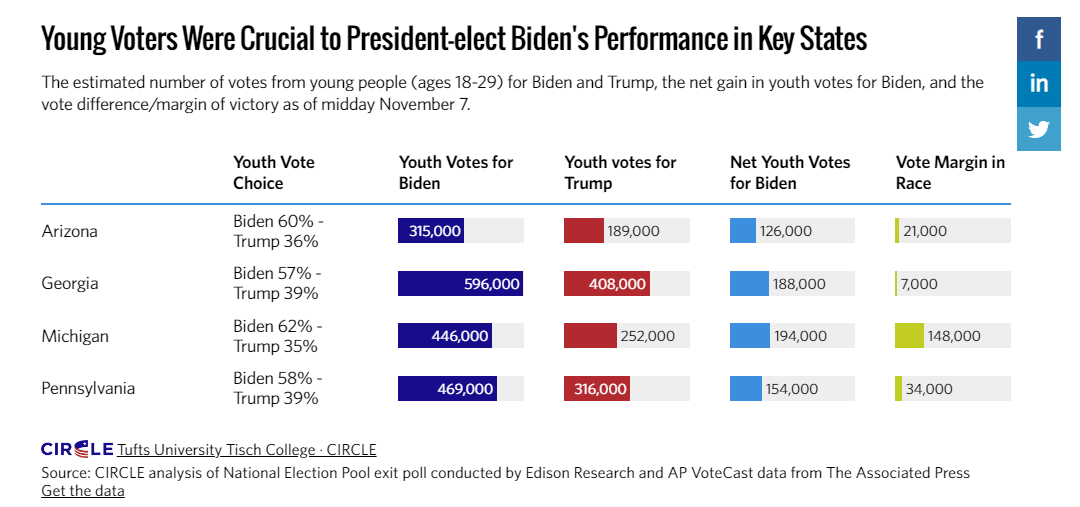
If not for us younger voters (and my age cohort in 2020 voted more than 2 to 1 for Biden, see below)
Celerity
Aug 2023
#43
that poster's data at their link ends with 2016, thus misses the large upsurge from 2018 onward
Celerity
Aug 2023
#57
Your link data ends at 2016, it doesn't show the large upturns starting in 2018, thus is non
Celerity
Aug 2023
#56
That is factually untrue when comparing the 2016 POTUS election versus the 2020 POTUS election,
Celerity
Aug 2023
#63
Thanks for posting all these great data collections! It is GREAT NEWS
DemocraticPatriot
Aug 2023
#67
IF they turned out in HUGE 40-50% numbers they would control almost all elections going forward.
NoMoreRepugs
Aug 2023
#65