A Political/Cultural Glimpse Into America's Future: Generation Z's Views on Generational Change & the Challenges Ahead [View all]
https://www.prri.org/research/generation-zs-views-on-generational-change-and-the-challenges-and-opportunities-ahead-a-political-and-cultural-glimpse-into-americas-future/
Executive Summary
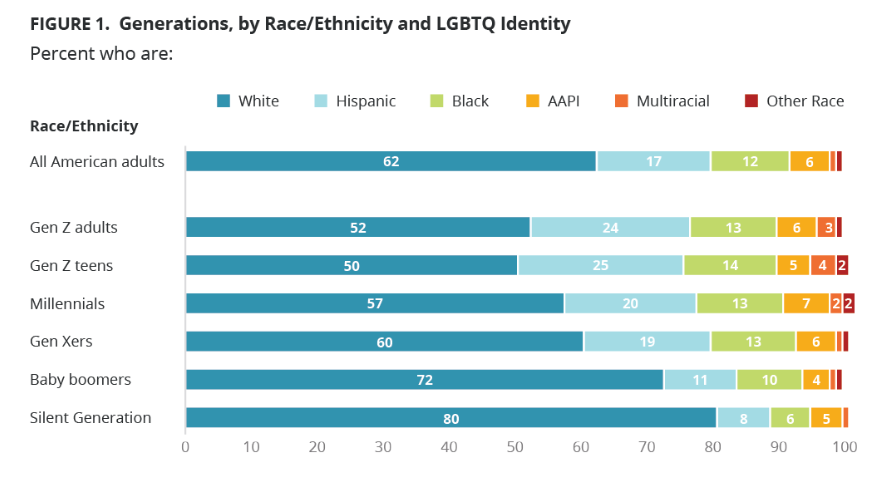
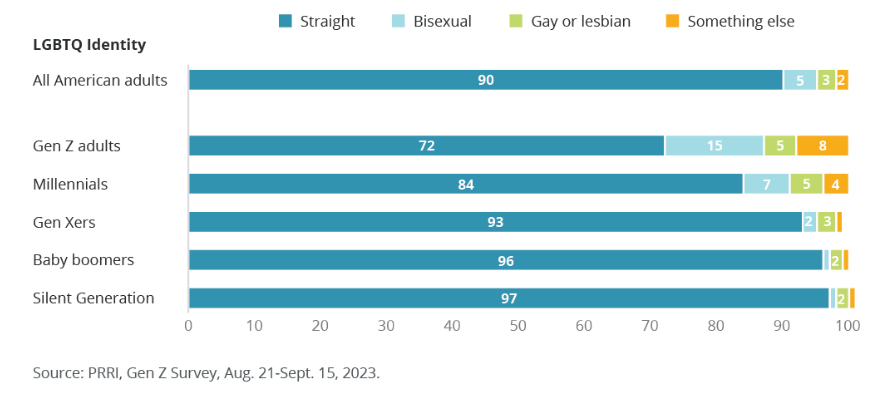
Members of Generation Z are coming into their own politically, socially, and culturally, bringing their values and viewpoints to their communities and workplaces, and to our nation’s political system. In addition to being the most racially and ethnically diverse generation in our nation’s history, Gen Z adults also identify as LGBTQ at much higher rates than older Americans. Like millennials, Gen Zers are also less likely than older generations to affiliate with an established religion. This report considers what sets members of Generation Z apart from older generations in terms of their political and cultural values, their faith in communities and political institutions, and their views on religion and the importance of diversity and inclusion in the nation’s democracy. The report is based on both the results of a national survey of all Americans, which includes oversamples of Generation Z — both Gen Z adults (ages 18–25) and Gen Z teens (13–17) — and on an analysis of ten virtual focus groups that included a wide cross section of Gen Z adults from across the United States.
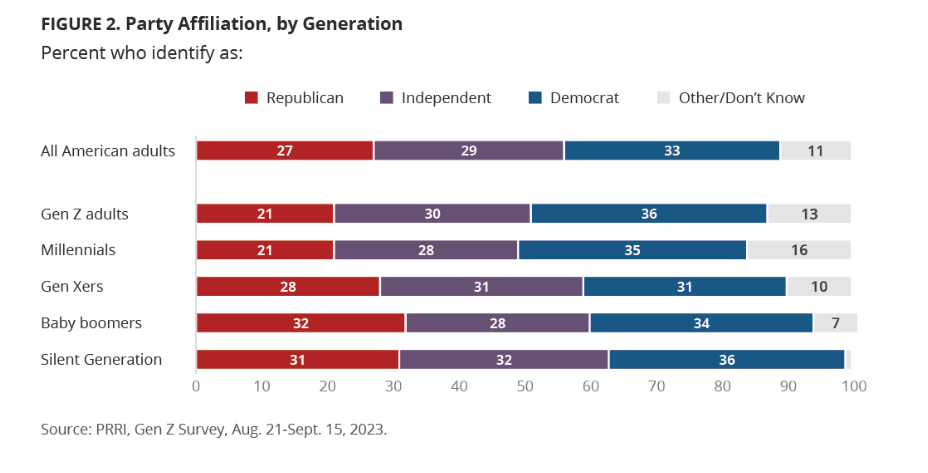
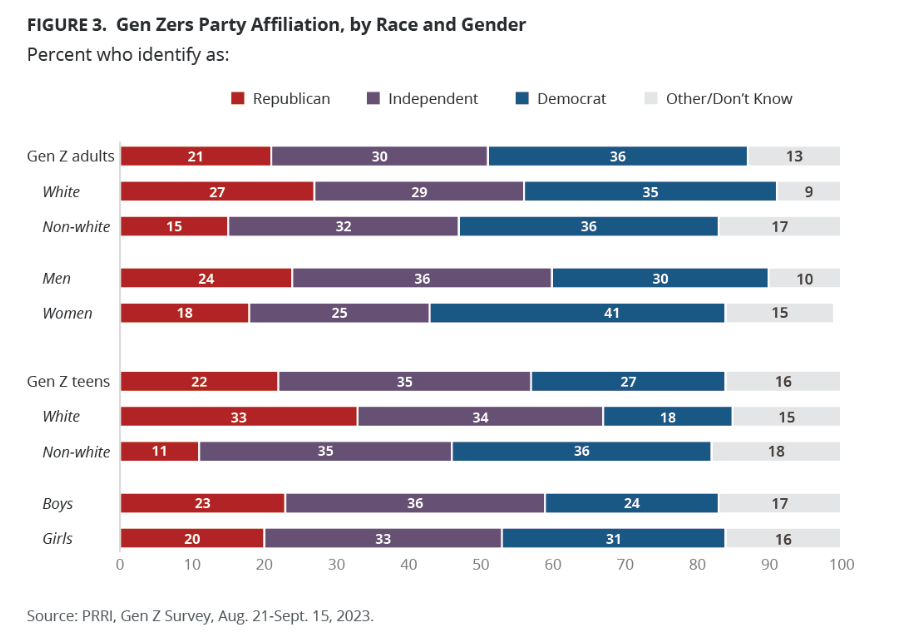
Gen Z adults trend slightly less Republican than older Americans. More than half of Gen Z teens do not identify with a major party, but most share their parents’ party affiliation.
Gen Z adults (21%) are less likely than all generational groups except millennials (21%) to identify as Republican. Meanwhile, 36% of Gen Z adults identify as Democrats, and this rate is similar to other generations, with the exception of Gen Xers, who are less Democratic (31%). More than half of Gen Z teens (51%) do not identify with either major political party, compared with 43% of Gen Z adults. Most Gen Z teens share the same partisan identity as their parents.
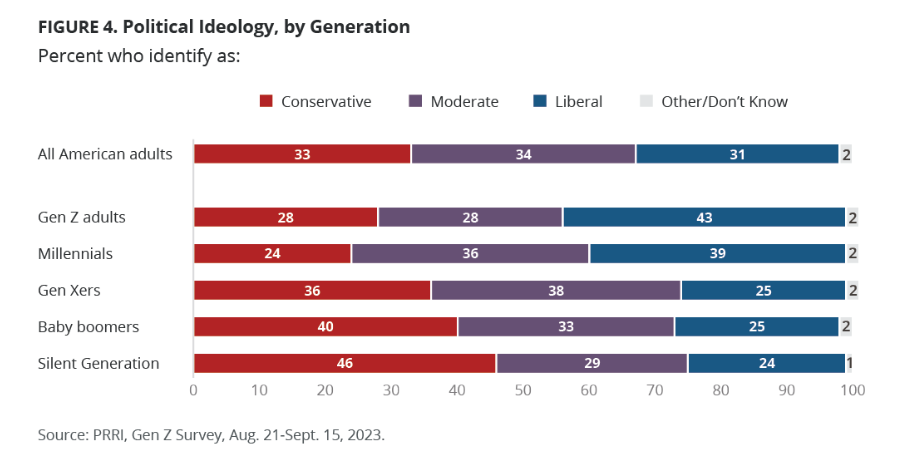
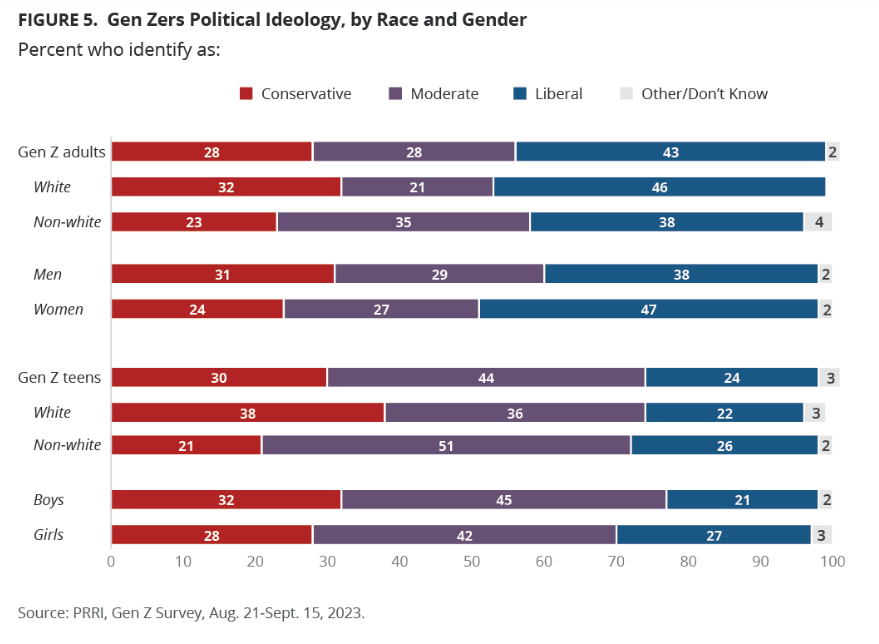
Gen Z adults are more liberal than older Americans. Gen Z teens are more moderate.
With the exception of millennials (24%), Gen Z adults (28%) are notably less likely than other generational cohorts to identify as conservative. And Gen Z adults (43%) identify as liberal at a higher rate than other generations. A plurality of Gen Z teens (44%) identify as moderate. While Gen Z women are substantially more liberal than Gen Z men (47% vs. 38%), that gender gap is smaller among Gen Z teens, with 27% of teen girls and 21% of teen boys identifying as liberal. By contrast, white teens are more likely to identify as conservative (38%) than non-white teens (21%).
Gen Z is more religiously diverse than older generations. Gen Z teens mirror their parents’ religious affiliation. Gen Z teens are more likely than Gen Z adults to attend church or find religion important.
Gen Z adults are notably less likely to identify as white Christians and more likely to identify as religiously unaffiliated than older generations, with the exception of millennials. More than eight in ten white Christian Gen Z teens (83%) and Christian Gen Z teens of color (85%) report belonging to the same religion as their parents, compared with 68% of religiously unaffiliated teens. Gen Z Republicans—both adults and teens—attend church more often, express that religion is more important to them, and have higher trust in organized religion than Gen Z Democrats or independents.
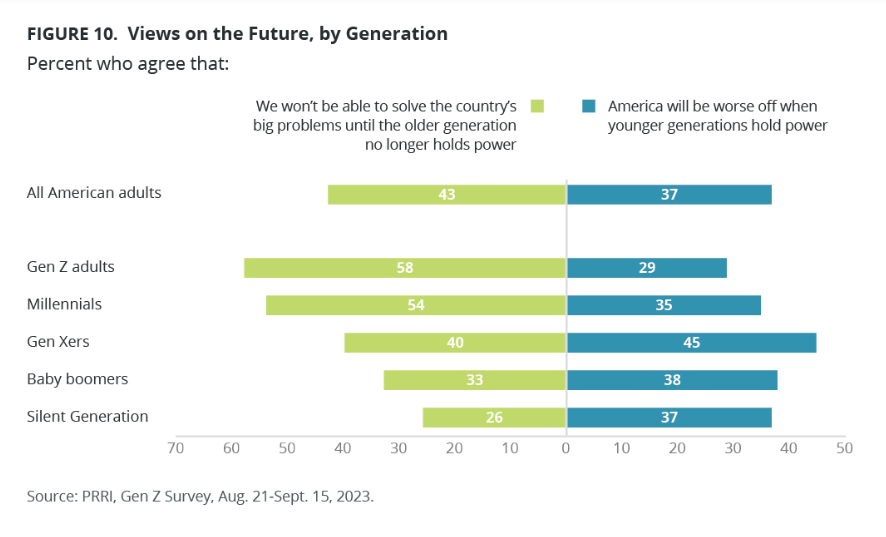
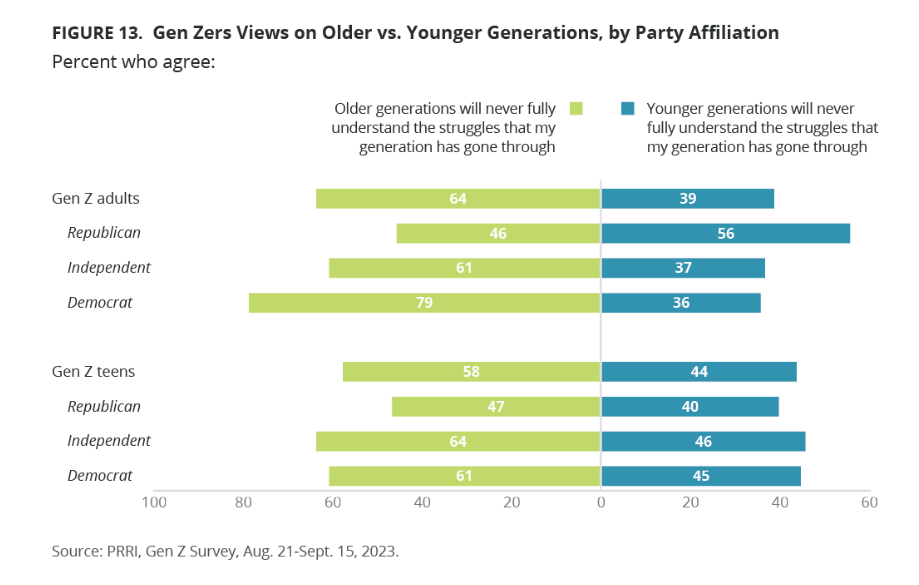
Most Gen Z Americans, particularly Gen Z Democrats, are more likely than older Americans to believe that generational change in political leadership is necessary to solve the country’s problems...................
snip
 much much more at the top link

 = new reply since forum marked as read