I’m just going to add these neat little pie charts from the article
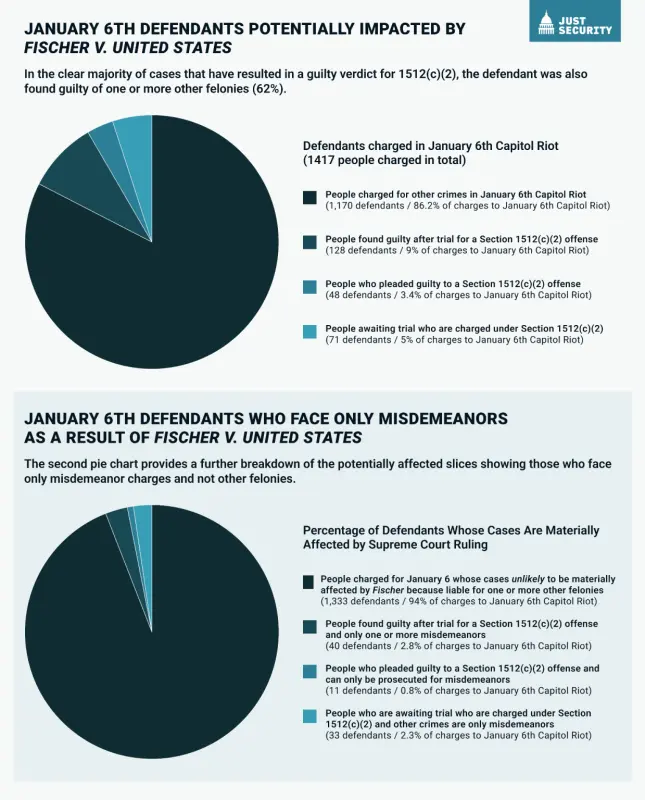
And one handy section of text
6. Charges against Trump materially unaffected.
The case against former President Trump remains prosecutable even though the Supreme Court has narrowed the scope of the obstruction statute. First, Trump is charged with other crimes (Conspiracy to Defraud the United States (18 USC 371) and Conspiracy Against Rights (18 USC 241)), which are unaffected by the ruling. Notably, those charges are based on the same alleged facts as the two obstruction charges against Trump (a Section 1512(c)(2) offense and a conspiracy to commit a Section 1512(c)(2) offense.) Second, as Justice Barrett suggested in oral argument, the issue in Fischer may not affect the statute’s application to charges involving interference with “the certificates arriving to the vice president’s desk” or other acts of obstruction that involve “acting on the certificates.” That line drawing has implications for the Section 1512(c)(2) charges against Trump that relate to the use of false elector certificates. Indeed, Special Counsel Jack Smith has also noted in Supreme Court filings “whether the Court interprets Section 1512(c)(2) consistently with a natural reading of its text or adopts the evidence-impairment gloss urged by the petitioner in Fischer, the Section 1512 charges in this case are valid.”
The majority in Fischer leaves this door wide open in writing: “[S]ubsection (c)(2) makes it a crime to impair the availability or integrity of records, documents, or objects used in an official proceeding in ways other than those specified in (c)(1). For example, it is possible to violate (c)(2) by creating false evidence—rather than altering incriminating evidence” (emphasis added).
Notably, the evidence-impairment provision in Section 1512(c)(2) could also apply to others involved in the false electors scheme
Well worth the whole read , thanks
✌🏻

 = new reply since forum marked as read