Welcome to DU!
The truly grassroots left-of-center political community where regular people, not algorithms, drive the discussions and set the standards.
Join the community:
Create a free account
Support DU (and get rid of ads!):
Become a Star Member
Latest Breaking News
Editorials & Other Articles
General Discussion
The DU Lounge
All Forums
Issue Forums
Culture Forums
Alliance Forums
Region Forums
Support Forums
Help & Search
General Discussion
In reply to the discussion: Ah, I see you are back for MORE of the Friday Afternoon Challenge! Today: Inspiration! [View all]
pinboy3niner
(53,339 posts)21. #5: Rubens - Deposition from the Cross (inspiration for Rembrandt)
In 1611, the Arquebusiers - Antwerp's civic guard - commissioned a Descent from the Cross by their illustrious townsman Rubens for their altar in the cathedral. The dean of the guild at that time was Burgomaster Nicolaas Rockox, who appear in the painting. The Descent from the Cross is the second of Rubens's great altarpieces for the Antwerp Cathedral. It shows the Visitation, and the Presentation of the Temple on either side of the Descent from the Cross. (The first triptych of the Raising of the Cross was executed in 1611-12.) His rich painterly Baroque technique incorporated both elements of Venetian design and also the composition and lighting of the Roman period of Caravaggio. But the result is purely Flemish.
Although at first sight the themes presented in the triptych seem extremely wide-ranging, they are actually linked, for St Christopher was the Arquebusiers' patron saint. When the triptych was closed, all that worshippers could see was this scene from the legend of St Christopher, whose Greek name 'Christophorus' means 'Christ-bearer'. This fact forms the key to the entire painting, in which the friends and holy women in the centre panel, and Mary and Simeon in the wings are also 'Christ-bearers'.
http://www.wga.hu/frames-e.html?/html/r/rubens/11religi/07desce.html
Although at first sight the themes presented in the triptych seem extremely wide-ranging, they are actually linked, for St Christopher was the Arquebusiers' patron saint. When the triptych was closed, all that worshippers could see was this scene from the legend of St Christopher, whose Greek name 'Christophorus' means 'Christ-bearer'. This fact forms the key to the entire painting, in which the friends and holy women in the centre panel, and Mary and Simeon in the wings are also 'Christ-bearers'.
http://www.wga.hu/frames-e.html?/html/r/rubens/11religi/07desce.html
Rembrandt, The Descent from the Cross:
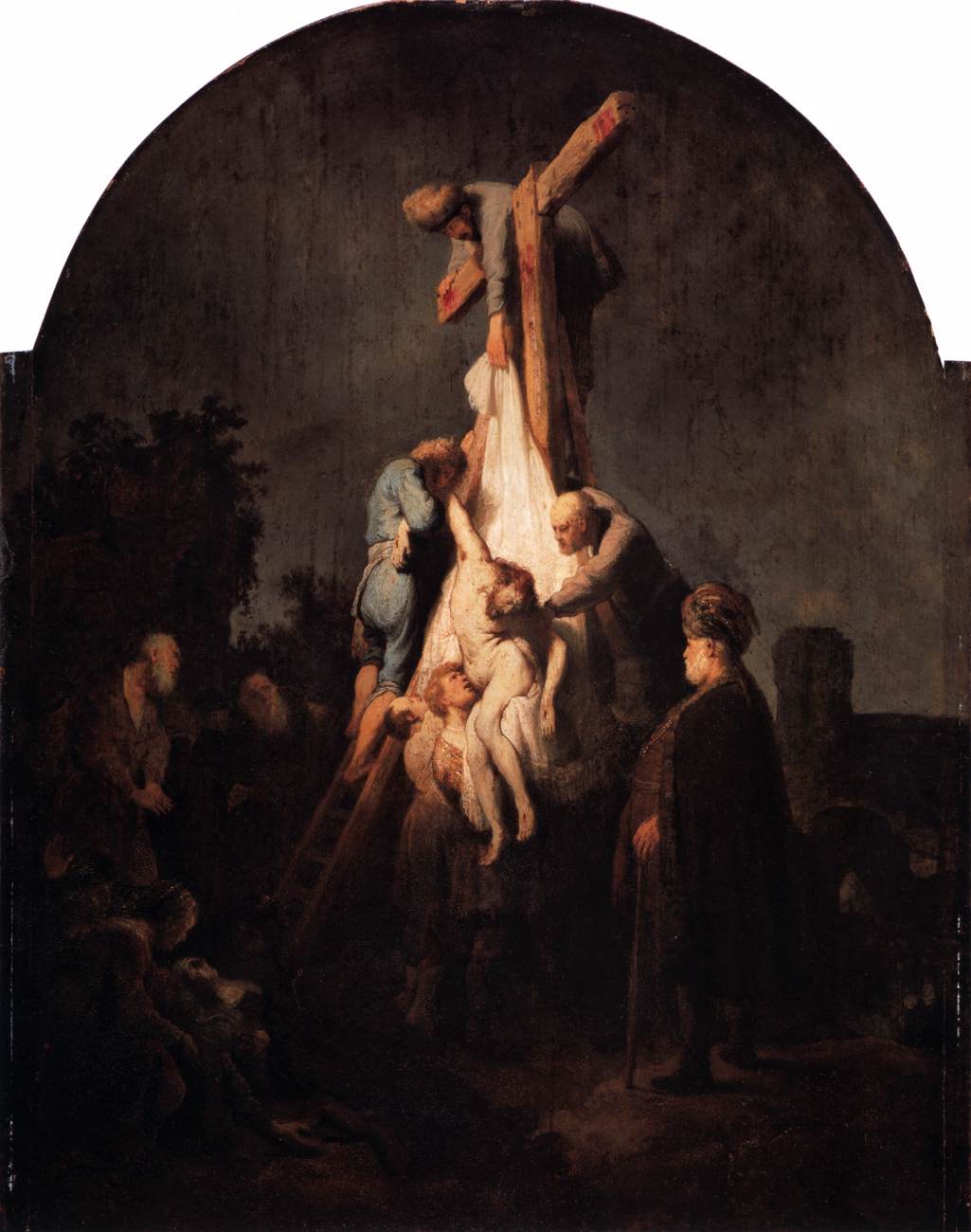
Rembrandt received a commission from the court in about 1628 through Constantijn Huygens, secretary to the Prince of Orange, for five paintings of the Passion of Christ. The series started with the Raising of the Cross and Descent from the Cross. He was hired to create small versions of Rubens famous altarpieces in Antwerp, the Raising of the Cross and the Descent from the Cross. Huygens asked Rembrandt to produce paintings less than one-twenty-fifth the size of the Rubenses. It must also have been agreed between Huygens and Rembrandt that the artist would inset himself into the composition of the Descent from the Cross as one of the followers of Christ who eased the body to the ground. Originally the Descent from the Cross was intended to be part of a triptych but finally it became one of the five paintings in this series.
http://www.wga.hu/html_m/r/rembrand/12passio/02passio.html
http://www.wga.hu/html_m/r/rembrand/12passio/02passio.html
Edit history
Please sign in to view edit histories.
Recommendations
0 members have recommended this reply (displayed in chronological order):
46 replies
 = new reply since forum marked as read
Highlight:
NoneDon't highlight anything
5 newestHighlight 5 most recent replies
RecommendedHighlight replies with 5 or more recommendations
= new reply since forum marked as read
Highlight:
NoneDon't highlight anything
5 newestHighlight 5 most recent replies
RecommendedHighlight replies with 5 or more recommendations
= new reply since forum marked as read
Highlight:
NoneDon't highlight anything
5 newestHighlight 5 most recent replies
RecommendedHighlight replies with 5 or more recommendations
Ah, I see you are back for MORE of the Friday Afternoon Challenge! Today: Inspiration! [View all]
CTyankee
May 2013
OP
Sure is, but who was inspired by this mosaic and what did he paint as a result?
CTyankee
May 2013
#15
It made a huge impression on Klimt. A major impact in the world of art, IMO...
CTyankee
May 2013
#20
#2: Andrea Mantegna - Lamentation of Christ (aka Dead Christ or Lamentation over the Dead Christ)
pinboy3niner
May 2013
#26
Ah, thanks. Mantegna inspired The Dead Christ (1582) by Annibale Carracci.
pinboy3niner
May 2013
#29
#1 HINT: Inspired by a crucifix in a chapel for his later painting, this artist
CTyankee
May 2013
#28
#1 remains to be guessed. Another hint: This "school" was in a coastal section of France
CTyankee
May 2013
#33
#1 is The Crucifix of Trémalo, Pont-Aven, an anonymous wood sculpture that inspired Gaugin
pinboy3niner
May 2013
#35