Latest Breaking News
In reply to the discussion: Earliest known evidence of human fire-making dating back 400,000 years is discovered in the UK [View all]
eppur_se_muova
(40,751 posts)Pyrite is well known as "fool's gold" because the brassy-gold, shiny color of unweathered pyrite has fooled many people into imagining a "rich strike" that wasn't. Under optimum conditions it forms large, well-formed crystals which are popular with collectors, and found in any rock shop or rock/mineral/gem collectors' convention. In all my years of being an amateur rock collector starting in grade school, I never heard (or more oddly, never read) of pyrite's spark-making ability. It's not even mentioned in the Boy Scout Manual, or in anything I've ever read on camping ! It seems to have once been common knowledge, but once iron and/or steel became commonly available, pyrite fell into disuse and its abilities were largely forgotten, at least in common discourse. We even overlook the name "pyrite" being derived from Greek "πῦρ", or fire, which gives us all those words starting with 'pyro-' having to do with fire or heat -- as well as "pyre", the poet's favorite synonym for fire !

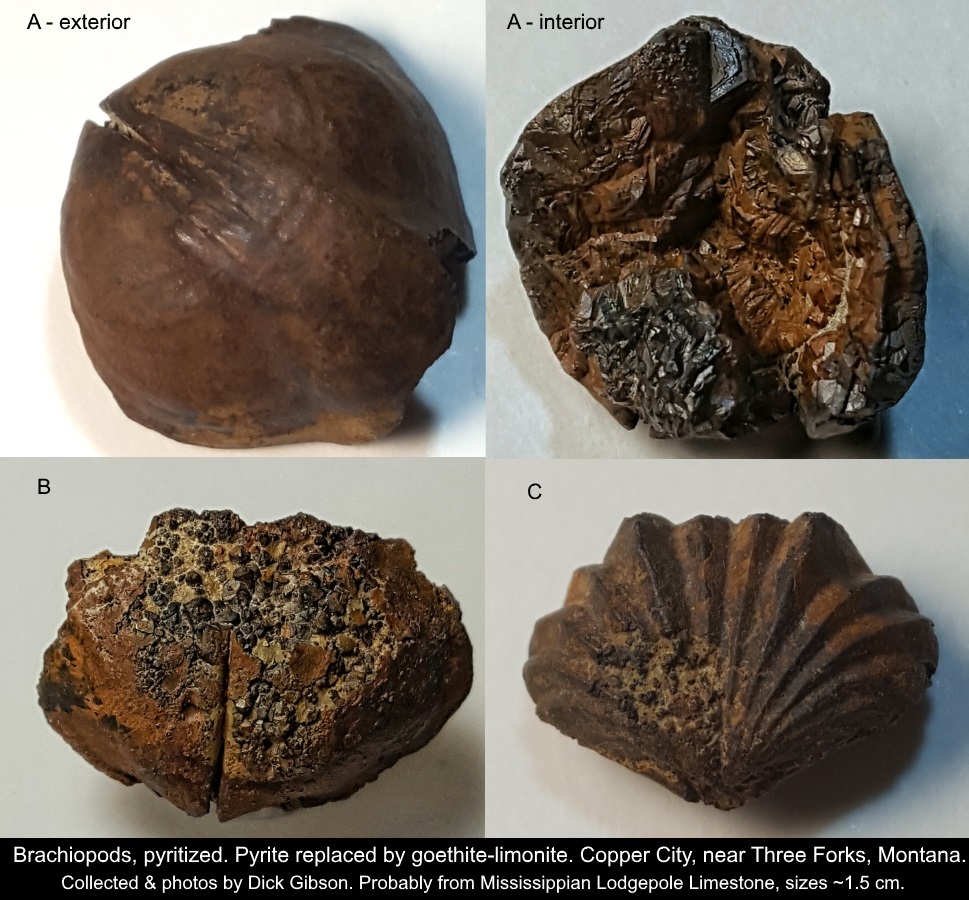
Pyrite has been made into jewelry since prehistoric times (still is), and flint (and its somewhat softer relative, chert) have been used since prehistoric times to make sharp tools and weapons. So it was probably pretty early in human existence, once humans began using and making tools and collecting shiny baubles, that someone -- maybe the very earliest of "someones" -- happened to strike flint and pyrite together and observed a hot spark*. All this has led me to realize that humans quite likely learned to make their own fire a very long time ago, and did not spend eons relying on "found fire" from lightning strikes and other natural sources of ignition, as has often been assumed. So the recent discovery has me thinking, to some extent, "of course", and wondering how many early human fire-starting nodules of pyrite have been overlooked due to weathering to rusty brown rocks or even breaking up altogether.
Weathered pyrite can be transformed completely into dark brown or reddish-brown iron oxide/hydroxide minerals, which are much less eye-catching:
*"Sometimes the hardest thing about making a discovery is recognizing that you have made a discovery." Although I have seen this attributed to Enrico Fermi, I cannot find a source.
Edit history
 = new reply since forum marked as read
Highlight:
NoneDon't highlight anything
5 newestHighlight 5 most recent replies
RecommendedHighlight replies with 5 or more recommendations
= new reply since forum marked as read
Highlight:
NoneDon't highlight anything
5 newestHighlight 5 most recent replies
RecommendedHighlight replies with 5 or more recommendations