Welcome to DU!
The truly grassroots left-of-center political community where regular people, not algorithms, drive the discussions and set the standards.
Join the community:
Create a free account
Support DU (and get rid of ads!):
Become a Star Member
Latest Breaking News
Editorials & Other Articles
General Discussion
The DU Lounge
All Forums
Issue Forums
Culture Forums
Alliance Forums
Region Forums
Support Forums
Help & Search
Environment & Energy
In reply to the discussion: (Independent) Fukushima probe to avoid assessing quake damage [View all]
kristopher
(29,798 posts)1. Additional background information on earthquake damage at plant
In the early days of the disaster a special panel to investigate the meltdowns was convened by Prime Minister Kan. This panel was composed of people from outside the nuclear industry with authority to conduct an investigation as they saw fit. They don't believe TEPCO whey TEPCO rules out the earthquake as the cause of the problems.
Panel doubts TEPCO claim tsunami caused nuke accident
December 06, 2011
By AKIRA SATO / Asahi Shimbun Weekly AERA
Not a few members of the government panel looking into the accident at the Fukushima No. 1 nuclear power plant are skeptical about Tokyo Electric Power Co. pointing the finger of blame at an unprecedented tsunami.
"The claim that tsunami alone caused the accident is nothing but a hypothesis," said panel member Hitoshi Yoshioka, vice president at Kyushu University, who has written a book about the social history of nuclear energy.
"I feel a majority of panel members feel this way. It is close to a common understanding that it would not be good to trust as is TEPCO's analysis that tsunami was the cause of the accident."
The conclusion reached by the panel could have ground-shaking ramifications for other nuclear power plants in Japan....
http://ajw.asahi.com/article/0311disaster/fukushima/AJ201112060052
December 06, 2011
By AKIRA SATO / Asahi Shimbun Weekly AERA
Not a few members of the government panel looking into the accident at the Fukushima No. 1 nuclear power plant are skeptical about Tokyo Electric Power Co. pointing the finger of blame at an unprecedented tsunami.
"The claim that tsunami alone caused the accident is nothing but a hypothesis," said panel member Hitoshi Yoshioka, vice president at Kyushu University, who has written a book about the social history of nuclear energy.
"I feel a majority of panel members feel this way. It is close to a common understanding that it would not be good to trust as is TEPCO's analysis that tsunami was the cause of the accident."
The conclusion reached by the panel could have ground-shaking ramifications for other nuclear power plants in Japan....
http://ajw.asahi.com/article/0311disaster/fukushima/AJ201112060052
Why is it important to both TEPCO and the strong pronuclear faction within the government and bureaucracy? Because this could have a profound effect on the ability of the country to resume use of their reactor fleet. They have 58 reactors and all but 8 are now idle (40) or closed permanently (10). The latest shutdown was caused by coolant leaking from a valve inside the containment vessel.
http://ajw.asahi.com/article/0311disaster/fukushima/AJ201112070075
TEPCO and the rest of the (global) nuclear industry have a strong selfish motive to promote the assumption that it was the tsunami. The earthquake that the plant experienced was far weaker than the 9.0 forces at its epicenter; in fact it was only a bit more than the reactors' design parameters.
If one of them failed as a result of quake forces it means that every reactor in Japan, and anywhere else that is in an earthquake zone must be viewed with a very critical eye. And since earthquakes are a lot more common than tsunami it means that the costs of upgrading safety and/or forced shutdowns stands to be enormous.
The table released by TEPCO comparing the earthquake's actual directional forces at the Fukushima #1 site to the reactor's design specs:
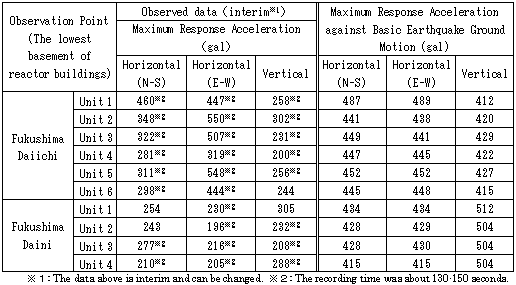
Glossary
· Observed Record of Earthquake Intensity
Record that indicates the intensity of an earthquake (Unit: gal)
· Regulatory Guide for Reviewing Seismic Design of Nuclear Power Reactor Facilities
Revised in September 2006 based on the newly accumulated knowledge on seismology and earthquake engineering and advanced technologies of seismic design, this is a regulatory guide in reviewing the validity of the seismic design of nuclear power reactor facilities.
· Basic Earthquake Ground Motion Ss
A basic earthquake ground motion in seismic design of facility, stipulated in Regulatory Guide for Reviewing Seismic Design of Nuclear Power Reactor Facilities
· Maximum Response Acceleration against Basic Earthquake Ground Motion Ss
Assuming Basic Earthquake Ground Motion Ss in the evaluation of the earthquake-proof safety, this is the Maximum value of the quake of a building, which is expressed in acceleration.
"Revised in September 2006 based on the newly accumulated knowledge on seismology and earthquake engineering and advanced technologies of seismic design, this is a regulatory guide in reviewing the validity of the seismic design of nuclear power reactor facilities."
http://www.tepco.co.jp/en/press/corp-com/release/11040103-e.html
Here is a first person narrative of what people on the scene observed, published in July.
...The authors have spoken to several workers at the plant who recite the same story: Serious damage to piping and at least one of the reactors before the tsunami hit. All have requested anonymity because they are still working at the plant or are connected with TEPCO. One worker, a maintenance engineer in his late twenties who was at the Fukushima complex on March 11, recalls hissing and leaking pipes. “I personally saw pipes that came apart and I assume that there were many more that had been broken throughout the plant. There’s no doubt that the earthquake did a lot of damage inside the plant," he said. "There were definitely leaking pipes, but we don’t know which pipes – that has to be investigated. I also saw that part of the wall of the turbine building for Unit 1 had come away. That crack might have affected the reactor.”
The reactor walls of the reactor are quite fragile, he notes. “If the walls are too rigid, they can crack under the slightest pressure from inside so they have to be breakable because if the pressure is kept inside and there is a buildup of pressure, it can damage the equipment inside the walls so it needs to be allowed to escape. It’s designed to give during a crisis, if not it could be worse – that might be shocking to others, but to us it’s common sense.”
A second worker, a technician in his late 30s, who was also on site at the time of the earthquake, narrated what happened. “It felt like the earthquake hit in two waves, the first impact was so intense you could see the building shaking, the pipes buckling, and within minutes, I saw pipes bursting. Some fell off the wall. Others snapped. I was pretty sure that some of the oxygen tanks stored on site had exploded but I didn’t see for myself. Someone yelled that we all needed to evacuate and I was good with that. But I was severely alarmed because as I was leaving I was told and I could see that several pipes had cracked open, including what I believe were cold water supply pipes. That would mean that coolant couldn’t get to the reactor core. If you can’t sufficiently get the coolant to the core, it melts down. You don’t have to have to be a nuclear scientist to figure that out.”
As he was heading to his car, he could see the walls of the reactor one building itself had already started to collapse. “There were holes in them. In the first few minutes, no one was thinking about a tsunami. We were thinking about survival.”
The reactor walls of the reactor are quite fragile, he notes. “If the walls are too rigid, they can crack under the slightest pressure from inside so they have to be breakable because if the pressure is kept inside and there is a buildup of pressure, it can damage the equipment inside the walls so it needs to be allowed to escape. It’s designed to give during a crisis, if not it could be worse – that might be shocking to others, but to us it’s common sense.”
A second worker, a technician in his late 30s, who was also on site at the time of the earthquake, narrated what happened. “It felt like the earthquake hit in two waves, the first impact was so intense you could see the building shaking, the pipes buckling, and within minutes, I saw pipes bursting. Some fell off the wall. Others snapped. I was pretty sure that some of the oxygen tanks stored on site had exploded but I didn’t see for myself. Someone yelled that we all needed to evacuate and I was good with that. But I was severely alarmed because as I was leaving I was told and I could see that several pipes had cracked open, including what I believe were cold water supply pipes. That would mean that coolant couldn’t get to the reactor core. If you can’t sufficiently get the coolant to the core, it melts down. You don’t have to have to be a nuclear scientist to figure that out.”
As he was heading to his car, he could see the walls of the reactor one building itself had already started to collapse. “There were holes in them. In the first few minutes, no one was thinking about a tsunami. We were thinking about survival.”
Meltdown: What Really Happened at Fukushima?
http://www.theatlanticwire.com/global/2011/07/meltdown-what-really-happened-fukushima/39541/
Edit history
Please sign in to view edit histories.
Recommendations
0 members have recommended this reply (displayed in chronological order):
9 replies
 = new reply since forum marked as read
Highlight:
NoneDon't highlight anything
5 newestHighlight 5 most recent replies
RecommendedHighlight replies with 5 or more recommendations
= new reply since forum marked as read
Highlight:
NoneDon't highlight anything
5 newestHighlight 5 most recent replies
RecommendedHighlight replies with 5 or more recommendations
= new reply since forum marked as read
Highlight:
NoneDon't highlight anything
5 newestHighlight 5 most recent replies
RecommendedHighlight replies with 5 or more recommendations