Environment & Energy
Showing Original Post only (View all)
We're SAVED!!! Jet fuel from cellulose. [View all]
The paper I'll discuss in this brief post is this one:
Production of Sustainable Aviation Fuel Precursor from Furanics Using High Surface Area Ordered Mesoporous Sulfonic Acid Functionalized Silica Bhushan S. Shrirame and Sunil K. Maity Industrial & Engineering Chemistry Research 2026 65 (6), 3094-3105
It's not clear if the stumble bum Orange Pedophile in the White House will ever get the Strait of Hormuz that he got shut reopened, about which I am personally ambivalent, since I oppose fossil fuels. I would personally prefer that they not be phased out by catastrophe that will fall mostly on poor people - Jeff Bezos, Trumper, can afford $50/gallon gasoline - but I don't have any control at all over the world.
It's too bad that fossil fuel supplies will be cut off to make hydrogen by steam reforming, since agriculture depends on the Haber-Bosch process to make ammonia from air and hydrogen, because if it were not for the coming famine because of the breakdown of the planetary atmosphere because the so called "renewable energy" scam soaked up vast sums of money for no result, since, wow, we could make jet fuel from cellulose according to this paper, if, and only if, we can grow crops, which we may not be able to do.
From the introductory text:
Biomass is a prominent energy source, following coal, oil, and natural gas. Annually, over 140 billion metric tons of biomass (dry) are produced globally, almost ten times the world’s energy consumption. (4) The inedible agricultural waste and forest residues are the most attractive lignocellulose biomasses in a biorefinery due to their low cost and abundance. Recently, the U.S. Department of Energy listed several biomass-derived chemicals that have the potential to replace petrochemicals, known as platform chemicals. Furfural and 5-hydroxymethyl furfural are the promising platform chemicals, retaining their place in the revised list. (6) The production of these platform chemicals from lignocellulose biomass encompasses three distinct steps: extraction of cellulose/hemicellulose, hydrolysis of cellulose/hemicellulose, and dehydration of monosaccharides to their respective furans. Besides derivative products, these furans also serve as starting materials for producing SAF-range (C8–C16) hydrocarbons. SAF manufacturing from these furans involves carbon–carbon coupling reactions with carbonyl compounds to obtain the SAF precursor of the desired carbon number. (7−9) The high molecular weight oxygenated precursor is then converted to SAF via hydrodeoxygenation (HDO). The furfural derived from low-value hemicellulose is an excellent furanic carbonyl compound for SAF production. On the other hand, 2-methylfuran (MeF), a selective hydrogenation derivative of furfural, is the most promising furan for C–C coupling via hydroxyalkylation–alkylation (HAA) reaction. In 2020, the International Energy Agency estimated global furfural production at 200,000 to 360,000 tons. (10,11) The furfural market was valued at USD 556.74 million in 2022 and is projected to reach USD 954 million by 2030. (12,13) In 2025, the MeF market was valued at USD 653.1 million and is expected to grow at a 4.6% compound annual growth rate. (14) The present work thus proposes producing SAF precursors from furfural and MeF
The original process for making furanic molecules, including furan itself, was developed by the Quaker Oats Company in the 1950s.
Here's the process:
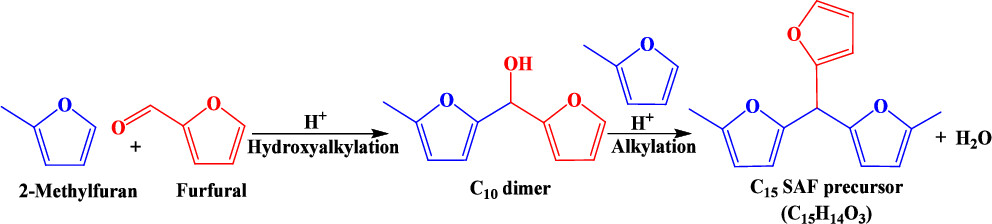
The caption:
The molecule on the left, methyl furan, is made by the hydrogenation of the next molecule on the left, furfural, which is itself made by the thermal decomposition of 5-hydroxymethyl furfural, which is made by acidic dehydration and heat from cellulose.
The catalyst, which replaces apparently, MoO3 supported on ZrO2 and an alternative, NbOPO4, is earth abundant silicon supporting an acid sulfate.
The reaction to make the jet fuel takes place at 523 K (around 250oC).
There's no information on where the heat for this reaction will come from, but of course, we can do like the Chinese do when they make hydrogen, burn coal, and hire dishonest idiots to run around and say the hydrogen comes from so called "renewable energy." There's also no information on the farm machinery to collect the biomass, transport to the chemical plant, heat it in sulfuric acid to make furans, and then hydrogenate some of it, and heat the furan derivatives to make "sustainable" jet fuel.
We're saved. If you're planning on flying to Paris to see the Mona Lisa, don't worry, be happy. "Sustainable" biobased jet fuels are just around the corner.
Have a pleasant Sunday.
 = new reply since forum marked as read
Highlight:
NoneDon't highlight anything
5 newestHighlight 5 most recent replies
= new reply since forum marked as read
Highlight:
NoneDon't highlight anything
5 newestHighlight 5 most recent replies