NNadir
NNadir's JournalI didn't know that Ralph Towner died.
He was a major player in my emotional life; I saw him in concert many times, often when he toured with the late John Abercrombie, but with many other musicians in various incarnations, including the band Oregon.
There was a certain night, very sad for me as I saw it at the time, a long time ago in San Diego, long before I met my future wife, this piece went right through me.
It turned out to be for the best, but I didn't know it then. I'm an atheist but I always liked this quote from Jean Ingelow: "I have lived to thank God that all my prayers have not been answered."
Anyway:
Ralph Towner
Damn! It appears that seeing this movie will not fit into my schedule.
L'EtrangerI have always been a huge fan of Camus since discovering him.
I worked very hard, given the limitations of my French, to translate this passage from La Peste, and am proud of what came out:
On dira sans doute que cela n'est pas particulier à notre ville et qu'en somme tous nos contemporains sont ainsi. Sans doute, rien n'est plus naturel, aujourd'hui, que de voir des gens travailler du matin au soir et choisir ensuite de perdre aux cartes, au café, et en bavardages, le temps qui leur reste pour vivre. Mais il est des villes et des pays où les gens ont, de temps en temps, le soupçon d'autre chose. En général, cela ne change pas leur vie. Seulement il y a eu le soupçon et c'est toujours cela de gagné. Oran, au contraire, est apparemment une ville sans soupçons, c'est-à-dire une ville tout à fait moderne. Il n'est pas nécessaire, en conséquence, de préciser la façon dont on s'aime chez [15] nous. Les hommes et les femmes, ou bien se dévorent rapidement dans ce qu'on appelle l'acte d'amour, ou bien s'engagent dans une longue habitude à deux. Entre ces extrêmes, il n'y a pas souvent de milieu. Cela non plus n'est pas original. À Oran comme ailleurs, faute de temps et de réflexion, on est bien obligé de s'aimer sans le savoir.
I'm - justifiably or not - proud of my translation of this passage, which strikes me as all too real:
One will be compelled to say that this is not particular to our city; many of our contemporaries are this way. Without a doubt, nothing is more natural, to see people working from morning to night and then, afterwards, squandering, on cards, in coffee shops, on gossip, the time they have left to live. Yet there are cities where there are people for whom, from time to time, there is a glimmer of other things. In general this doesn’t change their lives. There is only this glimmer, and this is what always triumphs. Oran, by contrast, is a city without such glimmers, that is to say, it is a totally modern city. It is not necessary therefore to specify how we love at home. The men and the women either rapidly devour one another very quickly in what is called an act of love, or they engage in long lives as a couple. Between these extremes, there is often no middle. Neither is this unique. In Oran, as elsewhere, we are compelled, for a lack of time and reflection, to love one another without even knowing it.
...to love one another without even knowing it...
The point in history Camus, a Pied-Noire in Algeria, represents, for me, a kind of essential record of the dying Imperial age, and on a deeper level, the agony of indifference to what life itself actually is, with, in the case of L'Etranger, an underbelly of the contempt associated with racism and sexism that so characterize our more recent, modern times.
La Peste, which I set out to translate during the Covid crisis, not ever coming close to finishing it, as the end of my life approaches, strikes me on a deeper level, even if, in the book, the character of Bernard Rieux, the doctor, was a relatively young man, albeit one involved in facing mortality. His touching bare bones description separation from his wife, who is leaving for a health sanitorium to recover (from tuberculosis? He doesn't say) moves me.
As for L'Estranger:
L'Estranger was the first Camus novel I ever read, in my early 20s, in an English translation. (I have come to recognize how translation can murder a literary work. My own effort at translations is not without that difficulty.)
I've read that the film is very good, very faithful to the novel but not without the signature of our modern times.
Unfortunately the showings do not fit into my schedule, and I don't know when there will be a showing somewhere that will.
Metrobus cancellations after hydrogen bus fire in Crawley
This sort of thing is increasingly common when these expensive things for the purpose of greenwashing and marketing fossil fuels are purchased and put into service for a year or two until reality strikes.
Metrobus cancellations after hydrogen bus fire in Crawley
Metrobus passengers have reported multiple cancelled buses and having to wait for up to an hour, after a fleet of 42 hydrogen-powered buses were removed from service when one caught fire on December 2, 2025.
Passengers have taken to social media to criticise the delays.
Theresa Spence said: "I had to wait for nearly an hour, in minus six degree temperatures, for a number 20. Other people at the bus stop were waiting over an hour for a number 10.
"When a bus did come through, it was full."
Lauren Keen added: "It’s beyond a joke when people are late for work or kids are late for school.
"Sometimes the bus is too packed so people are rejected to get on..."
The article describes these disasters as "zero emission," which is bullshit, because in Great Britain as is the case everywhere, hydrogen is overwhelmingly made by the steam reformation of dangerous fossil fuels, usually methane but sometimes coal, especially in China.
We cannot expect journalists to know science; my regular joke is that one cannot get a degree in journalism if one has passed a college level science course with a grade of C or better.
The scientific illiteracy of journalists, along with the bait and switch advertising of fossil fuel companies (here and elsewhere) of hydrogen as "green" is responsible for the popularity in the general public of these expensive and dangerous devices, most of which are written off as a loss as reality sets in.
It turns out there is an analytical reason we will not get a weekly data point at Mauna Loa for the 2nd time in half...
...a century. The last time was because of, I believe, the orange pedophile's shut down a few weeks back.
The data is being rejected because of a precision issue, probably an instrumental effect and not an effect of atmospheric instability.
The graphic of daily hourly readings demonstrates the problem:
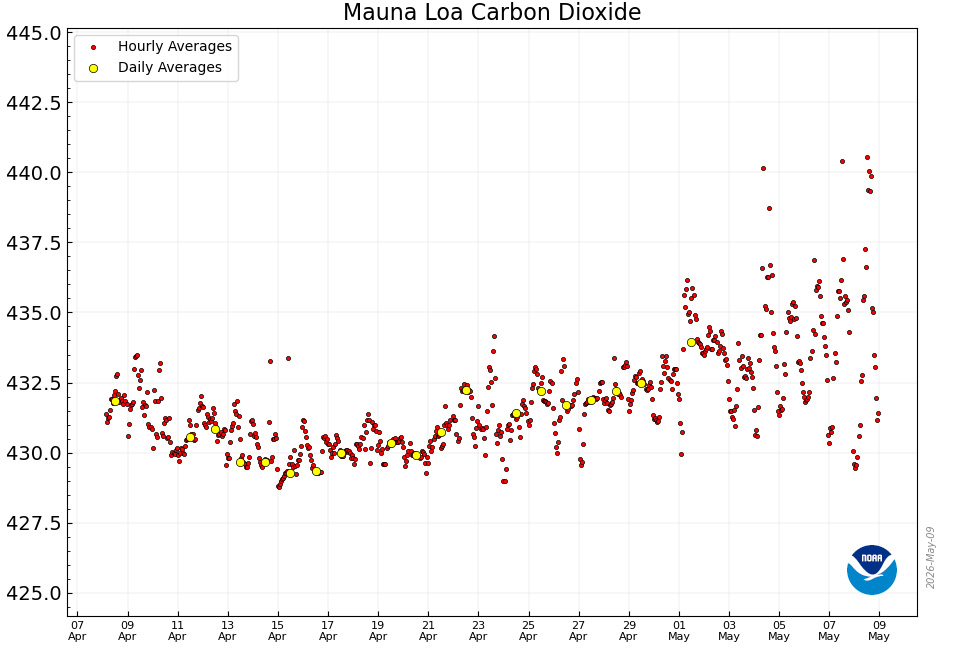
Recent Daily Average Mauna Loa CO2
This may be a result of a lack of money to maintain the instrument or a lack of qualified service engineers, I don't know.
It couldn't happen at a worse time, as we are surely approaching the annual maximum.
Oh no. They're writing about Epstein in Scientific Journals!
(Trust me, I can argue this post is appropriate for the Lounge.)
I came across this paper this morning:
From Paradox to Practice: A Review on Production Strategies, Stability Mechanisms, and Theoretical Insights of Bulk Nanobubbles Ananda J. Jadhav and Aniruddha Bhalchandra Pandit Industrial & Engineering Chemistry Research 2026 65 (13), 6725-6763
From the text:
Let me tell you from experience, it sucks when you have a very common last name. It's why we chose to give my sons my wife's beautiful rare last name of Italian origin, even if everyone pronounces it wrong and even if they're easy, unlike me, to find them (or stalk them) on the internet where happily, they have positive profiles.
With a common name, the same jokes, year after year, decade after decade, you're expected to laugh, even if you've heard it a zillion times. I try to be gracious about it, sometimes it's difficult.
The Epstein-Plesset model was first published in 1950, by "P.S. Epstein" at the California Institute of Technology.
J. Chem. Phys. 18, 1505–1509 (1950)
I don't know anything about P.S. Epstein, but he or she wrote a long time ago, 76 years ago, and presumably he or she didn't live long enough to hear even worse jokes than the ones I hear because the name "Epstein," unlike my name, has become a pejorative. The famous people associated with my name - there are many - were all admired in general social culture, albeit in a sometimes goofy way.
Um, delicious!!! Recovery of Highly Toxic Tellurium Used for Super Efficient Solar Cells.
The paper I'll discuss briefly in this post is this one: Adsorption and Recovery of Tellurium from Aqueous Solutions Using Calcined Mg–Al Layered Double Hydroxide Adsorbent Umama Rashid Lamiya, David J. Shoemaker, Xiaobo Lei, Samia Alam, William E. Holmes, Jonathan Raush, Mark E. Zappi, and Daniel Dianchen Gang Industrial & Engineering Chemistry Research 2026 65 (11), 6196-6208.
I won't have much time to spend on this paper, but I thought some excerpts would be in order, since, as we have antinukes around here in praise of lead based perovskites for solar cells, being indifferent to issues in the toxicology of distributed pollutants, maybe we can add affection for tellurium to it.
From the introductory text:'
I added the bold for commentary. First off, the element is rarer than platinum, gold and silver. It's a good thing that the solar industry is trivial and useless form of energy, because if it weren't, and were to depend on an element rarer than these elements, well, one can draw one's conclusions about cost.
Of course, platinum, gold and silver are not toxic; they are inert elements, but we'll turn to that below. Cadmium, selenium, arsenic, indium and tellurium are not; they are all toxic, very toxic.
Even though the text, rare for the solar scam, uses a unit of energy, in this case the gigawatt-hour to describe solar energy - rare since most of the liars representing this junk as "green" use units of power (Watts) as if solar cells ever reached their peak power for more than a few minutes in a 24 hour period (this is rare) the comparison with coal is nonsense. Coal is the dirtiest of all energy sources, but the reason it remains a major source of primary energy is that it is reliable, something solar energy is not and never will be, owing to a widely reported phenomenon known as "night." Decades of toxic battery and idiotic hydrogen bullshit have not addressed this flaw, and never will.
The only form of primary energy that is more reliable than coal is nuclear energy. As I pointed out recently, the top 30 most reliable large scale power plants in the United States are all nuclear plants, the next most reliable plants are generally coal plants:
Sorted by capacity utilization, a list of the largest power plants in the United States.
Solar and wind plants are notoriously unreliable, which is why the cost of solar and wind energy - often misrepresented as "cheap" - is actually responsible for high electricity rates once the requirement for redundant plants is included, the LFSCOE as opposed to LCOE, the latter as inherently dishonest as the view that a Watt is the same as a Joule.
The only form of energy that is more reliable than coal is nuclear energy, which advocates of solar energy hate, having no interest whatsoever in the use of fossil fuels, about which they couldn't care less.
There is no "revolutionary change" connected with solar PV energy. It is a trivial form of energy; after the expenditure of trillion dollar sums on it, as of 2024, it produced just 9 Exajoules out of the 2024 worldwide energy demand of 654 Exajoules, actually growing by 1 Exajoule over 2023, slower than the growth of coal, gas and petroleum, about which, again, antinukes couldn't care less.
Both cadmium and tellurium are toxic elements, a point the paper makes with respect to tellurium:
If ingested, tellurium can accumulate in the kidney, bone, heart, lungs, and spleen, potentially leading to irreversible degenerative effects on these organs. (23) In nature, Te can be present in several forms, including tellurate (TeO42–, Te(VI)), tellurite (TeO32–, Te(IV)), elemental tellurium (Te0), organic dimethyl telluride (CH3TeCH3), and inorganic telluride (Te2–). (24) Among these, tellurium oxyanions pose significant toxicity, while tellurite shows nearly ten times the toxicity of tellurate. (25) To control Te contamination in the environment and meet the worldwide increasing demand for Te as a renewable energy resource for achieving the clean energy goal, it is crucial to develop economic and sustainable tellurium recovery methods.
Oh well then.
Tellurium is, I confess, a fission product. Roughly, over more than 70 years, about 80,000 tons of used nuclear fuel has been collected in the United States, still, for the next two years until China over takes it, the world's largest producer of nuclear energy. Of this, ignoring the zirconium cladding, about 95% represents unreacted uranium available for recovery and reuse, and about 1-2% is plutonium with traces of the higher actinides americium and curium, as well as traces of the lower actinide neptunium. Of the remaining fission products 3 to 4%, tellurium represents 1% meaning that all of the tellurium in valuable used nuclear fuel is at maximum, 80,000 X 0.04 X 0.01 = 32 tons, considerably shy of 78 million tons of solar waste. All of the radioactive isotopes of tellurium found in used nuclear fuel have short half-lives and tellurium isolated from used nuclear fuel a decade or so old will be perfectly suitable for use in say, thermoelectric devices localized in industrial settings, although I wouldn't recommend it as a consumer item.
The authors continue:
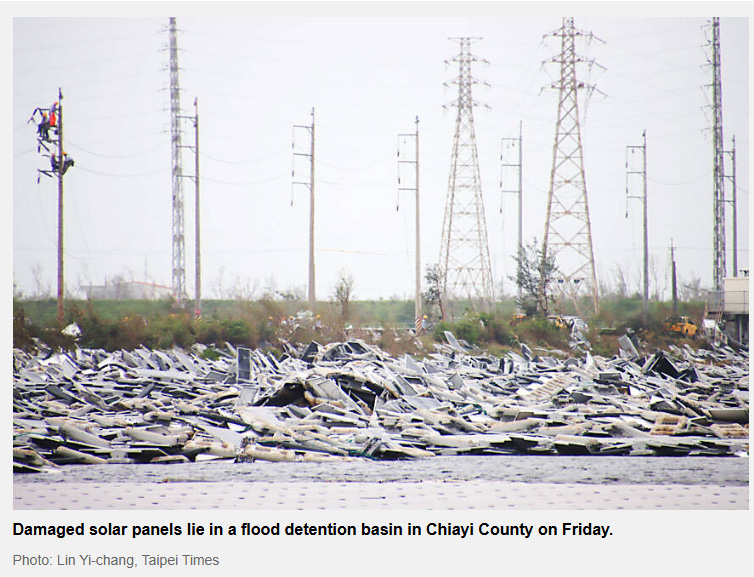
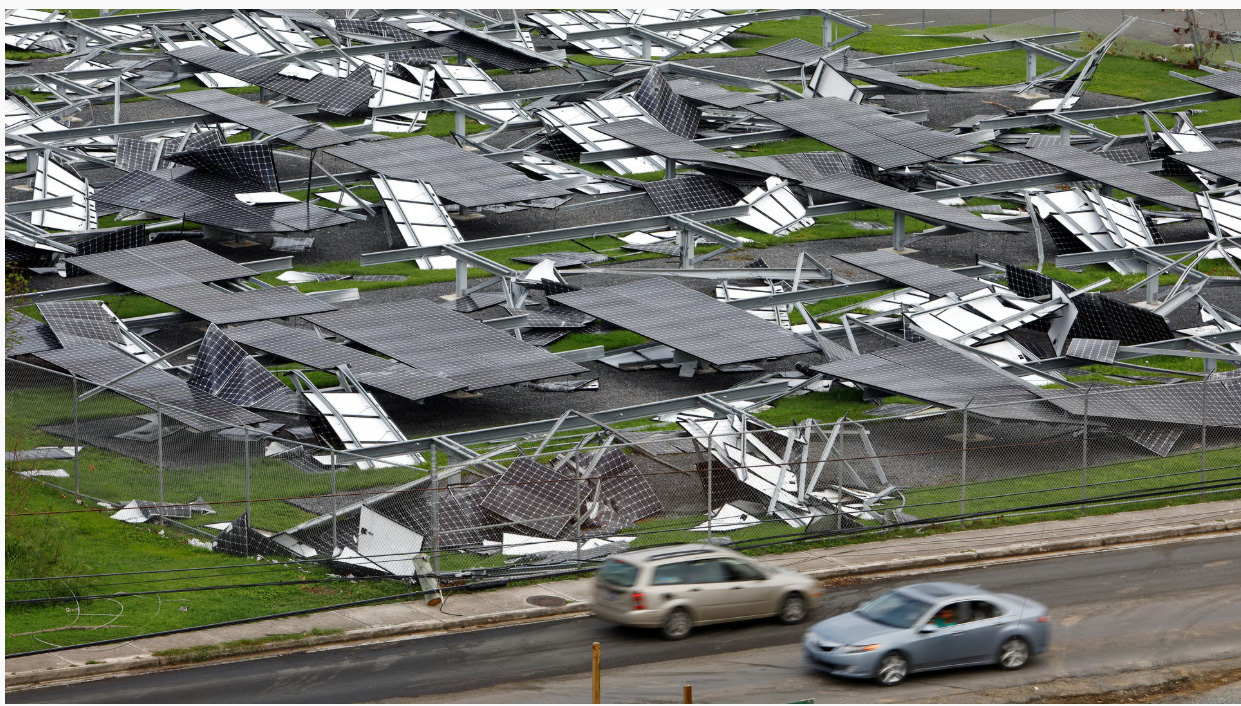
Don't worry, be happy. There are plenty of people around here to tell you that solar energy is "green" and that we should tear the shit out of vast tracts of wilderness to make industrial plants that will be electronic waste is about 25 years, assuming that stuff like this doesn't happen:
From Inside Climate News:
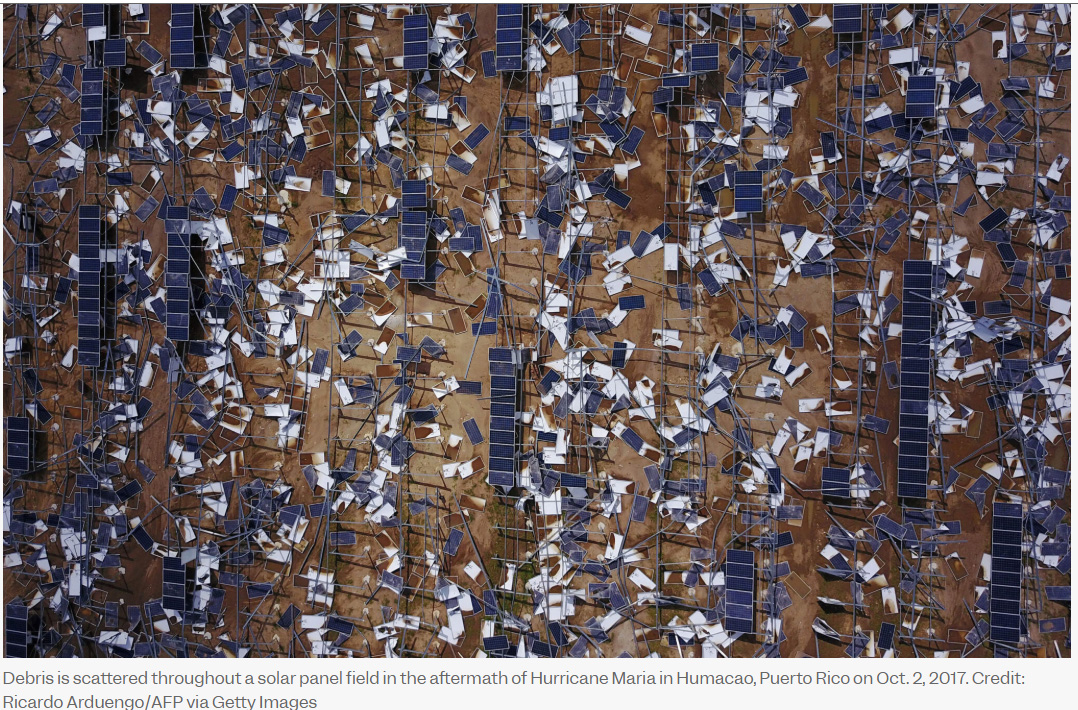
Virgin Group Company BMR Energy Announces Plans to Rebuild St. Thomas Solar Farm
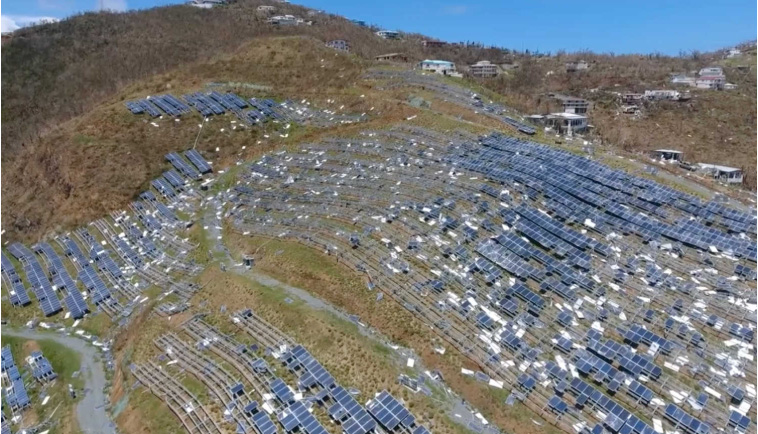
Renew Economy:
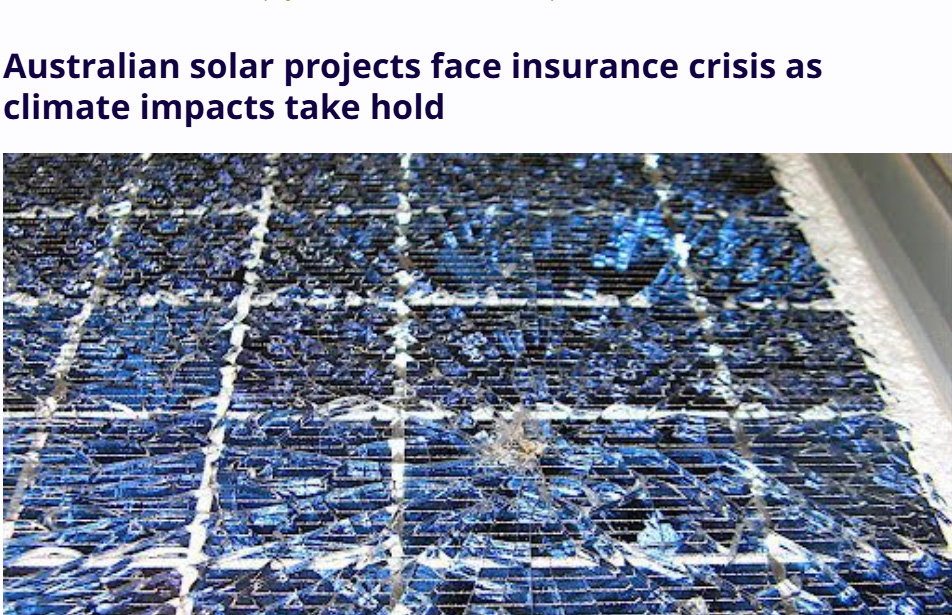
Solar groups deny damage, pollution claims after Danas
(There's reference to denial again.)
Why the solar revolution is in grave danger—and how it can be saved
Um, delicious.
Have a nice weekend.
Thank you for recognizing my position on energy.
Your remarks about my personality reflect a filter. I definitely hold a less than generous view of people whose scientific ignorance, of say, the second law of thermodynamics, for one example, which underlies the battery and hydrogen based fossil fuel greenwashing that goes on around here, the implications of mass to energy ratios for another.
At the end of my life I am certainly selective on my social relationships, who I value and those who I hold in a range between distaste and outright contempt.
Where one falls in that range is a function of the level of hypocrisy for one thing. We are all hypocrites to some extent. I am. I drive a hybrid car that gets excellent gas mileage for instance, but I am aware of the enormous moral cost of batteries, the human slaves who labor under horrific conditions to mine cobalt for batteries, the the general unsustainablily of the car CULTure in general. The car requires fossil fuels to run, and even if it has the lowest carbon intensity of any car on the PJM grid, it is still a dirty device.
My environmental views have always been guided by respect for wilderness. I have never had an ounce of respect, none, for people who look at wilderness and see an opportunity for land development for short lived industrial energy plants strewn across millions of square kilometers, trashed riverine and riparian zones. I also consider the oceans to be a valuable wilderness. For another example, I am aware of the carbon retention of the desert ecosystem's root matrices that all of our antinukes think should be rendered with bulldozing into solar industrial parks.
Thus I have even less respect for clowns crying crocodile tears for climate issues while applauding the destruction not only of benthic zones on continental shelves, but also the upper oceanic layers of water as proposed in this latest example of rotely applauded nonsense. Whence the wire to connect this shit? Whence the metal to make it?
I have spent most of my life in science. In my private life I more or less live and breathe it. I don't have a "few friends" who are scientists. Almost everyone I know in my professional life is a scientist. Not all of them are nice people, nor do they need to be nice people to do good science.
They only needed to do good science to be good scientists.
None other than Issac Newton, for example, was an asshole on a personal level. He took personal pleasure in signing death warrants of counterfeiters in his honorary role as Warden of the Mint. Albert Einstein was a terrible psychologically abusive husband to his first wife, who was a good scientist herself.
One can take a certain level of satisfaction in who doesn't like oneself. I do, right here at DU.
My views on energy have been formulated outside of my professional life, and are based on tens of thousands of hours over close to 40 years of work in the primary scientific literature, attendance at high level scientific meetings and lectures and personal reflections calculations and discussions. If there are dilletants with superficial knowledge whining and crying that they don't like me, who drool with disrespect for my efforts while musing illiterately that we should tear the shit out of the planet's seas and land for short term bourgeois unsustainable affectations related to so called "renewable energy," this will in no way offend me.
Nor does it dissuade me from my profound admiration for the work of the finest minds of the 20th century, who discovered nuclear energy, a tool with the potential, with all its risks understood, to save the world, only to have their work trashed and demeaned by intellectual Lilliputians.
I have no apologies for what I do here, nor my scientific knowledge nor my choices about whom I chose to respect or decline to respect. In turn, I am unmoved by those who hold me in barely disguised contempt, and again, can indeed take some satisfaction, indeed pleasure, from it.
No one in the antinuke cults should hold their breaths expecting me to apologize for my personality. They'll die faster than the planet they've done do much to kill.
Have a nice day.
A Discussion, Written Before the War, of the Properties of Ukrainian Used Nuclear Fuel in a Russian Journal.
I've been writing some ideas down for my son to exploit the energy value of the higher transplutonium actinides and I came across this paper which I was sourcing to understand the neutron fluxes from spontaneous fission in a system I'm envisioning that I'd like to share with him before I die.
It's this one: Zalyubovskii, I.I., Pismenetskii, S.A., Rudychev, V.G. et al. External radiation of a container used for dry storage of spent VVER-1000 nuclear fuel from the Zaporozhie nuclear power plant. Atomic Energy 109, 396–403 (2011). The paper was translated from Russian as described in this note:
So I'm reading along happily to provide a reference, and suddenly I realized that one of the authors was writing the reactor in question from which the used fuel was obtained (a Russian VVER) that's been in the news because of concerns it would be shelled by the Russians. It's the Zaporozhie Nuclear Power Plant, Energodar, Ukraine. The authors of the paper are Ukrainian, not Russian.
I didn't notice, I was so caught up in the technical issues.
Ukraine has a strong commitment to nuclear energy, but all of the reactors therein, including the closed Chornobyl RBMKs are of Russian design. (The modern VVER, the latest edition, irrespective of the criminality of the Putin regime, is a beautiful high quality reactor being exported around the world. I'm not sure entirely which version of the VVER the Zaporozhie reactor is.) The Ukrainian commitment to nuclear energy is even stronger to eliminate the need to buy gas from the Russian enemy. (The Ukrainians are certainly not like the Germans. They wish to do away with fossil fuels, not nuclear.)
The abstract is as follows:
It turns out that the measured radiation flux is lower than the calculated value.
In any case, it does seem that the dry storage containers emit more radiation than Western dry casks do, at least from a cursory expectation on my part.
I actually think, the safety implications aside, there is value in irradiating air, since doing so eliminates some very problematic greenhouse gases, the famous (and still present) CFC's, as well as HFC's, N2O and SF6. I hope to hand off some approaches to this to my son before I kick off. If it were up to me, I would encourage the irradiation of the air and I do encourage the irradiation of the air; many of my ideas at the end of my life focus on ways to do this.
In any case, it's very sad that this fine reactor has been placed in a war zone; the war sucks.
Operando Monitoring of Plutonium on Ion Exchange Columns Using UV/Vis/NIR Spectroscopy.
The paper to which I'll briefly refer is this one: UV–Vis–NIR Reflectance Spectroscopy and Chemometrics for Monitoring Pu Directly on an Ion Exchange Column Luke R. Sadergaski, Jeffrey D. Einkauf, Hunter B. Andrews, Laetitia H. Delmau, and Jonathan D. Burns Industrial & Engineering Chemistry Research 2026 65 (9), 4673-4680.
I am not dissuaded that the element plutonium, named after a planet that has been declared not to be a planet, is the key to saving this planet. Via conversion to plutonium, we, in theory, could close down every energy mine, including fossil fuel mines, on the planet for centuries, by converting the huge inventory of already mined and isolated 238U to plutonium via the fast neutron spectrum. We could also work to heal the vast destruction of wilderness associated with the so called "renewable energy" scam, and work to restore the land destroyed by these land intensive industrial facilities.
The current industrial procedure for the isolation of plutonium, which is present in used nuclear fuel, depending on "burn-up" (which could be compared to gas mileage on a car) to the extent between 1% - 2%, is the PUREX process, a solvent extraction process which relies on a biphasic mixture of hydrophobic solvents and aqueous solvents. This is not my favorite process; it works fine but is rather problematic in many ways, since the solvents need to be cleaned up, and some of them are petroleum byproducts, kerosene being one example. It is possible to make kerosene from carbon dioxide and nuclear hydrogen using the FT process that Jimmy Carter was fond of while trying to scare OPEC, but my feeling is "Why bother?"
I favor the fluoride volatility process which relies on distillation of volatile metal fluorides which the actinides uranium, neptunium and plutonium form, as do many of the valuable fission products that we need to recover in order to save what is left to save of the world.
Nevertheless, nobody cares what I think, and as result, the aqueous nitric acid solutions resulting from the Purex process are likely be present. Industrial scale ion exchange resins exist, and this paper offers an approach to removing and recovering residual trace plutonium from aqueous nitric acid.
From the paper, out of the Oak Ridge National Lab:
Anion exchange columns are widely used for purifying Pu and rely on the speciation behavior of Pu(IV) in HNO3. (12,13) In dilute HNO3, Pu(IV) predominantly exists as an aquo complex, but as the acid concentration increases, nitrate ligands increasingly coordinate with the Pu(IV) center to form various nitrato complexes. In concentrated HNO3, Pu(IV) forms complexes with nitrate ions to yield anionic species such as Pu(NO3)62–, which interact strongly with the positively charged sites on the resin and allow Pu to be retained while other noncomplexed or positively charged contaminants pass through. (14) The sorbed Pu can subsequently be eluted in dilute HNO3, effectively separating the Pu from fission products and other actinides such as U(VI). (9,15) The efficacy of these anion exchange columns to purify Pu depends on maintaining the proper acid conditions. Techniques such as UV–vis–NIR absorption spectroscopy, which is often combined with multivariate analysis, can detect electronic transitions associated with different Pu(IV) species to provide insights into their relative populations and monitor Pu in process analytical applications. (16−20)
To better understand Pu(IV) speciation on an anion exchange column and improve in situ monitoring capabilities, we introduce a fiber-optic UV–vis–NIR reflectance spectroscopic method that enables direct, in situ measurements on a glass column during Pu(IV) loading and elution. This approach integrates spectroscopic monitoring directly into the column environment to provide continuous insight into chemical changes as they occur. Reflectance spectroscopy measures a material’s absorption properties from the light reflected off its surface; thus, this technique offers a noninvasive method to probe the column interior without disrupting the separation process. (20−23)
In this article, we demonstrate the ability to monitor an ion exchange column directly with a reflection probe and identify unique Pu(IV) species on the resin before elution. The absorption spectra acquired on the anion exchange column are compared with solution analogs over a range of HNO3 concentrations from 0.5 to 13 M...
I'm not going to spend a lot of time going over the statistical principal component analysis (PCA), a statistical means of transforming the vector of multivariate inputs (in this case the three spectral wavelengths) to address the data analysis.
A picture of the apparatus used can be found in the paper, which gives a feel for the apparatus. For the experiments in question, 240Pu was used, which has a fairly high critical mass; the issue of criticality would need to be addressed on a larger scale approach using this technology, but I wouldn't suggest it to be applicable on an industrial scale.
The apparatus in the lab:
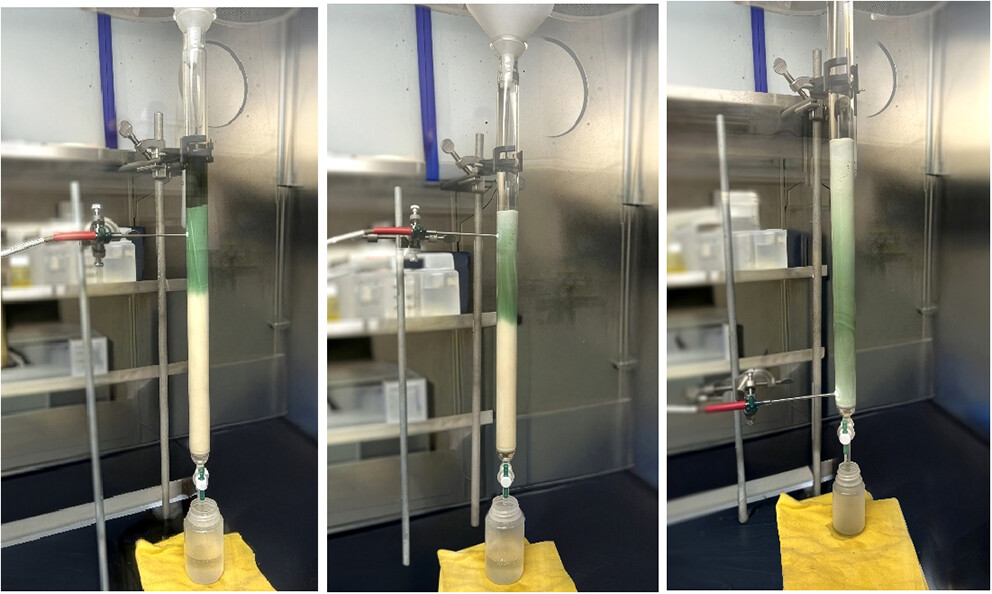
The caption:
Because of the many available electronic transitions among the rich array of orbitals available in this heavy f element, plutonium complexes and salts are generally highly colored. The nitrate complex here is green.
Here is the spectra across the range evaluated of the complexes at different acid strength:
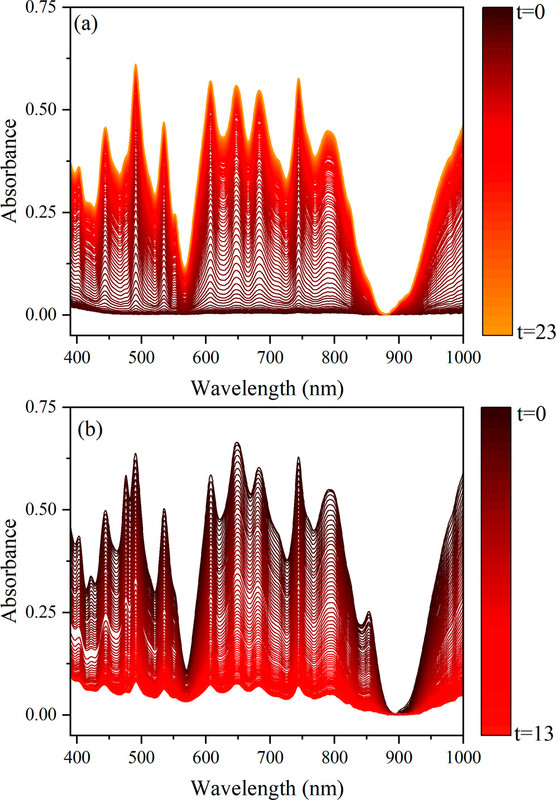
The caption:
From the paper's conclusion:
The ability to probe chemical changes directly on a glass column surface offers significant advantages over traditional effluent-based flow cell approaches. In situ spectral data reveal spatial gradients, resin saturation behavior, and breakthrough dynamics. The fiber-compatible design supports deployment in remote systems, making it well-suited for challenging environments such as radiochemical separations and nuclear process monitoring. In dynamic systems in which the scores trajectory follows a consistent pattern through processing conditions, deviations from the expected trajectory could be used as early indicators of process shifts, making the method useful for real-time monitoring and prediction...
Again, clean plutonium separations are critical to the survival of what is left of the environment, and this paper, while esoteric, is a contributor to making sure that is done cleanly and in a sustainable fashion.
An interesting paper.
Have a nice evening.
New Weekly CO2 Concentration Record Set at the Mauna Loa Observatory, 432.44 ppm
As I've indicated repeatedly in my DU writings, somewhat obsessively I keep spreadsheets of the of the daily, weekly, monthly and annual data at the Mauna Loa Carbon Dioxide Observatory, which I use to do calculations to record the dying of our atmosphere, a triumph of fear, dogma and ignorance that did not have to be, but nonetheless is, a fact.
Facts matter.
When writing these depressing repeating posts about new records being set, reminiscent, over the years, to the ticking of a clock at a deathwatch, I often repeat some of the language from a previous post on this awful series, as I am doing here with some modifications now. It saves time.
The most recent post (not my last on this topic, assuming I live through this year) reflecting updating this last year is below.
The readings are, as of this morning as follows:
Week beginning on April 26, 2026: 432.44 ppm
Weekly value from 1 year ago: 430.29 ppm
Weekly value from 10 years ago: 407.86 ppm
Last updated: May 03, 2026
Weekly average CO2 at Mauna Loa
This is the new all time highest record, 432.44 superseding , 431.73 ppm, set a few weeks ago:
New Weekly CO2 Concentration Record Set at the Mauna Loa Observatory, 431.87 ppm, as I noted in a similar post on April 12th.
As I always remark in this series of posts, if one looks, one can see that the rate of accumulation recorded at the Mauna Loa CO2 Observatory is a sine wave superimposed on a roughly quadratic axis:
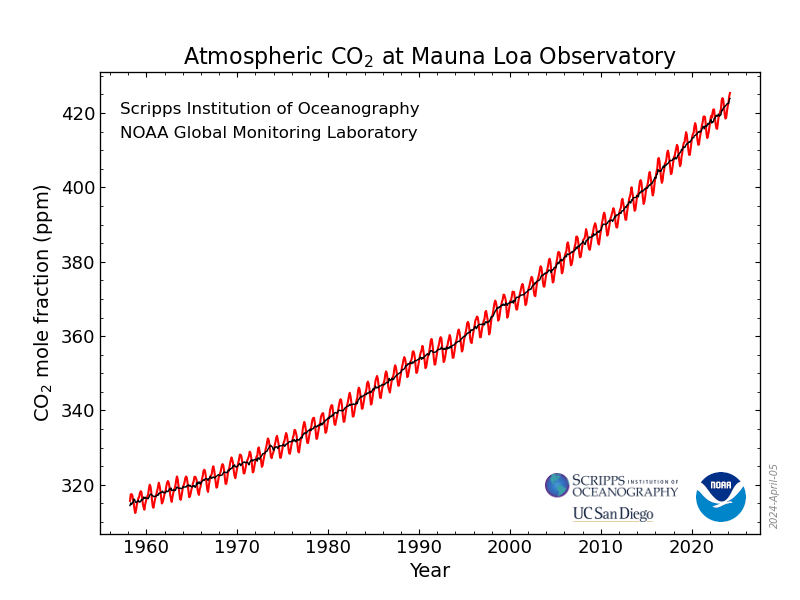
Monthly Average Mauna Loa CO2
We should always expect the final "all time record" in late April or in May, whereupon the concentrations will decrease until late September or October; this one which may not be the last for the year, is in May.
Weekly average CO2 at Mauna Loa
In 2025, the then highest value ever recorded 430.83 ppm took place in the week beginning May 5, 2025, and fell thereafter. In 2024, the then highest value ever recorded 427.94 ppm took place in the week beginning April 21, 2024, and fell thereafter. In 2023, the then highest value ever recorded 424.64 ppm took place in the week beginning May 28, 2023, and fell thereafter. In 2022, the then highest value ever recorded 421.63 ppm took place in the week beginning May 29, 2022, and fell thereafter and so on.
If we focus on the week to week comparators over a ten year period the situation is even more dire.
All but one of the top 50 ten year week to week comparators have taken place since 2024. The one that didn’t occurred in 2021. However this week is not in the top 50.
As it happens - I consider it statistical noise - 2026 has started out as a rather mild year for new accumulations of the dangerous fossil fuel waste carbon dioxide in the planetary atmosphere, when viewed as week to week comparisons with the same week of 2025. Only three weeks in 2026 have seen an increase over 3.00 ppm over that of 2025, that of week 8, the week beginning February 22, 2026, when the increase over week 8 of 2025 was 3.04 ppm, and week 13, beginning March 29, 2026. Overall however, the 21st century is appalling on this metric. In the 20th century, going back to 1976, 3.82% of weekly readings recorded and compared to the previous year exceeded 3.00 ppm. In the 21st century, 16.83% of weekly readings recorded and compared to the previous year exceeded 3.00 ppm.
One may wish to argue that the mild readings at the outset of 2026, the current reading notwithstanding, is all about solar and wind crap - all of which will be landfill in 20 to 25 years along with the batteries, with battery and hydrogen redundancy schemes designed to obscure that so called "renewable energy" is actually backed up by dangerous fossil fuels - that it is not, irrespective of my sense to the contrary - statistical noise.
I suspect that recent lower measurements, including a very rare negative reading compared to a week of previous year (week 15 of 2026 compared to week 15 of 2025) are tied to the Orange Pedophile in the White House's war, depriving poor people of the ability to consume petroleum and gas.
People love to jump up and down celebrating the useless solar and wind industries despite their odious failure to address the collapse of the planetary atmosphere. I hear lots and lots of prattling about solar and wind in China - ignoring the huge tragedy of rather dirty lanthanide mines in Baotou - while no success is attributed to the fact that China has built 61 new nuclear reactors in this century, and has 38 under construction, a rate of nuclear construction not seen since the construction of more than 100 reactors in the United States, and over 50 in France in the 20th century.
Actually, though, my firm contention that nuclear energy is the only sustainable form of climate gas free energy that is acceptable and sustainable notwithstanding, I don't really believe the noble nuclear efforts of China are having much effect. It's helpful, but hardly enough. In a sustainable world, we would need thousands of nuclear reactors, not hundreds.
Assuming that the Mauna Loa CO2 Observatory is not shut by the anti-science bigots who have seized control of our government and canceled our Constitution, we are likely to see higher readings this year. The consequences, irrespective of whether the numbers are available and honestly reported, will not be subject to lies or misrepresentations by potentially thuggish liars; the planet will continue to burn, the weather will become more extreme and out of control. Oh and assholes will still carry on about how nuclear energy is "too dangerous," and the destruction of the planetary atmosphere is not "too dangerous."
These people will tell us, in a delusional counterfactual statement that so called "renewable energy" will save us. These chanting people who chant that "renewable energy" will save us and that nuclear energy is "too dangerous," will continue to so chant despite the observable fact that "renewable energy" has not saved us, isn't saving us, and, I assert, won't save us. People say we "need" solar and wind. We don't. They remain trivial sources of primary energy, their much hyped, in mathematically illiterate “percent” talk cannot keep pace with the growth in the use of dangerous fossil fuels. They have not and cannot stop dangerous fossil fuel wars, nor can they arrest the rising death toll from air pollution associated with dangerous fossil fuels.
The reactionary impulse to make our energy supplies dependent on the weather, this precisely at the time we have destabilized the weather by lying to ourselves about our continuous and rising use of dangerous fossil fuels, was always an ignorant attack on nuclear energy. It was never about preventing the extreme global heating we now observe, never about the environment (you don't tear the shit out of wilderness to make industrial parks and declare yourself "green" ) and never about costs, since the required redundancy - while kept off the books dishonestly - is expensive, and, as it is almost always fossil fuel based, dirty.
It is interesting and notable that the same people who still carry on with stupid reference to putative "costs" of nuclear energy that they themselves caused with picayune objections - they couldn't give a fuck about the cost of the extreme global heating we are now experiencing - and attack nuclear energy on this basis are completely and totally disinterested in attacking the unimaginable external costs of dangerous fossil fuels, costs recorded in millions of deaths and expensively treated diseases each year, the destruction of vast ecosystems by fire and alternately inundation or just plain heat.
Irrespective of their inane anti-science rhetoric about batteries and hydrogen, as it disregards the laws of thermodynamics, an apologetic orgy of wishful thinking designed to make the failed solar and wind industries appear to be reliable, which they will never be, all the money spent on solar and wind is clearly wasted and ineffective. The impulse is reactionary, to make our energy supplies depend on the weather, precisely at the time we have destabilized the weather because the reactionary fantasy is not working.
How much money is it?
The size of investment in so called "renewable energy" is 5.689 trillion dollars, compared to 592 billion dollars spent on nuclear energy (including a vague term the IEA calls "other clean energy" ), much of the latter to prevent the willful and deadly destruction of existing nuclear infrastructure. Presumably "other clean energy" includes fusion, which has provided zero useable energy for any purpose. As for fusion, magnetic confinement fusion relies on superconducting magnets, cooled by liquid helium. The world supply of helium is affected by the Orange Pedophile’s war in the Persian Gulf. (It won’t happen anyway.)
My strong opinion that nuclear energy is the last best hope of the planet is not subject to change by appeals to clap trap about so called "nuclear waste," the big bogeymen at Fukushima, Chernobyl (and even more silly) Three Mile Island, blah, blah, blah...
I suggest finding someone more credulous than I to whom to chant endlessly about these points. Take a drive in your swell car out to a "no nukes" concert and convincing yourself that rock stars know more about energy than engineers and scientists. You deserve it. Whether future generations suffer in extreme poverty because of your smug pleasures and appalling selective attention is not your concern.
Oh, and of course, be sure self identify as an "environmentalist." As one who gives a shit about extreme global heating, I won't credit this self identification anymore than I credit Donold Trump's descriptions of himself as a "very stable genius" and all that, but who cares what I think? The "...but her emails..." and "...sane washed Donold Trump..." media describes antinukes as "environmentalists" after all, even if I find that absurd and delusional, so there's that.
Be sure to prattle on about your complete and total indifference to the laws of thermodynamics, laws of physics that are not subject to repeal by appeals to wishful thinking, by carrying on about energy storage, lots of battery bullshit, hydrogen bullshit, etc. as if there was enough so called “renewable energy” to store for months at a time. There hasn’t been any such "renewable energy" surfeits, to justify this junk, there aren't any and there won’t be any, but none of this should prevent you from the ruined landscapes and mining pits you leave for future generations don’t exist, that they’re “green.” Screw future generations. If they need resources, they can sort through our landfills and ruins.
Tell everyone you know that it’s OK to spend ten times more money on solar and wind as we spend on nuclear energy, even though the trillion dollar quantities squandered on them haven’t done a damned thing to address extreme global heating, aren’t doing a damned thing to address extreme global heating, and won’t do anything to address extreme global heating, but will leave a legacy of dead industrial parks where wilderness used to be.
Do all these things. Don't worry. Be happy.
Our media will declare you an “environmentalist.” Good for you.
As for me, I’m far more concerned with the collapse of the planetary atmosphere than I am with the fear that someone somewhere at some time may die from an industrial accident involving radiation. Let me repeat: I am far more concerned with the vast death toll, extreme environmental destruction, and the global heating associated with the normal use of dangerous fossil fuels than I am about carrying on insipidly about Fukushima.
Nuclear energy is not risk free, nor will it ever be. It is simply vastly superior to all other options, which in a rational world, as opposed to the one in which we live, would be enough to embrace it.
When our country, as precious as it has been to us, is an ancient memory, the rot we left behind in the planetary atmosphere will yet persist.
History, should history remain recorded and accessible, will not forgive us, nor should it.
Have a pleasant Sunday afternoon.
Profile Information
Gender: MaleCurrent location: New Jersey
Member since: 2002
Number of posts: 38,473