niyad
niyad's JournalBill Penzey does it again!!! In honour of the algae swamp, which, he
noted, is Iran-flag-green, he is reminding us that pubs ARE the swamp, so all green spices are 30% off.
He also has a beautiful comment for Juneteenth.
For those unfamiliar with Penzeys: www.penzeys.com
About krasnov and his department of injustice. Given the glee with which he
has turned this once-useful department against his perceived enemies, destroying its credibility in the process, it occurred to me that this goes back to the early 70's. He and his kkk father were nailed by the DOJ for their refusal to rentt to blacks in the apartments that were built with taxpayer money. We know that the orange screwworm holds grudges. And, in his outrageous use of the department as his personal mob protection racket, he has a three-fer. Going after his enemies, and destroying the credibility of the department that dared punish him for wrongdoing. And using OUR money wiith which to do it.
I daresay this is hardly original, but it did strike me rather forcefully.
Is Pankration* next for those bloodthirsty monsters? the lions
in the coliseum? What brutal insanity will they come up with next?
*Pankration: an ancient greek form of mixed martial arts dating from roughly the 7th century BCE (some scholars date it back to the 2nd millenium BCE). In some cases, it was a fight to the death.
With THIRTY FIVE* senate seats up for election, does anybody else
wonder what is going on with all the others, when msm attention is so narrowly focused? A number of our DU'ers are working tirelessly to get the word on ALL the elections, a truly monumental task, and I am most grateful.
THANK YOU!!!
Actually, 35, witth the two special elections in Florida and Ohio to replace couchhhumper and l'il marco, as Wiz Imp reminded us!
How ICE Became the Enforcement Arm of the Patriarchy (trigger warning)
(a lengthy, disturbing, unsurprising read)
How ICE Became the Enforcement Arm of the Patriarchy (trigger warning)
PUBLISHED 5/4/2026 by Camille Hahn
Loretta Ross and Jackson Katz—two feminist academics with decidedly different backgrounds and identities—discuss how U.S. federal agents became the enforcement arm of the nation’s racism and misogyny.

Minneapolis, Minn., Feb. 16, 2026. (Jerome Gilles / NurPhoto via Getty Images)
Speaking in early February, while the nation was still reeling from the killings of Minneapolis residents Renee Good and Alex Pretti by federal agents, Jackson Katz, a leading voice in gender violence prevention and masculinity studies, and Loretta Ross, a celebrated Black feminist scholar and cofounder of SisterSong, examined the deadly ways misogyny and racism intersect in Donald Trump’s America. The two of them had a nuanced exploration of how government institutions, cultural narratives and political movements shape—and weaponize—issues of gender and race. Their candid exchange critiques the forces behind U.S. Immigration and Customs Enforcement and right-wing populism, and challenges us to rethink empathy, identity and our strategies for building a more inclusive feminist movement.
This article originally appears in the Spring 2026 print issue of Ms. The following is an excerpt of their conversation. To read the interview in full, along with more fearless feminist journalism, join the Ms. community today and get every issue delivered straight to your mailbox.

Spring 2026 issue of Ms. (Art by Brandi Phipps)
Camille Hahn, Ms.: At colleges like Texas A&M and Kennesaw State University, we’re witnessing the elimination of women’s and gender studies and Black studies programs at a time when they’re crucial to explain what’s going on—to put current events into a historical context. One example is the recent killings of Renee Good and Alex Pretti by U.S. federal agents. I’m wondering, how would you explain their deaths to your students?
Loretta Ross: I tend to see ICE as a well-financed, government-funded Ku Klux Klan, because this is the best dream the Klan ever had, which was to get government support and funding to go around terrorizing people. I don’t know how else to describe it.

Daiane Gomes Pereira, center, watches from the doorway as her husband João Paulo Gomes Pereira, foreground, embraces their son Marcelo Gomes da Silva outside their home on June 5, 2025, after Marcelo’s release from ICE detention. (Erin Clark / The Boston Globe via Getty Images)
Jackson Katz: Right on. The attempt to dismantle the whole intellectual architecture and academic study of gender and race and American history in an honest way is all connected. Because studying feminism, intersectional feminism, gives us great insight into what’s going on. … If you don’t learn about it, you’re just jumping from one event to the next without understanding how they’re connected.
Ross: The only way [this administration] can successfully manipulate people is to keep them ill-educated and scare them into advanced compliance and obedience. … It is not an accident that they’re attacking all forms of education and knowledge that don’t fit their political agenda. It is necessary, it is vital that they do so.
. . . .

Messages of support on the front door of a Mexican restaurant in White Bear Lake, Minn. At the time, it was temporarily closed after U.S. Immigration and Customs Enforcement (ICE) agents descended on the area. (Roberto Schmidt / AFP via Getty Images)
. . . .
https://msmagazine.com/2026/05/04/trump-ice-immigration-officer-police-violence-patriarchy-jackson-katz-loretta-ross/
More Than Half of States Now Cover Doula Care Under Medicaid
More Than Half of States Now Cover Doula Care Under Medicaid
Kennedi Munson | June 3, 2026
As of April 2026, over half of U.S. states, along with Washington, D.C., provide Medicaid coverage for doula care. 27 states and D.C. currently offer coverage, while seven additional states (Arkansas, Maine, Montana, Nebraska, New Hampshire, Tennessee, and Vermont) are in the process of implementing programs. Under these policies, Medicaid enrollees can receive coverage for doula services, while certified doulas are reimbursed for prenatal and postpartum visits, as well as labor and delivery attendance. The expansion comes as the United States continues to face a maternal health crisis. The U.S. has the highest maternal mortality rate among comparable high-income countries, with 18.4 maternal deaths per 100,000 live births. The rate is significantly higher for Black women, who experience 50.3 maternal deaths per 100,000 live births.
In response to these disparities, many Black and Indigenous communities have long relied on doula care as a source of support throughout pregnancy, childbirth, and the postpartum period. However, doula services have historically not been covered by Medicaid or private insurance, limiting access for many low-income families. Doulas are trained, non-clinical professionals who provide physical, emotional, and educational support during pregnancy, birth, and postpartum recovery. The expansion of state doula coverage through Medicaid marks a valuable enhancement of the perinatal health workforce that promotes evidence-based education, connections to resources, and support during delivery.
Oregon became the first state to explore Medicaid coverage for doulas, when it enacted H.B. 3311 inJune 2011. Minnesota followed in 2013, with the passage of SF 699. Since then, momentum has steadily grown across the country. Implementation varies by state. In Virginia, for example, doulas must first become certified through the Virginia Certification Board, register as network providers, enroll in Medicaid, and complete 60 hours of training before providing services. Despite growing support for Medicaid-funded doula care, challenges remain. Some doulas have called for “more awareness and outreach, and continuing to give evidence-based information on how doulas are actually beneficial throughout the pregnancy, birth, and postpartum periods.”
Awareness remains a significant barrier. In 2013, only 6% of women reported using doula services. While utilization has increased since then, many pregnant patients are still unaware that they may be eligible for Medicaid-covered doula care. Other challenges doulas have expressed with Medicaid coverage for their care include: a shortage of doulas in some regions, limited Medicaid reimbursements, and independent doulas wanting to be more involved in discussions with state Medicaid staff. As more states expand Medicaid coverage for doula care, addressing these challenges will be critical to ensuring that patients can fully benefit from these services. Greater awareness, stronger support for the doula workforce, and more equitable implementation could help reduce maternal mortality rates and improve reproductive health outcomes, particularly for historically marginalized communities.
https://feminist.org/news/more-than-half-of-states-now-cover-doula-care-under-medicaid/
Protesters call on Kenyan government to halt femicide crisis
Protesters call on Kenyan government to halt femicide crisis
Advocacy groups have given the government 40 days to intervene to deal with the plague of gender-based violence.
Protesters carry an empty coffin as they stage a sit in during a protest against femicide, in Nairobi on June 1, 2026.
Protesters carry an empty coffin as they stage a sit-in during a protest against femicide, in Nairobi, Kenya on June 1, 2026 [Simon Maina/AFP]
By Heba Habib, AFP and AP
Published On 1 Jun 20261 Jun 2026
 ?resize=770%2C513&quality=80
Thousands of Kenyans have marched through central Nairobi to demand that the government declare a national crisis over rising cases of femicide and child disappearances. The march, composed mostly of women, was organised on Monday by the End Femicide movement alongside women’s rights, human rights, and child protection groups. It was one of the largest demonstrations against gender-based violence the Kenyan capital has seen in months, and brought traffic to a standstill across parts of the city’s central business district. The protest organisers used the brutal murder of a gospel singer, Rachel Wandeto, to rally support. Wandeto was doused with petrol and set on fire by three men as she walked home in Nairobi on May 16. She suffered burns to over 85 percent of her body and died two days later at Kenyatta National Hospital. The lobby groups have given the Kenyan government a 40-day ultimatum to declare gender-based violence a national crisis, or face nationwide protests.
Participants dressed in white carried red roses and gathered around symbolic coffins covered in flower petals in a tribute to the victims. A large wall listing the names of the dead stood at the centre of the gathering beneath the message “Stop Femicide in Kenya”. Protesters carried placards reading “Stop Killing Women,” “Enough is Enough,” and “End Pedicide”. Former Chief Justice David Maraga joined the march, lending his voice to calls for stronger government action.
 ?w=770&resize=770%2C513&quality=80
Kenyan women and activists hold placards during a protest against femicide, in Nairobi on June 1, 2026 [Simon Maina/AFP]
The ultimatum to the government demanding action, issued on May 21, came as the Federation of Women Lawyers in Kenya reports receiving roughly 70 gender-based violence cases every week across its three offices in Nairobi, Mombasa, and Kisumu. More than 10,500 child protection cases were recorded between January 2025 and March 2026, including 1,952 abductions and 6,820 cases of abandonment, according to data released by Children Services Principal Secretary Carren Ageng’o. Nearly 2,328 children are unaccounted for.
Get instant alerts and updates based on your interests. Be the first to know when big stories happen.
Protesters have accused the government of failing to investigate cases properly, and have called for stronger protections, faster investigations, harsher penalties, and more support for affected families. In response to the pressure, authorities announced late last month the formation of a dedicated investigative unit, combining criminal intelligence analysts, forensic experts, homicide investigators, and other specialists.
https://www.aljazeera.com/news/2026/6/1/protesters-call-on-kenyan-government-to-halt-femicide-crisis
"SUFFS: The Musical" PBS Great Performances
For those unacquainted with this Tony Award winning musical, it tells the story of the American Women's Suffrage Movement from the March in 1913 to the heart-stopping moment of ratification by a single vote in 1920.
https://www.reddit.com/r/musicals/comments/1t82s8p/suffs_full_performance_on_pbs_official_youtube/
Latin American Feminists Train U.S.-Based Doulas on New Mifepristone Protocol for Second-Trimester Abortions
Latin American Feminists Train U.S.-Based Doulas on New Mifepristone Protocol for Second-Trimester Abortions
PUBLISHED 6/5/2026 by Carrie N. Baker
U.S. abortion doulas are turning to decades of Latin American feminist expertise to make second-trimester medication abortions safer, less painful and more accessible.
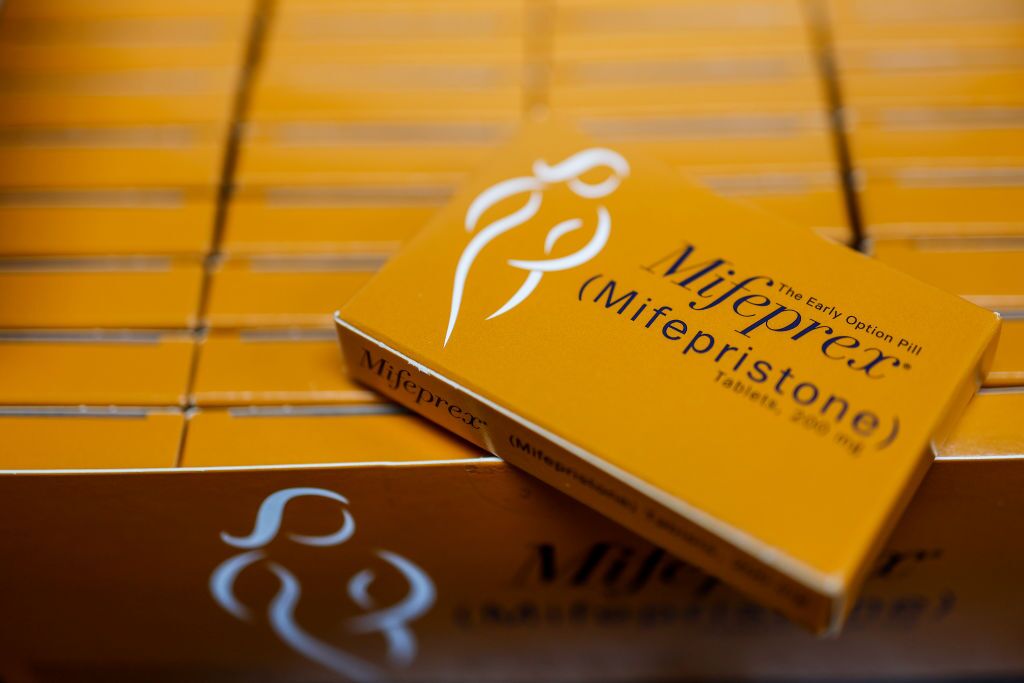
Mifepristone works to end a pregnancy by binding to progesterone receptors and blocking progesterone’s effects. Beyond its abortion pill usage, mifepristone has broader medical promise, including potential uses for fibroids, miscarriage care, Cushing syndrome and some cancers. (Anna Moneymaker / Getty Images)
Across the world, women living in countries that ban licensed clinicians from performing abortions have always found ways to access abortion outside of the medical system. Today, abortion pills have made it much safer. When the Supreme Court overturned Roe v. Wade and many states banned abortion, U.S.-based activists turned to Latin American feminists who have run collectives supporting women seeking abortions outside of the medical system for decades. With their guidance, U.S.-based activists have created their own feminist collectives that now serve thousands of women and girls each month in 38 states that ban and restrict abortion access, including the entire Southeast and much of the Midwest of the country. These collectives provide free abortion pills and the doula support to see them through. As Republicans create ever higher barriers to abortion that push abortion seekers later into pregnancy, U.S.-based activists are learning from Latin American feminists who have developed protocols to make second-trimester medication abortion easier and safer. With training and guidance from Latin American feminists, U.S.-based collectives are now using a double-dose mifepristone protocol for pregnancies 17 weeks of gestation and longer.
The protocol works in three steps:
one 200 mg mifepristone tablet taken orally, then waiting 24 hours;
taking another 200 mg mifepristone tablet orally and waiting another 24 hours;
then taking 400 mg of misoprostol (two tablets) under the tongue every three hours until expulsion of the pregnancy is complete.
Mifepristone blocks the absorption of progesterone in the uterus, preparing the uterus to shed the pregnancy. Misoprostol then causes contractions to expel the pregnancy tissue. For second-trimester abortions, taking two mifepristone means needing less misoprostol, which eases painful contractions and shortens the time to uterine expulsion, explained one Latin American expert, Mora, who supports people having abortions, called accompaniers. (Real name withheld to protect privacy.)
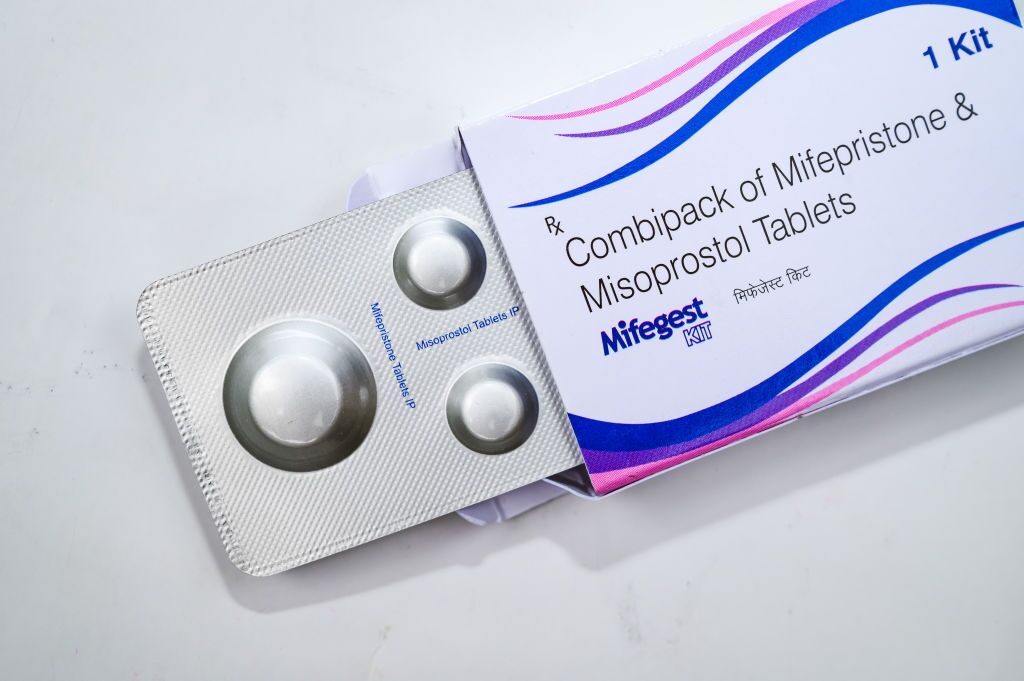
The World Health Organization recommends two regimens for medication abortion: misoprostol alone or combined with another medication, mifepristone. (Soumyabrata Roy / NurPhoto via Getty Images)
Describing how mifepristone helps separate a pregnancy from the uterine lining, Mora said: “Mifepristone detaches the gestational sac from the inner side of the uterus, which is less painful than if the detachment comes from contractions caused by misoprostol.” Whereas mifepristone’s side effects are mild—mainly headaches and some nausea that can be treated with medications—misoprostol causes diarrhea, chills and vomiting, which are much harder to experience. “The side effects of the miso are very high in comparison to mife,” said Mora. “After taking mife you can go about life [and normal activities], but starting miso is what gets you home in bed.” Using two mifepristone also significantly reduces the period of painful contractions—from 15 to 18 hours, to often less than six hours, which is critical for women who have to work or care for children or relatives.
. . . .
Resources for Abortion Seekers
To learn about these services, people are using the Plan C website. The organization has researched several community networks over the years, and there are now five listed on their website. See INeedAnA.com for more information about second-trimester abortions with medications.
Contact the Miscarriage and Abortion (M+A) Hotline to speak to a volunteer medical provider anonymously and for free for questions during an abortion or miscarriage, including self-managing an abortion in the second trimester. Second-trimester self-managed abortion may increase legal risks https://www.ineedana.com/legal-risks . Repro Legal Helpline https://reprolegalhelpline.org/ offers free legal support.
https://msmagazine.com/2026/06/05/two-mifepristone-home-self-managed-abortion-pills-later-late-term-second-trimester-pregnancy/
The Growing Acceptance of a Movement That Wants to Punish Women for Abortion (Trigger warning)
(AND THE FUCKING, MISOGYNIST, PATRIARCHAL, THEOCRATIC, CHRISTOFASCIST WAR ON WOMEN CONTINUES APACE!!! )
The Growing Acceptance of a Movement That Wants to Punish Women for Abortion (Trigger warning)
PUBLISHED 6/4/2026 by Shoshanna Ehrlich
Once considered the far fringe of antiabortion politics, abortion abolitionists are gaining influence in legislatures, Republican Party politics and the broader antiabortion movement.
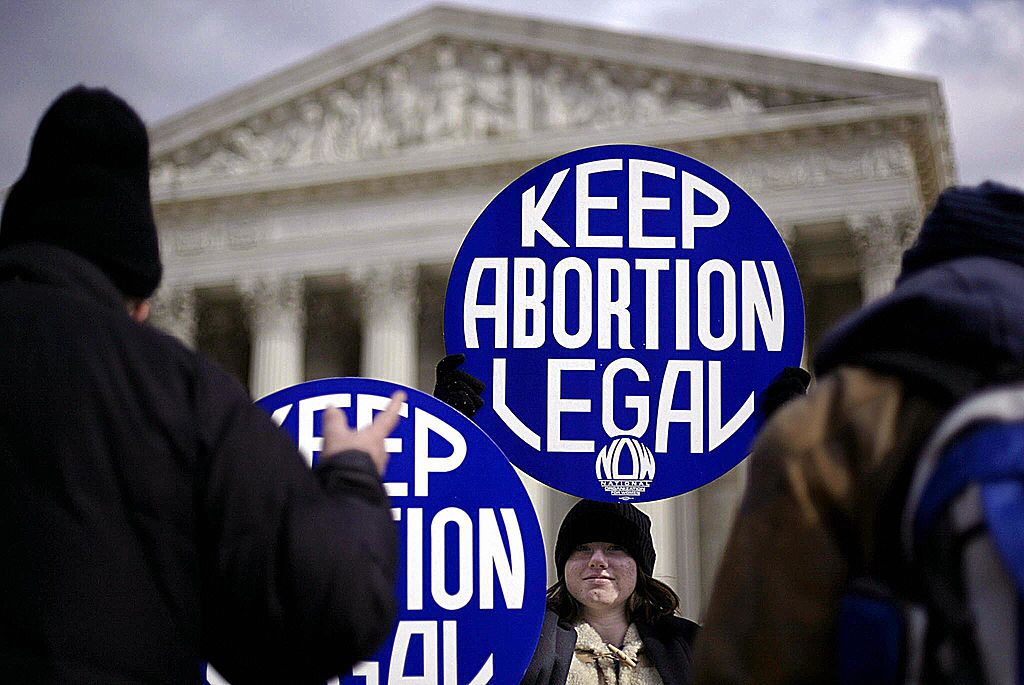
An abortion-rights activist counterprotests the annual antiabortion March for Life, in front of the U.S. Supreme Court on Jan. 22, 2004. (Tim Sloan / AFP via Getty Images)
When South Carolina’s abortion abolitionist bill, the Unborn Child Protection Act (S. 1095), was voted out of committee and onto the full Senate floor in late April—“an unprecedented move toward locking up women who have an abortion,” according to Dana Sussman in Slate—it raised a question: How much influence have abortion abolitionists gained within the broader antiabortion movement?Abortion abolitionists, who seek to criminalize abortion without exceptions and punish women who obtain abortions as murderers, have long been considered the outer fringe of the antiabortion movement. Their roots can be traced to what Colleen Scerpella described in The Prospect as “a new generation of mostly white, male, conservative Baptists, Presbyterians and Christian Reconstructionists”—or what she calls “extreme Christian patriarchy.” As I wrote in Ms. a little more than a year ago, the dramatic increase in abortion abolitionist bills filed by state lawmakers after Roe v. Wade fell, signaled the growing influence of this movement.
That extremism has not gone unnoticed: In 2024, the Southern Poverty Law Center identified four abolitionist organizations as “male supremacist hate groups.” Recent research has likewise found that the strongest supporters of arresting women who have abortions are Americans who endorse Christian nationalism, believe “true Americans are white,” and look to the state to enforce a particular ethnocultural social order. The South Carolina bill, which makes the pregnant woman herself subject to misdemeanor liability, prompted me to revisit the question of whether abortion abolitionists have made more inroads into the mainstream antiabortion movement. The evidence suggests they have.
A Refresher on Abortion ‘Abolitionists’
Abortion abolitionists reject the incremental approach favored by what is commonly called the “mainstream pro-life movement.” While many antiabortion organizations argue that laws protecting fetuses should not punish pregnant women—whom they often portray as victims of abortion providers—abolitionists insist that abortion should be treated as murder in all circumstances, and that those who obtain abortions should face the same criminal penalties as any other person accused of homicide. Central to their ideology is the belief that fetuses are entitled to the equal protection of the law from the moment of fertilization. This conviction has given rise to so-called “equal protection” bills—personhood-style measures that seek the criminalization of abortion as murder. States considering so-called equal protection abortion bills include Georgia, Idaho, Iowa, Kansas, Kentucky, Missouri, South Carolina and Texas, with similar measures introduced and later stalled in Indiana, North Dakota and Oklahoma. In states where the death penalty remains legal, critics warn that such laws could theoretically expose people who obtain abortions to capital punishment.
. . . . . .
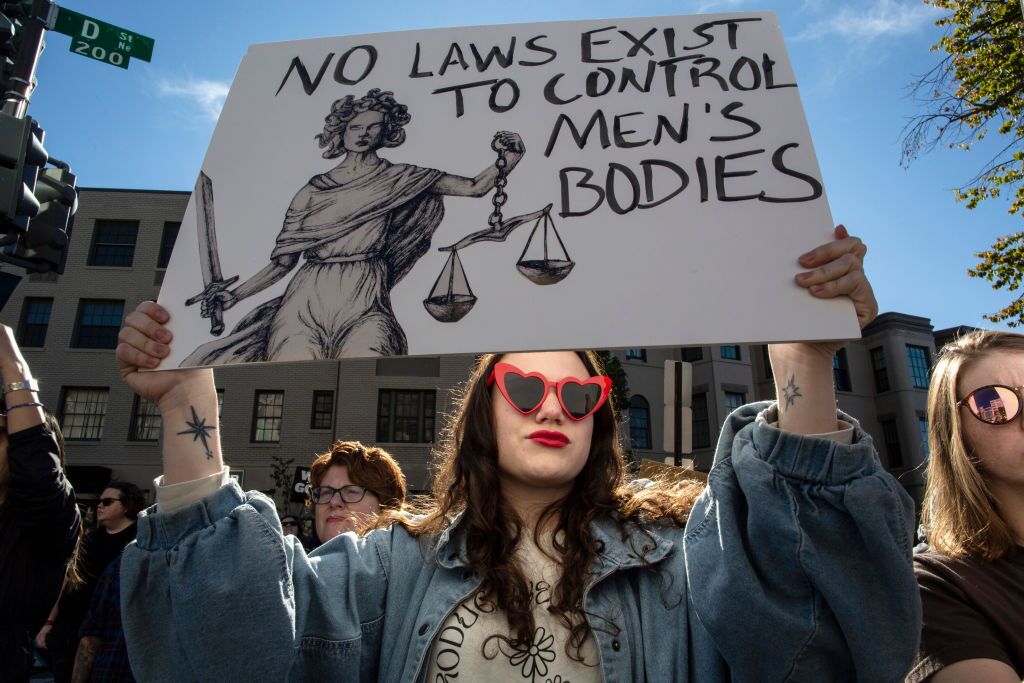
No Laws Exist to Control Men's BodiesAn abortion-rights activist in front of the Heritage Foundation, the conservative think tank that published Project 2025. (Probal Rashid / LightRocket via Getty Images)
.. . . .
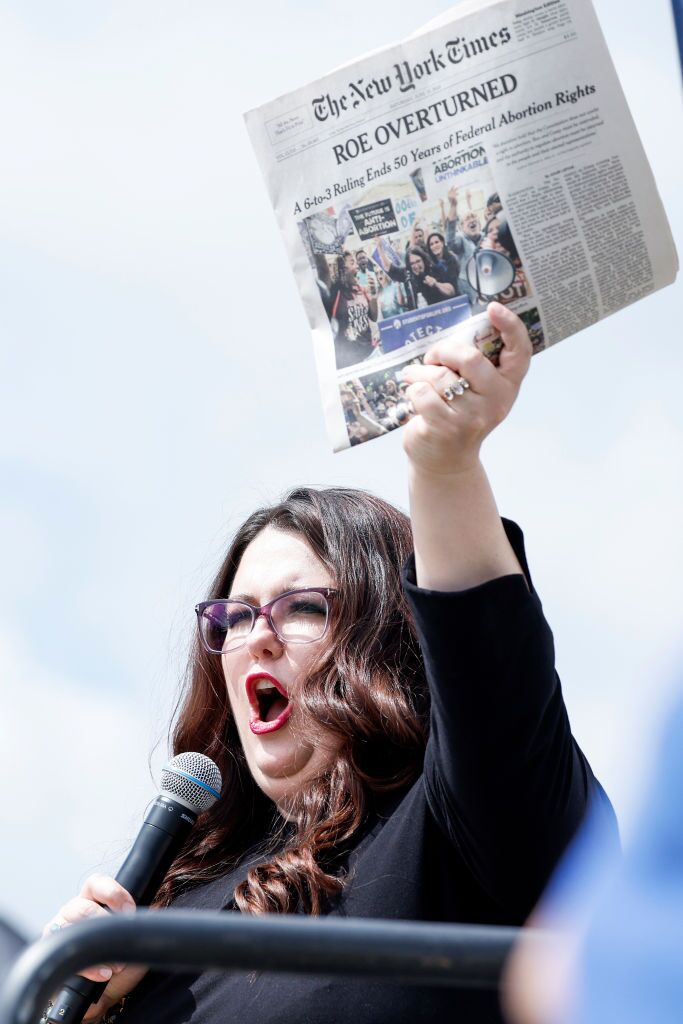
Kristan Hawkins, with Students for Life, holds up a copy of the New York Times front page from June 24, 2022, on the one-year anniversary of the U.S. Supreme Court’s decision in Dobbs v. Jackson Women’s Health, which overturned Roe v. Wade. (Anna Moneymaker / Getty Images)
. . . .
The movement’s insistence that women who obtain abortions should be punished as murderers echoes some of the same gendered assumptions that shaped the nation’s earliest abortion laws. Notably, these laws are the product of the 19th-century campaign by physicians who regarded it as their “manly duty” to speak out against what they regarded as the growing evil of induced abortions by white, married and middle-class, Protestant women. (Alesha E. Doan and I write about this in our book Abortion Regret: The New Attack on Reproductive Freedom.) One of the movement’s leaders, Boston physician Dr. Horatio Storer, called for “a bold and manly utterance of the truth” against what he described as “the most horrid social enormity of the age.” Coming full circle, given the origin story of our country’s criminal abortion laws, it is not surprising that the strongest supporters for punishing women who have abortions are often Christian and/or white nationalists, who look to “the state to enforce a particular ethnocultural social order,” write researchers Darci K. Schmidgall, Samuel L. Perry and Joshua B Grubbs. Dobbs appears to have created new space for the revival of that rhetoric—one that is steeped in the misogynistic and racialized assumptions of the 19th-century antiabortion movement but repackaged through the modern language of abolition and equal protection.
https://msmagazine.com/2026/06/04/abortion-abolition-punish-women-republican-south-carolina/
Profile Information
Member since: Tue Jul 29, 2003, 03:30 PMNumber of posts: 135,259