DemocratForJustice
DemocratForJustice's JournalMessage auto-removed
Message auto-removed
Message auto-removed
Message auto-removed
Message auto-removed
Message auto-removed
Income inequality in America over the last 30 and 100 years
Income changes 1950 to 1980 and 1980 to 2007, by income group
http://1.bp.blogspot.com/-RBJ23r3jdSo/UTDBK7FislI/AAAAAAAAAdA/qhk6gNcatv0/s640/Family+income.jpg
Income changes since 1970
http://3.bp.blogspot.com/-EoQdjasE9Bo/UUIXP4DIr9I/AAAAAAAAAdo/Lgtki5BZTHY/s640/income+changes+since+1970.png
CEO to average worker pay 1980 to 2010
http://3.bp.blogspot.com/-KXDjoGo-rjU/UCDyTMK9XJI/AAAAAAAAABU/RnD5ugenkYI/s1600/CEO+to+employee+pay.jpg

When there are relatively small income discrepancies and a thriving middle class, the economy grows at it's fastest pace, e.g. in America in the 1950's and 1960's.
When the disparity grows too large the economy can fall off a cliff (e.g. 1930's) or we tend to get a stagnant economy (like now).
The main factors in play for the recent large increase in income disparity are :
Legislation that favors the rich
The current over $1.3tn a year of annual Corporate Welfare
The current over $1.2tn a year of handouts and bailouts to the big banks
Massive money printing by the Federal Reserve (now $1tn a year), which pushes up inflation on basic things that disproportionately affect the poor compared to the rich - food, energy etc.
N.B. Executive pay has risen so much in the last 30 years because there is no longer any control over it.
50 or 100 years ago most companies were owned by a small group of people - a family, or a small group of families, or a small group of major shareholders.
This structure meant that executives were made accountable for the value that they delivered to their owners.
The small number of owners all wanted value for money in the senior managers that they hired (principally the board members).
Now executive remuneration is largely set by remuneration committees for each company.
Each remuneration committee is mostly made up of executives of other companies.
Executive A will sit on the remuneration committee of company B.
Executive B will sit on the remuneration committee of company C.
Executive C will sit on the remuneration committee of company A.
etc. etc.
And they will all vote themselves huge pay awards.
Large proportions of a large number of companies are also owned by large investment funds, e.g. Calpers - the Californina State Pension Fund and large insurance companies that offer pensions.
The executives of the large insurance companies also sit on the remuneration committees of other companies and they certainly don't want their large pay awards questioned.
So they too vote for large payments, irrespective that it is directly against the interest of their investors.
The situation with the executives of large government (or union) pension funds is less clear cut. They also earn large amounts and don't want to see their pay cut as part of general pressure.
However they are also under strong pressure from the state and city governments, to deliver best returns.
Indeed just about the only criticism of outlandish pay awards to senior executives in the last few years has come from Calpers and not many have come from them.
The system that decides executive pay needs to be completely reformed.
It diverts company profits away from shareholders and into the pockets of board members.
Shareholders like pension and investment funds.
N.B2 There is a also a large correlation between large scale expansion of the money supply and increasing income inequality.
When there was little money printing (over and above GDP growth) there was low income inequality (e.g. 1950 to 1970).
Once the printing presses started whirring there was also increasing disparity in income between the rich and the poor - the situation since circa 1980.
http://4.bp.blogspot.com/-7VJ0V3c593s/UIbuq5ITZ3I/AAAAAAAAARo/-2kvNa8asv8/s400/Total+US+money+and+inflation.png
FISA court renews NSA surveillance program to capture millions of phone calls
The Obama administration has renewed the authority for the National Security Agency to regularly collect the phone records of millions of Americas as allowed under the Foreign Intelligence Surveillance Act.
The United States government has reportedly asked the FISA court every 90 days since 2006 to renew an order that compels the nation’s telecommunication providers to hand over telephony metadata pertaining to millions of US citizens. The program has been conducted in near total secrecy, however, until NSA leaker Edward Snowden released top-secret documentation to the Guardian newspaper which caused an international backlash upon being published last month.
In that Guardian article, the paper showed that the NSA could collect metadata for 90 days up until July 19, at which point that power would expire if a reauthorization was not resubmitted. Just moments before the 5 p.m. deadline on Friday, though, the Officer of the Director of National Intelligence confirmed that the FISA court has reaffirmed that authority.
Read more at :
http://rt.com/usa/fisa-court-renew-authority-340/#.UemuXXUyhLs.twitter
A Single NSA Wiretap Could Lead To Snooping On '2.5 Million Americans'
At a recent judiciary hearing on the wide-ranging surveillance practices of the NSA revealed a staggering practice called "three-hop analysis."
Three-hop analysis means that when the NSA requests justification for tapping a "suspected terrorist," they can also tap that suspect's contacts, then their contacts, and the contacts of their contacts.
Pete Yost of the Boston Globe explained the scope of these taps:
If the average person calls 40 unique people, three-hop analysis could allow the government to mine the records of 2.5 million Americans when investigating one suspected terrorist.
Read more at:-
http://www.businessinsider.com/edward-snowden-nsa-wiretap-snoops-millions-2013-7
The numbers NOBODY wants you to see. Military spend now TRIPLE that of cold war, 50% higher than
GW Bush
Inflation adjusted chart
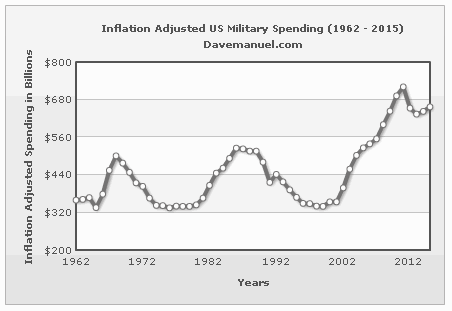
See the following for the numbers each year :-
http://www.davemanuel.com/2010/06/14/us-military-spending-over-the-years/
From this it can be seen that current military spending is now far higher than it was during the height of the cold war and the Vietnam war.
But the current numbers very significantly understate the true level of National Security spending.
The government is trying to cover up the true levels by hiding a long list of military spend in other departmental budgets.
E.G. the cost of maintaining America's nuclear arsenal, which is booked to the Department of Energy.
E.G. the increased costs of Veterans pensions and medical care that are a direct result of the wars (they are not included in the Pentagon budget).
Neither is the massive ramp up in DHS spending for domestic spying etc.
In 2011 the true level of military spending was about $930bn.
For 2012 true military spending increased VERY substantially to $1,219bn.
The REAL National Security budget - the numbers NOBODY wants you to see :-
http://www.truth-out.org/archive/item/94731:the-real-us-national-security-budget-the-figure-no-one-wants-you-to-see
N.B. CBO spending plans show that military spending is planned to increase every year from 2014 to 2023 - rising by well over $100bn from 2012 levels by 2023.
Profile Information
Member since: Wed Jul 17, 2013, 09:33 AMNumber of posts: 78